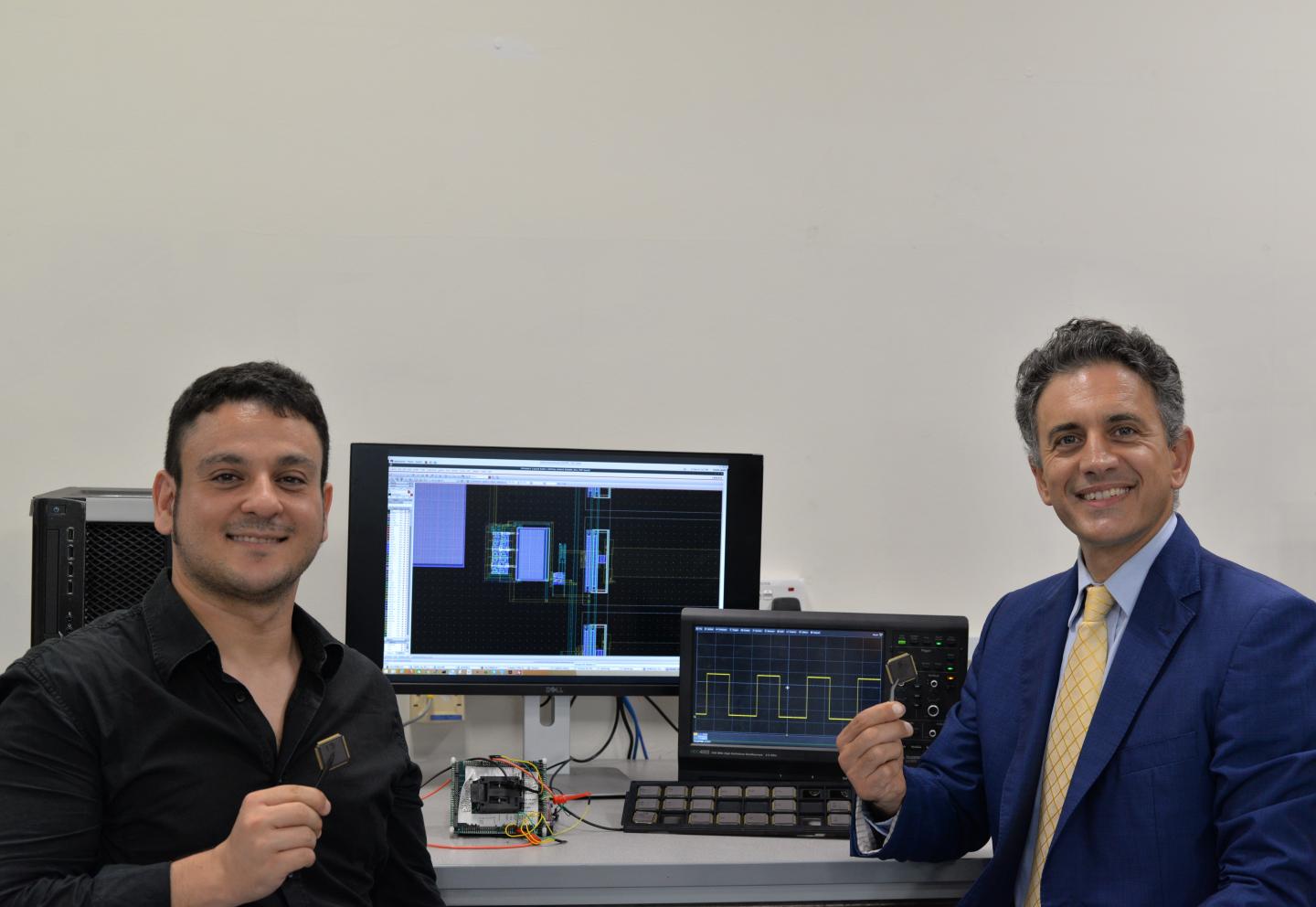
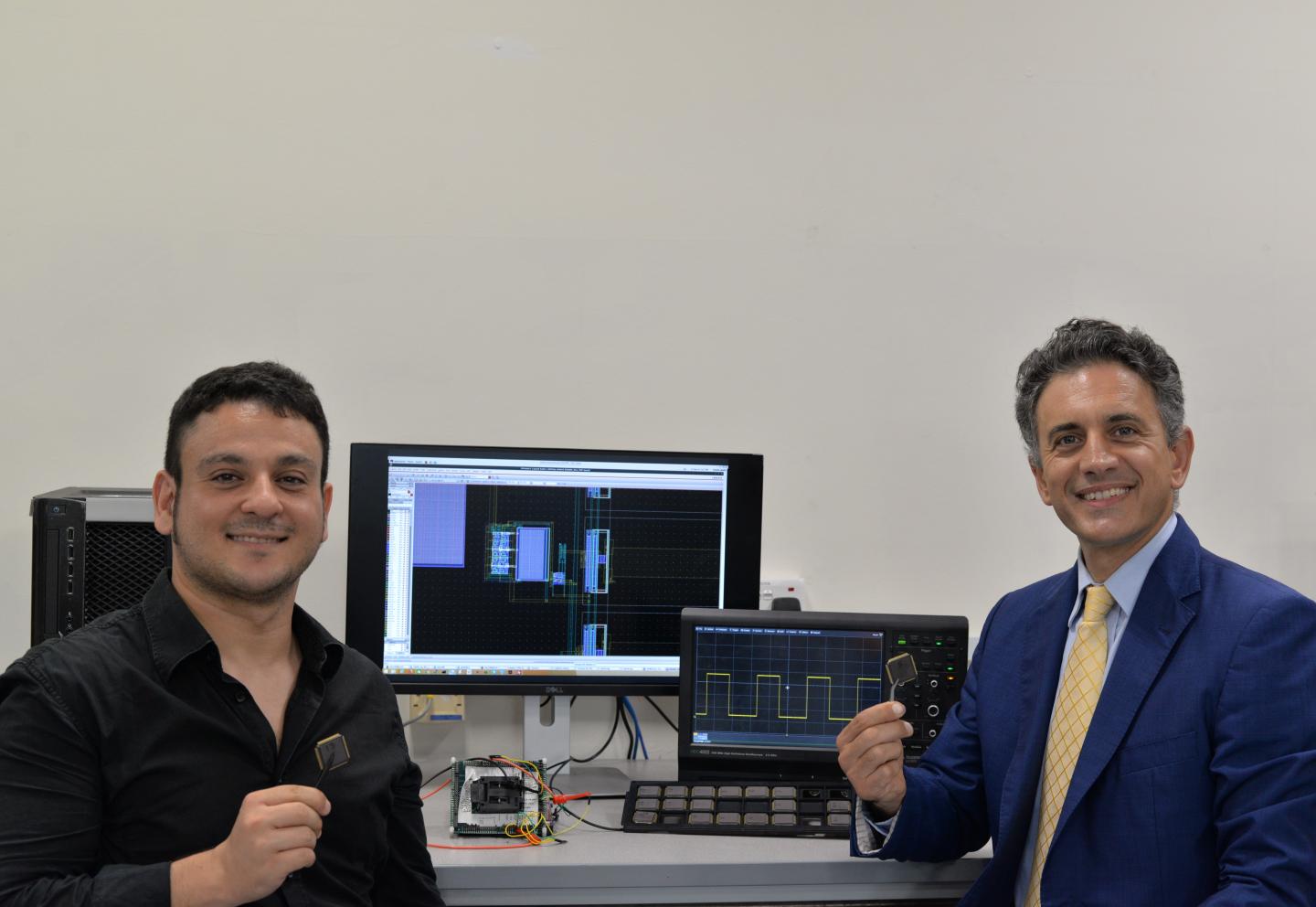
Credit: National University of Singapore
Researchers from the Green IC research group at the National University of Singapore (NUS) have invented a low-cost 'battery-less' wake-up timer – in the form of an on-chip circuit – that significantly reduces power consumption of silicon chips for Internet of Things (IoT) sensor nodes. The novel wake-up timer by the NUS team demonstrates for the first time the achievement of power consumption down to true picoWatt range (one billion times lower than a smartwatch).
"We have developed a novel wake-up timer that operates in the picoWatt range, and cuts power consumption of rarely-active IoT sensor nodes by 1,000 times. As an element of uniqueness, our wake-up timer does not need any additional circuitry, as opposed to conventional technologies, which require peripheral circuits consuming at least 1,000 times more power (e.g., voltage regulators). This is a major step towards accelerating the development of IoT infrastructure, and paves the way for the aggressive miniaturisation of IoT devices for long-lasting operations," said team leader Associate Professor Massimo Alioto from the Department of Electrical and Computer Engineering at the NUS Faculty of Engineering.
The research was conducted in collaboration with Associate Professor Paolo Crovetti from the Politecnico di Torino in Italy.
Enabling long-lasting IoT applications
IoT technologies, which will drive the realisation of smart cities and smart living, often require the extensive deployment of smart, miniaturised silicon-chip sensors with very low power consumption and decades of battery lifetime, and this remains a major challenge to date.
IoT sensor nodes are individual miniaturised systems containing one or more sensors, as well as circuits for data processing, wireless communication and power management. To keep power consumption low, they are kept in the sleep mode most of the time, and wake-up timers are used to trigger the sensors to carry out a task. As they are turned on most of the time, wake-up timers set the minimum power consumption of IoT sensor nodes. They also play a fundamental role in reducing the average power consumption of systems-on-chip.
The NUS invention substantially reduces power consumption of wake-up timers embedded in IoT sensor nodes. "Under typical office lighting, our novel wake-up timer can be powered by a very small on-chip solar cell that has a diameter similar to that of a strand human hair. It can also be sustained by a millimetre scale battery for decades," Assoc Prof Alioto explained.
This technology breakthrough was made public at the 2018 Symposia on VLSI Technology and Circuits in Honolulu, Hawaii, the premier global forum where advances in solid-state circuits and systems-on-chip are presented.
Ultra-low power consumption
The NUS team's innovative picoWatt range wake-up timer has the unprecedented capability of operating without any voltage regulator due to its reduced sensitivity to supply voltage, thus suppressing the additional power that is conventionally consumed by such peripheral always-on circuits. The wake-up timer can also continue operations even when battery is not available and under very scarce ambient power, as demonstrated by a miniaturised on-chip solar cell exposed to moon light.
Significant reduction in production cost
In addition, the team's wake-up timer can achieve slow and infrequent wake-up using a very small on-chip capacitor (half a picoFarad). This helps to significantly reduce silicon manufacturing costs due to the small area (40 micrometres on each side) required.
"Overall, this breakthrough is achieved through system-level simplicity via circuit innovation. We have demonstrated silicon chips with substantially lower power that will define the profile of next-generation IoT nodes. This will contribute towards realising the ultimate vision of inexpensive, millimetre-scale and eventually, battery-less sensor nodes," added research team member Dr Orazio Aiello, who is a Visiting Research Fellow at the Department.
Next steps
The team is currently working on various low-cost, easy-to-integrate, energy-autonomous silicon systems with power consumption ranging from picoWatts to sub-nanoWatts. These critical sub-systems will make future battery-less sensors a reality, with the end goal of building a complete battery-less system-on-chip. This will be a major step towards the realisation of the IoT vision worldwide.
###
Media Contact
Goh Yu Chong
[email protected]
656-601-1653
@NUSingapore
http://www.nus.edu.sg/