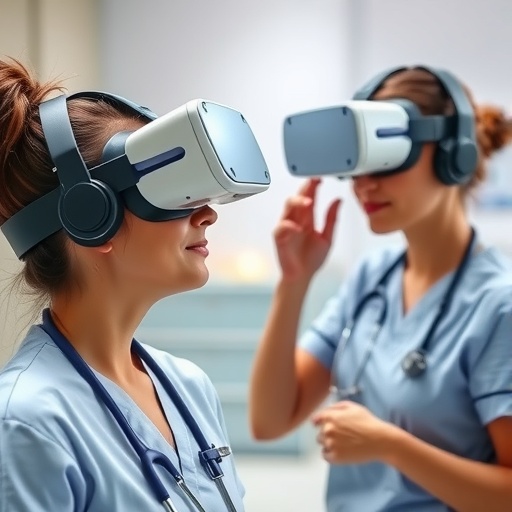
In a groundbreaking study conducted by researchers M. Hoff and J.K. Jensen, the transformative role of virtual reality (VR) simulation in nursing education is explored, particularly in the context of equipping nurses with the necessary competencies to manage violent and threatening behaviors. This qualitative study, published in BMC Nursing, sheds light on the perceptions of nurses regarding the efficacy of VR as a teaching tool in complex and often distressing scenarios encountered in healthcare settings.
Virtual reality technology has surged in popularity across various fields, and its application in nursing education represents a significant advancement. Traditional training methods often struggle to simulate real-life situations where nurses encounter aggressive or unpredictable behaviors from patients. This study delves into the perspectives of nurses who have experienced VR simulations firsthand, offering valuable insights into how this technology can reshape learning environments and better prepare them for challenges in the field.
The researchers employed a qualitative approach, providing a rich narrative filled with the lived experiences of nurses who participated in the VR simulations. These immersive experiences allow participants to practice and refine their responses to potentially violent situations in a safe and controlled environment, which is crucial for minimizing real-world risks. By engaging in VR scenarios, nurses can develop not only technical skills but also critical thinking and emotional resilience, essential components of effective patient management.
The findings from the study highlighted that many nurses felt more confident in their abilities after participating in VR simulations. They reported a greater understanding of how to de-escalate situations that could lead to violence, as well as improved communication skills that are vital in defusing tensions. This newfound confidence can translate into better patient care and safer hospital environments, underscoring the necessity of incorporating VR technology into the nursing curriculum.
Moreover, the study reveals that nurses appreciate the versatility of VR simulations, which can be tailored to reflect different scenarios they may encounter in their healthcare settings. This customization allows for a more focused approach to learning, enabling nurses to engage with specific skills they may be lacking or find challenging. The ability to repeat simulations also contributes to an iterative learning process, where nurses can reinforce their skills repeatedly until they achieve a level of proficiency that can be relied upon in real-life situations.
Interestingly, the research found that the social dynamics among nurses changed positively as a result of VR training. Participants reported enhanced collaboration and teamwork during simulation exercises, fostering an environment where they could learn from each other’s experiences. This camaraderie is crucial in the nursing profession, where the stress of managing violent situations can often feel isolating. By providing a platform for shared learning, VR simulations help build a supportive community among nurses, which can improve overall job satisfaction and retention rates in the profession.
The challenges associated with managing violent and threatening behaviors in healthcare settings have been well-documented, with many institutions facing an increasing incidence of such interactions. As healthcare continues to evolve, the need for effective training modalities becomes paramount. The study’s authors argue that VR technology is not just an innovative approach but a necessary one that meets the urgent demands of modern nursing practice.
Participants in the study expressed excitement about the potential for VR technology to revolutionize training programs not only in nursing but also across other healthcare professions. The ability to immerse oneself in complex scenarios offers a unique opportunity for students and professionals alike to confront their fears and biases in a structured yet flexible learning environment. This could lead to a cultural shift in how healthcare workers approach difficult situations, paving the way for more empathetic and effective care.
The qualitative insights garnered from this research provide valuable implications for nursing educators and policymakers. As the demand for skilled nurses continues to rise, integrating innovative training solutions like VR into educational programs may become a critical strategy for improving not only the quality of care but also the mental health and wellbeing of healthcare professionals facing incessant challenges.
As we look ahead, the future of nursing education may very well be shaped by technological advancements such as virtual reality. This study serves as a pivotal point in embracing innovative pedagogical methods, advocating for a paradigm shift in how nurses are trained to deal with the realities of their profession. In a landscape where violence in healthcare is an unfortunate reality, equipping nurses with the tools to manage these situations effectively can drastically alter patient outcomes and the well-being of healthcare teams.
In conclusion, the qualitative study by Hoff and Jensen underscores an essential narrative in the intersection of technology and healthcare education. By harnessing the power of virtual reality simulations, nurses are not only prepared to handle the complexities of managing aggressive behaviors but are also empowered to enhance the overall quality of care they provide. The integration of these simulations into nursing curricula holds promise for revolutionary changes, leading to safer and more competent nursing practice in an increasingly unpredictable healthcare environment.
Subject of Research: The use of virtual reality simulation in nursing education.
Article Title: Nurses’ perceptions about the use of virtual reality simulation to develop competencies in managing violent and threatening behaviours: a qualitative study.
Article References:
Hoff, M., Jensen, J.K. Nurses’ perceptions about the use of virtual reality simulation to develop competencies in managing violent and threatening behaviours: a qualitative study.
BMC Nurs (2026). https://doi.org/10.1186/s12912-026-04296-6
Image Credits: AI Generated
DOI:
Keywords: Virtual reality, nursing education, simulation, violent behaviors, qualitative study.
Tags: addressing aggressive patient behaviorsenhancing nursing competencies with technologyimmersive learning experiences for nursesinnovative training methods in healthcaremanaging violent behaviors in healthcarenurses’ perceptions of VR trainingqualitative study on VR simulationsreal-life scenario simulation in nursingsafety training for nursing professionalstransforming healthcare education with VRvirtual reality for violence managementvirtual reality in nursing education