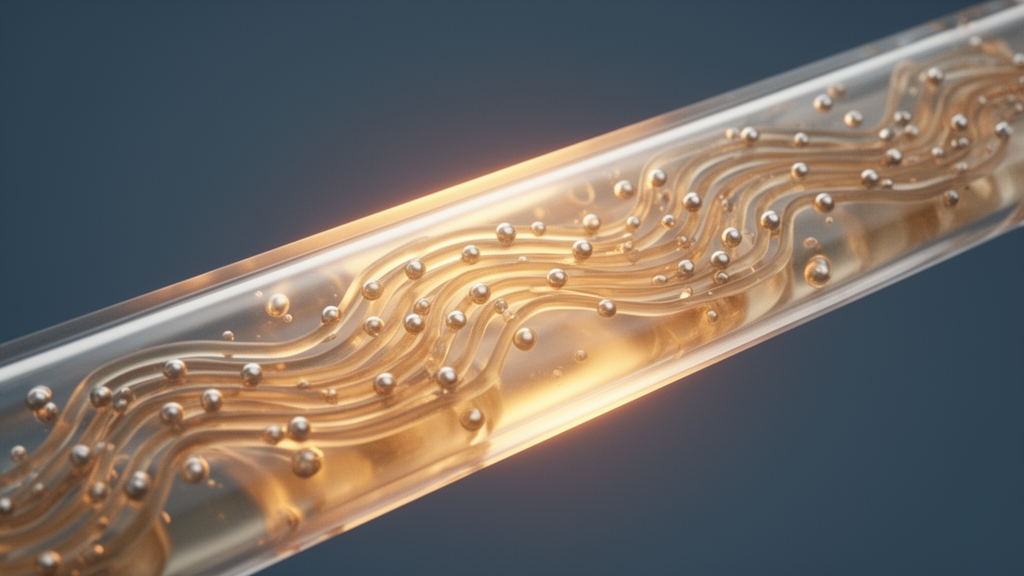
A comprehensive computational investigation led by researcher Arindam Sarkar has systematically detailed the intricate coupled mechanisms of magnetohydrodynamic boundary layer flow, nonlinear thermal radiation, and mass transfer within non-Newtonian Powell-Eyring nanofluids. Published in the journal Discover Molecules, the theoretical analysis focuses on the behavior of complex fluids flowing over a continuously expanding horizontal lamina where thermophysical properties vary directly with temperature. Non-Newtonian media, which include complex materials ranging from polymeric mixtures and chemical solutions to biological suspensions such as blood, do not follow the classical linear relationship between shear stress and rate of shear strain. To capture the nonlinear rheology characteristic of high shear rate environments, Sarkar implemented the constitutive Powell-Eyring formulation grounded in molecular theory. The computational study addresses an essential engineering challenge in advanced thermal regulation and manufacturing: determining how external electromagnetic controls and radiative heat exchange alter viscous resistance, thermal boundary layer development, and the spatial distribution of dispersed nanoscale particles across a moving surface.
The mathematical formulation models an incompressible, steady, two-dimensional boundary layer stream occupying the semi-infinite spatial domain adjacent to a flat surface that stretches linearly along the horizontal axis with a defined velocity proportional to coordinate distance. Perpendicular to this expanding sheet, a uniform magnetic field of constant strength is applied across the boundary layer. Because the induced magnetic Reynolds number is assumed to be exceedingly tiny, the secondary magnetic field induced by the motion of the electrically conducting liquid is negligible compared to the imposed field. In setting up the governing balance equations for conservation of mass, linear momentum, thermal energy, and solute concentration, the author incorporated realistic physical conditions that depart from simplified Newtonian assumptions. In particular, the dynamic viscosity and thermal conductivity of the working fluid are modeled as temperature-dependent quantities rather than idealized constants. Furthermore, the analysis adopts a variable Prandtl number that changes across the boundary layer as local thermal conditions shift, reflecting the true thermodynamic state of thermal systems exposed to severe operational gradients.
To model thermal transport with elevated physical fidelity, the energy equation incorporates the non-Fourier Cattaneo-Christov heat flux framework rather than relying solely on classical Fourier conduction. Standard Fourier models presume that thermal disturbances travel through a medium with infinite propagation speed, an approximation that breaks down in transient thermal regimes or systems characterized by noticeable thermal relaxation times. The inclusion of thermal relaxation terms through Cattaneo-Christov theory accounts for the brief time delay required for heat flux to respond to steep local temperature gradients. Thermal radiation within the participating nanofluid layer is approximated via the Rosseland radiative flux diffusion model, while internal viscous dissipation effects and resistive Joule heating generated by electrical currents passing through the conducting fluid are simultaneously evaluated. Nanoparticle kinematics are incorporated through Buongiorno’s framework, explicitly integrating the coupled slip mechanisms of Brownian diffusion and thermophoresis, wherein suspended nanoparticles move randomly via microscale kinetic impacts and migrate along thermal gradients away from hot boundaries.
The conservation laws for continuity, momentum, energy, and chemical species concentration initially manifest as a highly coupled, strongly nonlinear set of partial differential equations. To render these equations amenable to high-precision numerical computation, Sarkar applied similarity transformations utilizing a dimensionless spatial coordinate, a dimensionless stream function, a scaled temperature profile, and a normalized concentration distribution. These mathematical transformations reduce the governing partial differential system to an equivalent set of nonlinear ordinary differential equations defined over a semi-infinite spatial domain. The boundary conditions reflect the physical reality of the surface: the fluid adheres to the moving wall with a prescribed stretching velocity, experiences either uniform wall suction or surface mass injection, and exchanges thermal energy via a convective surface Biot number condition. Far from the lamina, the horizontal velocity component decays asymptotically to zero, while temperature and concentration levels relax smoothly to their ambient free-stream values.
Solving the resulting system of nonlinear coupled differential equations presents severe numerical difficulties due to strong cross-coupling between the variable viscosity function, the magnetic resistance terms, and the non-Fourier energy formulation. Sarkar resolved these equations using the Spectral Quasilinearization Method, an advanced numerical technique that couples quasilinearization linearization with Chebyshev spectral collocation. The algorithm linearizes the nonlinear ordinary differential operators by computing analytical Fréchet derivatives with respect to each unknown function and its derivatives across successive iterative stages. The linearized continuous differential relations are then discretized over a grid of Chebyshev-Gauss-Lobatto collocation nodes, transforming the boundary value problem into dense linear algebraic systems that are solved sequentially. The solution convergence was strictly validated using an infinity-norm residual error criterion across consecutive iterations. The author demonstrated that after only three spectral iterations, the residual error norms dropped below ten to the minus six for the velocity field and plunged below ten to the minus ten for both temperature and solute concentration profiles, confirming rapid spectral convergence.
The simulated profiles reveal a pronounced dual and opposing operational influence exerted by the transverse magnetic field on fluid transport. As the dimensionless magnetic parameter increases across the examined computational range, the Lorentz force generated by the interaction between the moving electrically conducting fluid and the perpendicular magnetic field acts directly as a retarding resistive mechanism against fluid momentum. This opposing force systematically suppresses the streamwise fluid velocity within the hydrodynamic boundary layer. Quantitatively, when the magnetic field parameter increases from zero to zero point six, the local wall shear stress coefficient increases by thirty-three point eighty-three percent, indicating significantly augmented frictional drag exerted on the expanding boundary. Conversely, the suppression of fluid momentum decelerates advective transport away from the solid surface, causing heat and dispersed species to accumulate within the near-wall zone. Combined with internal Joule dissipation resulting from electrical conduction currents, the strengthened magnetic field noticeably elevates fluid temperature and expands the solutal boundary layer thickness, leading to a one point sixteen percent reduction in the local Nusselt number and an eight point ninety-eight percent decrease in the local Sherwood number.
The investigation also established the quantitative sensitivity of the boundary layer profiles to variations in thermal radiation and convective buoyancy parameters. Increasing the thermal radiation parameter from zero point one to zero point three injects additional radiative thermal energy directly into the fluid film, causing a substantial upward shift in the local dimensionless temperature. When evaluating overall surface transfer rates, increasing the radiation parameter from zero to zero point six results in a six point twenty-two percent reduction in the skin-friction coefficient and generates an eight point zero two percent increase in the local Sherwood number. In contrast, increasing the thermal buoyancy parameter from zero point one to one point zero enhances natural convective circulation within the flow. The resulting acceleration of the buoyant fluid layer swiftly carries accumulated thermal energy away from the hot horizontal surface into the free stream, causing a measurable drop in fluid temperatures across the thermal boundary layer.
Mass transfer through wall suction and injection alters the flow characteristics in a predictable manner across the computational parameter domain. As the suction or injection parameter shifts from strong surface injection at negative zero point three to strong wall suction at positive zero point three, the boundary layer dynamics change fundamentally. Strong fluid injection energizes the flow by pushing fluid molecules and suspended particles away from the expanding lamina, reducing wall-shear friction and substantially thickening both the thermal and concentration boundary layers to produce the highest recorded velocity, temperature, and solutal fields. Transitioning toward positive suction reverses this behavior: fluid is forcefully drawn toward the porous boundary, dramatically elevating surface drag and thinning the boundary layers as heated and species-rich fluid is continuously removed from the near-wall region. Consequently, the velocity, temperature, and solutal profiles continuously decline as suction strength intensifies.
The distribution of suspended nanoscale particles within the host fluid exhibits sensitive dependence on Brownian motion and mass diffusivity parameters. Increasing the Brownian motion parameter from zero point five to one point five intensifies the energetic, chaotic collision of nanoparticles with surrounding fluid molecules. This accelerated microscale agitation facilitates internal thermal transport, raising the fluid temperature, but simultaneously drives nanoparticles away from dense surface regions into the bulk fluid, causing the concentration profile to decrease across the solutal boundary layer. In parallel, elevating the Schmidt number from zero point four to zero point seven diminishes relative molecular mass diffusivity compared to momentum diffusivity. Because the nanoparticles cannot diffuse rapidly across streamlines under higher Schmidt numbers, they remain confined within an exceedingly thin region near the boundary, leading to an overall drop in species concentration throughout the outer boundary layer.
Variations in the Prandtl number exert a consistent damping effect on both the hydrodynamic and thermal fields within the Powell-Eyring medium. As the ambient Prandtl number rises across the simulated interval from zero point five to one point four, momentum diffusivity increasingly dominates over thermal diffusivity. The corresponding reduction in thermal conduction capabilities prevents thermal energy from penetrating deeply into the stream, resulting in a significantly thinner thermal boundary layer and a rapid spatial drop in temperature. Simultaneously, higher Prandtl numbers correlate with an increase in fluid kinematic viscosity, which amplifies the dissipative influence of internal viscous stresses. This enhanced internal viscous resistance exerts an additional retarding force throughout the moving layer, causing a noticeable deceleration of fluid velocity profiles across the entire momentum boundary layer.
The computational framework and numerical benchmarks reported by Sarkar provide detailed quantitative insights into the multiphysics control of complex non-Newtonian boundary layer phenomena. By validating the Spectral Quasilinearization Method against prior hydrodynamic literature, including classical Keller-box solutions for Powell-Eyring flow, the study establishes an accurate foundation for predicting the simultaneous effects of electromagnetic Lorentz forces, radiative energy transport, and non-Fourier thermal relaxation. These mechanistic findings offer critical operational guidance for optimizing boundary layer heat transfer in advanced thermal management systems, materials processing operations, solar thermal collectors, and electronic cooling systems exposed to high temperatures. Furthermore, the precise quantitative mapping of localized heating and nanoparticle accumulation provides a theoretical baseline for evaluating controlled hyperthermia therapies and biomedical devices where non-Newtonian biofluids are manipulated through targeted external magnetic fields.
Subject of Research: Spectral quasilinearization modeling of magneto-radiative non-Newtonian nanofluid dynamics
Article Title: Magneto-radiative transport in a powell-eyring nanofluid with temperature-dependent properties: a spectral quasilinearization analysis
Article References: Sarkar, A. (2026). Magneto-radiative transport in a powell-eyring nanofluid with temperature-dependent properties: a spectral quasilinearization analysis. Discover Molecules, 3(1), Article 2. https://doi.org/10.1007/s44345-025-00043-7
Image Credits: AI Generated
DOI: 10.1007/s44345-025-00043-7
Keywords: nanofluid dynamics, magnetohydrodynamics, heat transfer, Powell-Eyring fluid, thermal radiation, computational fluid dynamics, spectral quasilinearization, boundary layer flow, Magneto-radiative, transport, powell-eyring, nanofluid
News Source: Audrey Campbell. (November 12, 2026). Numerical Simulation Maps Magneto-Radiative Heat Flow in Powell-Eyring Nanofluids. Scienmag.