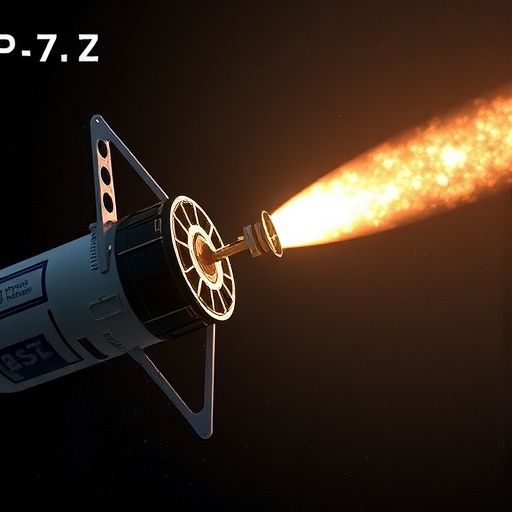
The U.S. Naval Research Laboratory (NRL) has marked a significant milestone in space technology and defense capabilities with the successful deployment of three advanced experimental payloads aboard the Department of War (DoW) Space Test Program’s (STP) Satellite-7 mission. The launch took place at approximately 4:33 a.m. PDT on April 7 from Vandenberg U.S. Space Force Base in California, carried into orbit by a Northrop Grumman Minotaur IV launch vehicle. This development reflects a concerted effort to enhance the United States’ technological edge in the ever-evolving domain of space operations, particularly with regard to national security and space situational awareness.
Central to NRL’s mission for the STPSat-7 spacecraft are three specialized instruments: the Lasersheet Anomaly Resolution and Debris Observation (LARADO), the Global Navigation Satellite System (GNSS) Orbiting Situational Awareness Sensor (GOSAS), and the Gadolinium Aluminum Gallium Garnet (GAGG) Radiation Instrument, known as GARI-1C. Each payload serves a distinct yet complementary role in advancing capabilities for environmental monitoring, navigation accuracy, and radiation detection in Earth’s orbit, thereby bolstering the military’s strategic usage of space.
The LARADO instrument addresses a critical challenge — the ubiquitous and growing presence of orbital debris. Small space debris represents a substantial hazard to operational satellites and space missions, yet remains elusive to ground-based observation systems. LARADO’s innovative design enables direct detection and characterization of these small fragments in low Earth orbit. According to Andrew Nicholas, the principal investigator and head of the NRL Sensor Development and Applications Section, LARADO’s data will be pivotal in refining debris models that inform spacecraft design and operational protocols, mitigating collision risks and the exponential proliferation of debris in orbit.
This instrument stems from a concept that originated over a decade ago in 2012, and since Fiscal Year 2022, it has received funding under NASA’s Heliophysics Division Space Weather Program within the Orbital Debris and Space Situational Awareness portfolio. The collaboration between NASA and the Department of War underpins the strategic importance of comprehensive environmental monitoring and predictive analytics for safeguarding current and future assets in space.
Parallel to LARADO’s mission is the GOSAS payload, a crucial advancement in improving navigation and communication reliability for military platforms. This CubeSat-compatible, programmable dual GPS receiver is engineered to analyze the GNSS environment directly from orbit and generate high-quality ionospheric space weather data products. Dr. Scott Budzien, an NRL research physicist and principal investigator of GOSAS, emphasizes the criticality of understanding space weather phenomena, which can adversely impact GPS accuracy and the integrity of military communications — essential components of modern warfare and operational readiness.
GOSAS builds upon the successful GROUP-C (GPS Radio Occultation and Ultraviolet Photometry-Collocated) experiment, which operated aboard the International Space Station from 2017 to 2023. Notably, GROUP-C first identified GPS interference originating from terrestrial sources, an observation that informed the design and development goals of GOSAS initiated in 2020. By refining positional accuracy and ensuring the robustness of satellite communications against space weather disruptions, GOSAS exemplifies the intersection of cutting-edge research and practical defense applications.
The third NRL payload, GARI-1C, embodies a leap forward in the detection and analysis of gamma radiation from orbit, potentially laying the groundwork for space-based defense against weapons of mass destruction. This instrument leverages advanced gamma-ray detector technology based on gadolinium aluminum gallium garnet (GAGG) scintillators, offering significant improvements over traditional gamma-ray detection systems. According to Dr. Lee Mitchell, principal investigator, GARI-1C provides enhanced energy resolution, reduced power consumption, and a smaller form factor, all of which are vital attributes for integration into compact, efficient satellite payloads.
One of the challenges in adopting commercial off-the-shelf electronics for space missions lies in their susceptibility to the harsh radiation encountered in the extraterrestrial environment. GARI-1C serves as a testbed for gauging the space-qualification of such technologies, providing valuable insights into their resilience and operational stability, which are fundamental to their future deployment in defense contexts. This radiation-hardening strategy ensures that emerging sensor technologies meet stringent requirements necessary for long-term performance and reliability.
The broader framework enabling the STPSat-7 mission is the Department of Defense (DoD) and Department of War’s Space Test Program (STP), which was established in 1966 with the goal of facilitating cost-effective and rapid flight opportunities for experimental payloads. Administered by the U.S. Space Systems Command, STP provides comprehensive support encompassing mission design, payload integration between spacecraft and launch vehicles, and on-orbit operational management for science and technology payloads with potential military utility. This program remains indispensable in fostering innovation and maintaining U.S. superiority in the space domain.
Highlighting the importance of collaboration, U.S. Space Force Lt. Col. Brian Shimek, the system program manager and director for STP, noted that the mission’s success underscores how pioneering research and development endeavors are central to preserving America’s strategic advantage in space. The synergy between NRL’s scientific expertise and the STP’s operational infrastructure exemplifies effective partnership in advancing national defense objectives.
NRL’s Space Science Division plays a pivotal role in this scientific frontier, conducting extensive research, development, testing, and evaluation across multiple disciplines such as solar-terrestrial physics, astrophysics, and atmospheric sciences. Embedded within the DoW STP at Kirtland Air Force Base in New Mexico, Lt. Elijah Ray serves as NRL’s military deputy and liaison, ensuring seamless coordination and advocacy for space experimentation efforts that align with defense priorities.
As a leading scientific and engineering command, NRL’s commitment transcends innovation by offering various collaboration mechanisms to engage the broader scientific community—including Cooperative Research and Development Agreements (CRADAs), licensing agreements, and contracts through diverse authorities such as 10 USC 4892. These frameworks facilitate the infusion of cutting-edge research into operational settings, reinforcing the United States’ capability to respond to emerging threats and challenges in the space environment.
The launch and operational deployment of LARADO, GOSAS, and GARI-1C aboard STPSat-7 represent a watershed moment in space technology, blending rigorous scientific exploration with defense imperatives. Together, these payloads are poised to deliver unprecedented insights and operational capabilities that enhance situational awareness, navigation fidelity, and threat detection from orbit. This integrated approach affirms the ongoing evolution of space as a contested and strategic domain, necessitating continuous innovation to safeguard critical assets and maintain global strategic balance.
Subject of Research: Advanced space-based payloads for orbital debris detection, GNSS-based navigation enhancement, and gamma radiation sensing for military applications.
Article Title: U.S. Naval Research Laboratory Advances Space-Based Defense and Environmental Monitoring Technologies with STPSat-7 Mission
News Publication Date: April 7, 2025
Web References:
– https://www.ssc.spaceforce.mil/Connect-With-Us/US-Space-Force-Front-Door/Space-Test-Program
– https://science.nasa.gov/heliophysics/
– https://www.vandenberg.spaceforce.mil/
– https://www.ssc.spaceforce.mil/About-Us/About-Us
– https://www.kirtland.af.mil/
Image Credits: Department of War Space Test Program (DoW STP)
Keywords
Space flight, Spacecraft, Space technology, Space weather, Orbital debris, GNSS, Gamma radiation detection, Military space applications, Space situational awareness, Satellite navigation, Space defense technology, Radiation-hardened electronics
Tags: environmental monitoring in Earth’s orbitGadolinium Aluminum Gallium Garnet radiation detectorGARI-1C radiation measurementGNSS orbiting situational awarenessLARADO debris observation instrumentmilitary space operations technologynational security space capabilitiesNorthrop Grumman Minotaur IV launchorbital debris detection technologyspace situational awareness sensorsSTPSat-7 mission payloadsU.S. Naval Research Laboratory space technology