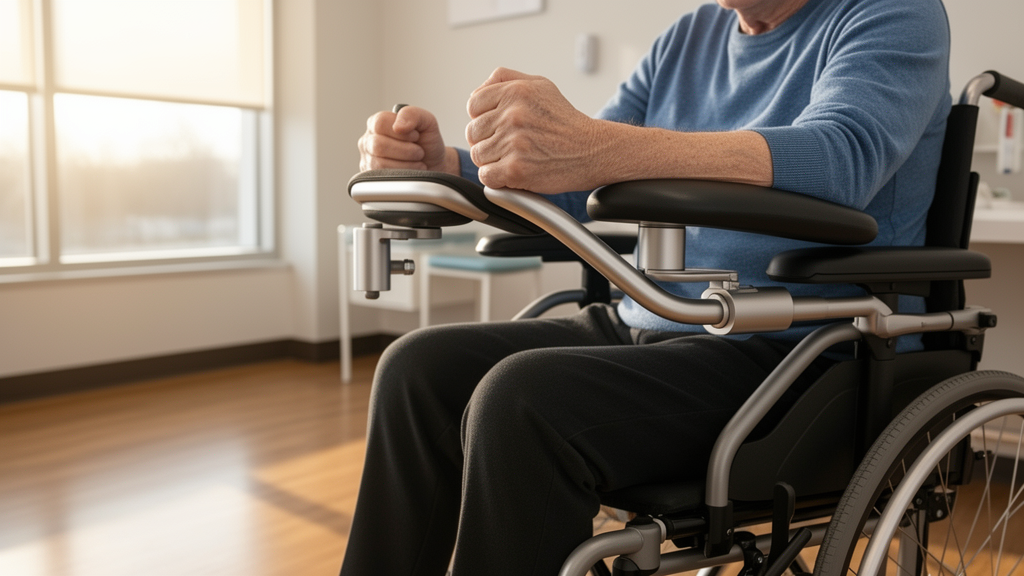
A novel wheelchair-mounted rehabilitation device called Boost enabled stroke inpatients to complete thousands of upper extremity movements during routine inpatient rehabilitation without direct supervision, according to a randomized controlled trial published in the Journal of NeuroEngineering and Rehabilitation. Chronic upper extremity impairment represents a common challenge following stroke, prompting investigators to evaluate whether integrating assistive technology into standard care could feasibly promote higher volumes of self-directed motor practice.
The study evaluated both the feasibility and preliminary clinical effects of the Boost device, which was specifically designed to assist individuals in upper limb motor recovery during inpatient stays. Thirty-five stroke inpatients were enrolled and randomized into two distinct exercise tracks to perform additional upper extremity practice alongside their standard therapy programs. One group utilized the wheelchair-mounted Boost mechanism, while the active control group practiced self-directed exercises guided by a therapist-customized booklet.
Baseline characteristics were comparable across both cohorts, reflecting the early post-stroke rehabilitation phase. At the beginning of the intervention, the mean time elapsed since stroke onset was 11.9 ± 4.6 days for the intervention group and 13.1 ± 5.9 days for the control group. Initial Upper Extremity Fugl-Meyer (UEFM) scores averaged 20.5 ± 10.1 in the Boost group and 21.0 ± 13.5 among controls, while total intervention durations averaged 11.9 ± 4.0 days and 17.2 ± 8.8 days, respectively.
Feasibility assessments focused on the total volume of independent practice completed and the practical integration of device sessions into routine inpatient care schedules. Participants assigned to the Boost intervention achieved substantial training volume, logging a mean of 3,359 ± 3,137 arm movements, with a median of 5,698 movements and an interquartile range spanning from 913 to 6,611 repetitions. Investigators noted that participants successfully integrated these high-repetition sessions into daily hospital routines without requiring direct continuous supervision from therapy staff.
Clinical evaluations encompassed a wide battery of standardized functional and impairment measures. Researchers tracked performance using the Upper Extremity Fugl-Meyer assessment, Box and Block Test, Motor Activity Log, Modified Ashworth Scale, alongside formal checks for shoulder subluxation and shoulder pain. When participants were reassessed at a three-month follow-up, researchers observed no statistically significant between-group differences across the primary clinical outcome measures.
Despite the lack of long-term group divergence, immediate post-intervention evaluations revealed notable patterns. The Boost cohort demonstrated a statistical trend toward greater immediate UEFM improvement, gaining an average of 11.8 points compared to 6.9 points in the control group (p = 0.06). Statistical modeling also demonstrated that overall UEFM gains were significantly predicted by the total number of Boost exercises completed (p = 0.02, R² = 0.34), showing a direct association between movement repetitions and motor improvements.
Patients presenting with less severe initial impairment, defined by a baseline UEFM score greater than 21, achieved significantly greater UEFM score improvements at hospital discharge when using Boost compared to controls receiving booklet practice (15.8 vs. 7.8 points, p = 0.01).
The researchers concluded that utilizing the Boost armrest is practical for expanding arm exercise opportunities during inpatient stroke rehabilitation without requiring continuous one-on-one therapist oversight. While the supplementary training did not establish statistically significant between-group differences at three months, the observed short-term motor gains—particularly in individuals with milder initial deficits—support conducting larger, adequately powered clinical trials to definitively assess efficacy.
Subject of Research: Feasibility and preliminary clinical effects of a wheelchair-mounted arm rehabilitation device after stroke
Article Title: Promoting arm movement practice with a novel wheelchair armrest early after stroke: a randomized controlled trial
Article References: Kim, S. J., Chan, V., Fullmer, N., Rosario, E. R., Kim, C., Liu, C. Y., Comellas, M., Zondervan, D. K., Reinkensmeyer, D. J., & Do, A. H. (2026). Promoting arm movement practice with a novel wheelchair armrest early after stroke: a randomized controlled trial. Journal of NeuroEngineering and Rehabilitation. https://doi.org/10.1186/s12984-026-02111-6
Image Credits: AI Generated
DOI: 10.1186/s12984-026-02111-6
Keywords: stroke rehabilitation, upper extremity recovery, wheelchair armrest, Boost device, randomized controlled trial, inpatient rehabilitation, motor recovery, self-directed exercise, Fugl-Meyer assessment, neurorehabilitation, arm movement practice, physical therapy, stroke recovery, occupational therapy, clinical trial
News Source: Cassandra Pierce. (November 20, 2026). Novel Wheelchair Armrest Device Encourages Self-Directed Upper Limb Practice After Stroke. Scienmag.