A pivotal breakthrough in battery technology that has profound implications for our energy future has been achieved by a joint-research team led by City University of Hong Kong (CityU).
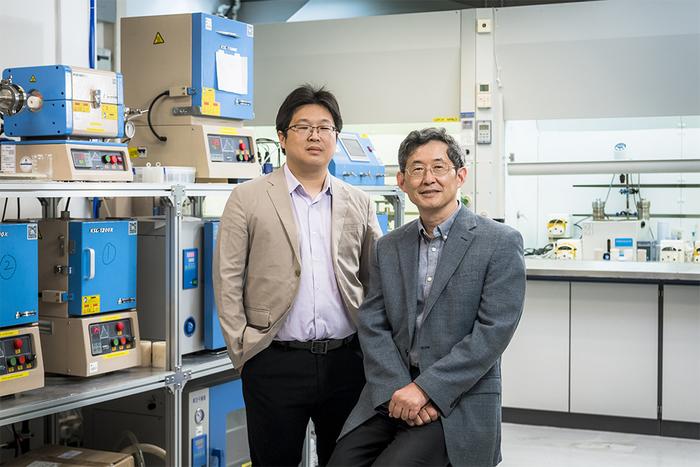
Credit: City University of Hong Kong
A pivotal breakthrough in battery technology that has profound implications for our energy future has been achieved by a joint-research team led by City University of Hong Kong (CityU).
The new development overcomes the persistent challenge of voltage decay and can lead to significantly higher energy storage capacity.
Lithium-ion batteries (LiBs) are widely used in electronic devices, while lithium-(Li) and manganese-rich (LMR) layered oxides are a promising class of cathodes for LiBs due to their high capacity and low cost. However, the long-standing problem of voltage decay hinders their application.
Professor Ren Yang, Head and Chair Professor of the Department of Physics (PHY), Professor Liu Qi, PHY, and their team have addressed the issue by unlocking the potential of LMR cathode materials. In their research, they stabilised the unique honeycomb-like structure within the cathode material, resulting in longer-lasting and more efficient batteries. Their insights are likely to transform the way we power our devices and are set to take the development of high-energy cathode materials to the next stage.
This research was recently published in Nature Energy titled “A Li-rich layered oxide cathode with negligible voltage decay”.
The team’s innovative approach focused on stabilising the honeycomb structure at the atomic level. By incorporating additional transition metal ions into the cathode material, the team reinforced the honeycomb structure, resulting in a negligible voltage decay of only 0.02 mV per cycle, the first time that LMR cathode material with such a low level of voltage decay has been reported.
Through advanced atomic-scale measurements and calculations, the team found that these interlayer transition metal ions act as a “cap” above or below the honeycomb structure, preventing cation migration and maintaining stability. The structure remained intact even at high cut-off voltages and throughout cycling, ensuring the batteries’ structural integrity.
“Our work has solved the voltage decay problem in the LMR cathode, with a capacity almost two times higher than the widely used cathode materials, ultimately paving the way for more powerful and sustainable energy storage solutions,” said Professor Liu.
These findings hold great potential for various applications, from powering electric vehicles to portable electronics. The next step involves scaling up the manufacturing process for large-scale battery production.
The paper’s first authors are Dr Luo Dong, Postdoc, Yin Zijia, PhD student from CityU PHY, Dr Zhu He from Nanjing University of Science and Technology (former Postdoc from CityU PHY), and Dr Xia Yi from Northwestern University/Portland State University, US. The corresponding authors are Professor Ren, Professor Liu, Professor Lu Wenquan from Argonne National Laboratory, US, and Professor Christopher M. Wolverton from Northwestern University. Other collaborators include researchers from the Chinese Academy of Science, Tsinghua University and Lanzhou University.
https://www.cityu.edu.hk/research/stories/2023/09/27/novel-battery-technology-negligible-voltage-decay-developed-cityu-worlds-first
Journal
Nature Energy
DOI
10.1038/s41560-023-01289-6
Method of Research
Experimental study
Subject of Research
Not applicable
Article Title
A Li-rich layered oxide cathode with negligible voltage decay
Article Publication Date
6-Jul-2023