
• HOME
  • NEWS
  • EXPLORE
    • CAREER
      • Companies
      • Jobs
    • EVENTS
    • iGEM
      • News
      • Team
    • PHOTOS
    • VIDEO
    • WIKI
  • BLOG
  • COMMUNITY
    • FACEBOOK
    • INSTAGRAM
    • TWITTER
Monday, November 23, 2026
BIOENGINEER.ORG
No Result
View All Result
  • Login
  • HOME
  • NEWS
  • EXPLORE
    • CAREER
      • Companies
      • Jobs
        • Lecturer
        • PhD Studentship
        • Postdoc
        • Research Assistant
    • EVENTS
    • iGEM
      • News
      • Team
    • PHOTOS
    • VIDEO
    • WIKI
  • BLOG
  • COMMUNITY
    • FACEBOOK
    • INSTAGRAM
    • TWITTER
No Result
View All Result
Bioengineer.org
No Result
View All Result
Home NEWS Science News Technology

Notched Multilayer Architecture Enables Programmable Visual Sensors for Structural Damage Detection

by
November 23, 2026
in Technology
Reading Time: 2 mins read
0
Notched Multilayer Architecture Enables Programmable Visual Sensors for Structural Damage Detection

Notched Multilayer Architecture Enables Programmable Visual Sensors for Structural Damage Detection

Share on FacebookShare on TwitterShare on LinkedinShare on RedditShare on Telegram

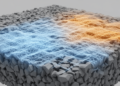
Researchers have developed a structurally gated multilayer hybrid architecture capable of visually signaling mechanical damage through optical color changes triggered by the rupture of a notched protective layer. Detecting localized structural damage before catastrophic failure presents a persistent engineering challenge in load-bearing materials and infrastructures. By mechanically separating the triggering mechanism from the underlying chromogenic sensing elements, the design allows mechanical activation behavior to be independently programmed through physical engineering rather than chemical redesign.

In conventional mechanochromic materials, the sensing chemistry is directly coupled to activation mechanics, which severely restricts the ability to control activation thresholds, sequential color responses, and selectivity toward specific deformation modes. The multilayer architecture overcomes this long-standing limitation by spatially decoupling the physical trigger from the chromogenic indicators. As external mechanical stress or deformation occurs, physical rupture of the notched protective layer acts as an engineered gate that exposes and activates the optical sensing component beneath.

Through systematic modification of the notch geometry within the protective barrier, researchers demonstrated that activation thresholds could be precisely adjusted across a broad mechanical range. This geometric tunability enables mechanical responses to be encoded into sequential optical alerts and deformation-mode-selective transitions. Because the activation threshold depends directly on the structural parameters of the protective notch rather than the intrinsic mechanical sensitivity of the dye or polymer, the same physical mechanism governs activation regardless of chemical differences.

The structural gating platform validated its chemistry-independent versatility by functioning seamlessly across three fundamentally distinct chromogenic mechanisms. The researchers confirmed reliable optical activation using phenolphthalein acid–base chromism, donor–acceptor charge-transfer complex formation, and polydiacetylene chromism. Because each of these chemical systems activates via entirely different molecular interactions, their shared responsiveness confirms that protective-layer engineering can provide a universal activation route across diverse responsive materials.

To demonstrate practical monitoring capability, the team implemented the architecture into large-area sensing arrays and deployed them to monitor concrete structures. The sensors successfully visualized crack initiation and progressive crack propagation under mechanical stress, offering early optical warning signals. Furthermore, segmented sensor layouts achieved spatially localized damage detection, establishing structurally gated multilayer architectures as an adaptable foundation for mechanically responsive warning materials in structural health monitoring.

Subject of Research: Programmable mechanochromic sensors using structurally gated multilayer architectures

Article Title: Structurally gated multilayer hybrid architecture for programmable mechanochromic sensing

Article References: Ban, T., Yun, S., Kim, S., Park, H., Park, J., Jeong, W., Park, J., Park, J., Eom, G.-H., Lee, S.-J., Jang, S.-H., Ahmadi, N., Park, B. J., & Kim, J.-M. (2026). Structurally gated multilayer hybrid architecture for programmable mechanochromic sensing. Advanced Composites and Hybrid Materials. https://doi.org/10.1007/s42114-026-02192-w

Image Credits: AI Generated

DOI: 10.1007/s42114-026-02192-w

Keywords: mechanochromic sensing, multilayer hybrid architecture, structural gating, notch geometry, damage detection, crack initiation, crack propagation, concrete structures, phenolphthalein chromism, charge-transfer complexes, polydiacetylene chromism, protective-layer engineering, optical activation, segmented sensor architectures, deformation selectivity, activation thresholds, acid-base chromism, structural health monitoring

News Source: Denise Maddox. (November 23, 2026). Notched Multilayer Architecture Enables Programmable Visual Sensors for Structural Damage Detection. Scienmag.

Tags: acid-base chromismactivation thresholdscharge-transfer complexesconcrete structurescrack initiationcrack propagationdamage detectiondeformation selectivitymechanochromic sensingmultilayer hybrid architecturenotch geometryoptical activationphenolphthalein chromismpolydiacetylene chromismprotective-layer engineeringsegmented sensor architecturesstructural gatingStructural Health Monitoring
Share12Tweet7Share2ShareShareShare1

Related Posts

Multimodal AI Framework Enhances Cultural and Brand Communication in Agricultural Packaging

Multimodal AI Framework Enhances Cultural and Brand Communication in Agricultural Packaging

November 23, 2026
Polynomial Model Evaluates Wear Rates Across Diverse Nanocomposite Surface Morphologies

Polynomial Model Evaluates Wear Rates Across Diverse Nanocomposite Surface Morphologies

November 23, 2026

Socioeconomic Factors Explain Most Regional Value Added Across European Industries

November 23, 2026

Thermally Healable Gelatin Interface Restores Over 97 Percent of Sensor Function

November 23, 2026

POPULAR NEWS

  • Ascorbate Accelerates Reductive Nitrosylation of Ferric Myoglobin to Form Protective Ferroheme

    Ascorbate Accelerates Reductive Nitrosylation of Ferric Myoglobin to Form Protective Ferroheme

    29 shares
    Share 12 Tweet 7
  • Review Synthesizes Pediatric Emergence Agitation Evidence into Preliminary Perioperative Nursing Sequence

    29 shares
    Share 12 Tweet 7
  • Galactose-Deficient IgA1 Levels Predict Long-Term Kidney Progression in IgA Nephropathy

    29 shares
    Share 12 Tweet 7
  • Hierarchical Conditional Memory Framework Improves Medical Entity Linking Accuracy and Consistency

    29 shares
    Share 12 Tweet 7

About

We bring you the latest biotechnology news from best research centers and universities around the world. Check our website.

Follow us

Recent News

Refined UMI-TnSeq Uncovers Genes Driving Bacterial Fitness During Pollutant Degradation

Multimodal AI Framework Enhances Cultural and Brand Communication in Agricultural Packaging

Polynomial Model Evaluates Wear Rates Across Diverse Nanocomposite Surface Morphologies

Subscribe to Blog via Email

Enter your email address to subscribe to this blog and receive notifications of new posts by email.

Join 88 other subscribers
  • Contact Us

Bioengineer.org © Copyright 2023 All Rights Reserved.

Welcome Back!

Login to your account below

Forgotten Password?

Retrieve your password

Please enter your username or email address to reset your password.

Log In
No Result
View All Result
  • Homepages
    • Home Page 1
    • Home Page 2
  • News
  • National
  • Business
  • Health
  • Lifestyle
  • Science

Bioengineer.org © Copyright 2023 All Rights Reserved.