• HOME
  • NEWS
  • EXPLORE
    • CAREER
      • Companies
      • Jobs
    • EVENTS
    • iGEM
      • News
      • Team
    • PHOTOS
    • VIDEO
    • WIKI
  • BLOG
  • COMMUNITY
    • FACEBOOK
    • INSTAGRAM
    • TWITTER
Wednesday, December 10, 2025
BIOENGINEER.ORG
No Result
View All Result
  • Login
  • HOME
  • NEWS
  • EXPLORE
    • CAREER
      • Companies
      • Jobs
        • Lecturer
        • PhD Studentship
        • Postdoc
        • Research Assistant
    • EVENTS
    • iGEM
      • News
      • Team
    • PHOTOS
    • VIDEO
    • WIKI
  • BLOG
  • COMMUNITY
    • FACEBOOK
    • INSTAGRAM
    • TWITTER
  • HOME
  • NEWS
  • EXPLORE
    • CAREER
      • Companies
      • Jobs
        • Lecturer
        • PhD Studentship
        • Postdoc
        • Research Assistant
    • EVENTS
    • iGEM
      • News
      • Team
    • PHOTOS
    • VIDEO
    • WIKI
  • BLOG
  • COMMUNITY
    • FACEBOOK
    • INSTAGRAM
    • TWITTER
No Result
View All Result
Bioengineer.org
No Result
View All Result
Home NEWS Science News Biology

Nostalgia can relieve pain

Bioengineer by Bioengineer
February 28, 2022
in Biology
Reading Time: 2 mins read
0
Nostalgia Can Relieve Pain
Share on FacebookShare on TwitterShare on LinkedinShare on RedditShare on Telegram

Reflecting on fond memories goes a step beyond making you feel warm and fuzzy: nostalgia can reduce pain perception. Nostalgia decreases activity in pain-related brain areas and decreases subjective ratings of thermal pain, according to research recently published in JNeurosci.
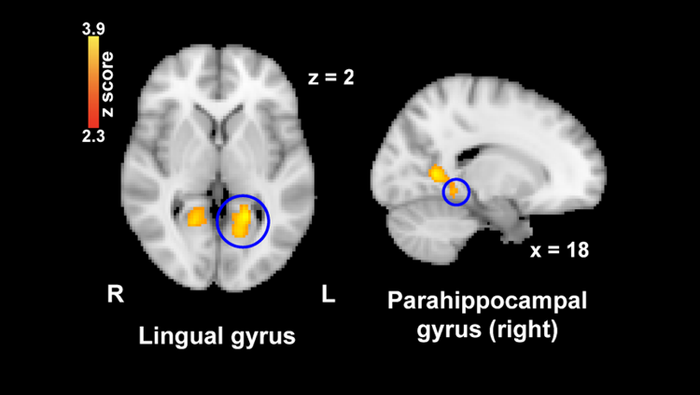
Nostalgia Can Relieve Pain

Credit: Zhang et al., JNeurosci 2021

Reflecting on fond memories goes a step beyond making you feel warm and fuzzy: nostalgia can reduce pain perception. Nostalgia decreases activity in pain-related brain areas and decreases subjective ratings of thermal pain, according to research recently published in JNeurosci.

Researchers from the Chinese Academy of Sciences measured the brain activity of adults with fMRI while the participants rated the nostalgia levels of images and rated the pain of thermal stimuli. The nostalgic images featured scenes and items from an average childhood, like a popular candy, cartoon TV show, and schoolyard game. Images in the control condition depicted corresponding scenes and items from modern life. Viewing nostalgic images reduced pain ratings compared to viewing control images, with the strongest effect on low intensity pain.

Viewing nostalgic images also reduced activity in the left lingual gyrus and parahippocampal gyrus, two brain regions implicated in pain perception. Activity in the thalamus, a brain region involved in relaying information between the body and the cortex, was linked to both nostalgia and pain ratings; the thalamus may integrate nostalgia information and transmit it to pain pathways. Nostalgia may be a drug-free way to alleviate low levels of pain, like headaches or mild clinical pain.

###

Paper title: Thalamocortical Mechanisms for Nostalgia-induced Analgesia

Please contact [email protected] for the full-text PDF and to join SfN’s journals media list.

About JNeurosci

JNeurosci, the Society for Neuroscience’s first journal, was launched in 1981 as a means to communicate the findings of the highest quality neuroscience research to the growing field. Today, the journal remains committed to publishing cutting-edge neuroscience that will have an immediate and lasting scientific impact, while responding to authors’ changing publishing needs, representing breadth of the field and diversity in authorship.

About The Society for Neuroscience

The Society for Neuroscience is the world’s largest organization of scientists and physicians devoted to understanding the brain and nervous system. The nonprofit organization, founded in 1969, now has nearly 37,000 members in more than 90 countries and over 130 chapters worldwide.


Journal

JNeurosci

DOI

10.1523/JNEUROSCI.2123-21.2022

Method of Research

Experimental study

Subject of Research

People

Article Title

Thalamocortical mechanisms for nostalgiainduced analgesia

Article Publication Date

28-Feb-2022

Share12Tweet8Share2ShareShareShare2

Related Posts

Global Spread of Plasmid-Driven Carbapenem Resistance

Global Spread of Plasmid-Driven Carbapenem Resistance

December 8, 2025
Low-Dose Irradiation Boosts Antioxidants in Produce

Low-Dose Irradiation Boosts Antioxidants in Produce

December 8, 2025

Rice miRNA: Key Regulator in Fungal Interactions

December 3, 2025

Human Impact Alters Leopard and Ungulate Dynamics

December 3, 2025

POPULAR NEWS

  • New Research Unveils the Pathway for CEOs to Achieve Social Media Stardom

    New Research Unveils the Pathway for CEOs to Achieve Social Media Stardom

    204 shares
    Share 82 Tweet 51
  • Scientists Uncover Chameleon’s Telephone-Cord-Like Optic Nerves, A Feature Missed by Aristotle and Newton

    121 shares
    Share 48 Tweet 30
  • Neurological Impacts of COVID and MIS-C in Children

    108 shares
    Share 43 Tweet 27
  • Nurses’ Views on Online Learning: Effects on Performance

    69 shares
    Share 28 Tweet 17

About

We bring you the latest biotechnology news from best research centers and universities around the world. Check our website.

Follow us

Recent News

Natural Oils and Nano-Emulsions: Herbicide Alternatives for Weeds

Stable Biopolymer Hydrogels for Controlled Metal Nanostructure Release

Transparent Solar Cells with UV-Blocking Fluorene Dyes

Subscribe to Blog via Email

Success! An email was just sent to confirm your subscription. Please find the email now and click 'Confirm' to start subscribing.

Join 69 other subscribers
  • Contact Us

Bioengineer.org © Copyright 2023 All Rights Reserved.

Welcome Back!

Login to your account below

Forgotten Password?

Retrieve your password

Please enter your username or email address to reset your password.

Log In
No Result
View All Result
  • Homepages
    • Home Page 1
    • Home Page 2
  • News
  • National
  • Business
  • Health
  • Lifestyle
  • Science

Bioengineer.org © Copyright 2023 All Rights Reserved.