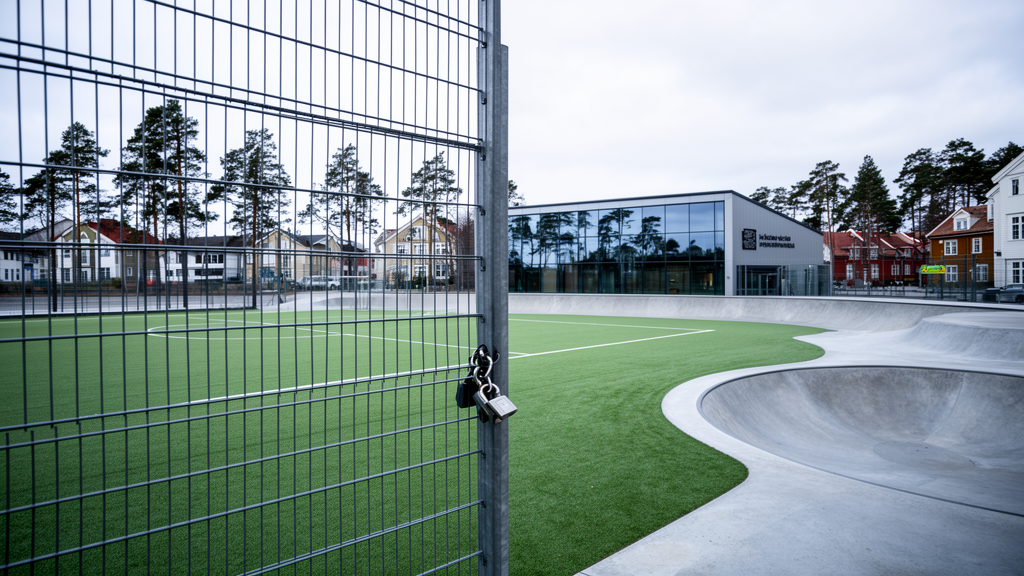
A new qualitative study published in Frontiers in Sports and Active Living reveals that structural and symbolic power dynamics in Norway significantly hinder the development of open facilities for self-organized physical activities. The research, conducted by Nils Asle Bergsgard, Tommy Langseth, and Regine Sønderland Saga, examines why flexible spaces for youth are difficult to establish despite growing demand. The authors argue that existing funding and governance systems are designed primarily to support traditional, organized sport, creating barriers for alternative, self-organized activities such as skateboarding, parkour, and street basketball.
The study draws on ten case studies from two separate research projects in Norway: the MIA study and the NAV study. These projects involved both realized and planned facilities, with data collected through semi-structured interviews with 49 informants. The researchers analyzed these interviews using three theoretical perspectives: co-creation processes, a three-level framework of power, and a horizontal approach to transitions and alliances.
The central finding is that co-creation processes, intended to involve young users in facility design, often remain at the level of consultation or placation. According to the authors, participation frequently stops short of genuine partnership. In many cases, architects designed not only the facilities but also the participatory process itself. Stakeholders were invited to comment on predefined options or choose between sketches developed by professionals. This expert-driven approach meant that while users could provide input, they did not have real control over problem definitions or final decisions.
The study identifies a persistent gap between the ambition of co-creation and its practice. The authors note that highly engaged individuals with strong organizational voices often dominate these processes. In contrast, unorganized youth, who lack formal representation, struggle to make their needs heard. Municipal actors acknowledged that they must speak on behalf of these “silent voices,” but this dynamic perpetuates a system where the unorganized are represented rather than empowered. The researchers argue that moving toward true partnership would require a fundamental redistribution of agenda-setting power.
Barriers to facility development operate simultaneously at political, structural, and symbolic levels. At the political level, organized sport holds a well-established position with direct access to decision-makers. At the structural level, the national funding system is biased toward standardized, activity-specific facilities. It is significantly easier to secure funding for traditional sports halls than for flexible, multi-purpose spaces that also function as social gathering points. One informant noted that if a project had been tied to a sports club, it would have received 12 million kroner through the gaming money scheme, highlighting the financial disparity.
At the symbolic level, the needs of organized sport are taken for granted as legitimate and natural. In contrast, the needs of self-organized youth require deliberate advocacy to be recognized as a valid policy concern. This asymmetry in symbolic capital shapes the entire field of facility provision. The authors describe this as a systemic bias where the “old ideology” that public administration exists primarily to serve organized sport remains prevalent. Unorganized youth are often viewed with suspicion, and their activities are not seen as deserving of public support in the same way as club-based sports.
Despite these barriers, the study identifies several enabling conditions that allow for change. One key strategy is the “generalization of interest,” where facilities are framed as serving broader societal goals such as crime prevention, school retention, and social inclusion. By linking self-organized activities to these wider objectives, proponents can build cross-sectoral alliances with actors like police, schools, and local businesses. This reframing helps legitimize the projects and secures political support beyond the traditional sport policy domain.
Another important mechanism is the “power of example.” Successful facilities, such as the Fysak house in Bergen, serve as visible demonstrations of what open spaces can achieve. These examples make the needs of unorganized youth tangible and generate political demand for similar facilities in other districts. The authors note that successful projects can become a resource in the local power game, helping to legitimize reallocations of funding and contributing to cross-party political agreement in some municipalities.
The role of individual “champions” is also highlighted as a critical factor. These individuals, whether private volunteers or committed civil servants, drive projects forward through long and complex processes. They possess the bureaucratic competence to navigate planning and funding systems, which can be a barrier for less experienced initiators. However, the study warns that relying on exceptional individuals creates a structural vulnerability. The departure of key actors can set processes back significantly, indicating a need for more institutionalized support structures.
The researchers conclude that more inclusive facility provision requires both reformed funding schemes and participatory planning processes that move beyond consultation. They suggest that investing in knowledge transfer, reforming national funding to accommodate mixed-use facilities, and developing genuinely participatory design processes are necessary steps. The study emphasizes that while the current system privileges organized sport, it is not immovable. Strategic action at the margins, through alliances and the accumulation of successful examples, can gradually reshape local facility policy.
The findings are specific to the Norwegian context but may have broader implications for other countries with similar funding structures. The authors note that neighboring countries like Denmark and Sweden exhibit similar features, including the prioritization of organized sport and structural funding biases. The study contributes to the understanding of how power structures influence the provision of recreational facilities and offers insights into how more equitable access to physical activity spaces might be achieved.
Limitations of the study include its qualitative design and reliance on interviews with key stakeholders. The data consists of interview transcripts that are not readily available due to privacy concerns. Future research would benefit from longitudinal perspectives that track how facilities develop in use over time and comparative studies across different national contexts.
This research provides a detailed analysis of the challenges facing the development of open facilities for self-organized activities. It highlights the complex interplay between political decisions, institutional arrangements, and symbolic hierarchies. By identifying both the barriers and the opportunities, the study offers a roadmap for policymakers and practitioners seeking to create more inclusive and flexible spaces for youth physical activity.
Broader empirical context cited by the authors underscores the scale of youth disengagement from traditional sports clubs in Norway. While diverse organized activities exist, approximately half of young people are not affiliated with any leisure-time organization. Furthermore, studies indicate that two-thirds of children who take up organized sports disengage by age 18, with nearly half dropping out during adolescence. This shift contrasts sharply with participation in self-organized physical activity, which engages nearly 87% of young adults aged 16 to 24, while fewer than one in four participate in organized sports. Socioeconomic inequalities, financial requirements such as equipment and registration fees, and heavy reliance on parental volunteering also create substantial barriers to club membership, whereas self-organized alternative sports demonstrate a more equitable socioeconomic distribution.
The study also details the financial and institutional architecture governing sports infrastructure in Norway, described as a tripartite arrangement between municipalities, sports clubs, and the national government. National government funding, derived from national gaming funds, covers on average about one-fifth of development and construction costs, while municipalities finance nearly two-thirds of total facility expenditures. However, because national lottery regulations mandate funding strictly for activity areas rather than social gathering spots, projects that combine physical recreation with spaces to hang out face severe funding hurdles. Informants contrasted this rigid structure with Denmark’s Lokale- og Anlægsfonden, which operates with architectural and functional criteria that encourage creative, innovative, and lower-threshold designs despite possessing smaller total financial resources.
Specific local disputes across the ten case studies further demonstrate how traditional sporting groups maintain control over municipal spatial planning. In one project within the NAV study, planners proposed a running loop intended to link an innovative facility with an existing athletics track. The proposal was ultimately discarded after an athletics community comprising roughly 60 active registered members objected that the loop might interfere with their training sessions. In other settings, physical education teachers on school sports programmes raised objections that their instructional needs were insufficiently accommodated, asserting that their formal public educational mandate gave their preferences greater weight than those of unorganized users.
Practical operational challenges also complicated efforts to combine school grounds with community recreation. Proponents encountered persistent difficulties when attempting to establish dual-use arrangements at primary schools, where facilities could serve pupils during daytime class hours and accommodate self-organized youth during evenings. These initiatives frequently stalled or required protracted negotiations due to municipal regulatory constraints, concerns regarding institutional liability, and the logistical burden of keeping educational buildings accessible and staffed outside regular school schedules.
Subject of Research: Co-creation, power structures and alliances—developing open facilities for self-organized activities
Article Title: Co-creation, power structures and alliances—developing open facilities for self-organized activities
Article References: Bergsgard, N. A., Langseth, T., & Saga, R. S. (2026). Co-creation, power structures and alliances—developing open facilities for self-organized activities. Frontiers in Sports and Active Living, 8, Article 1872961. https://doi.org/10.3389/fspor.2026.1872961
Image Credits: AI Generated
DOI: 10.3389/fspor.2026.1872961
Keywords: Co-creation, power, structures, alliances, developing, open, facilities, self-organized, activities, scientific research
News Source: Ophelia Keating. (November 13, 2026). Norwegian Study Finds Power Structures Block Youth Sport Facilities. Scienmag.