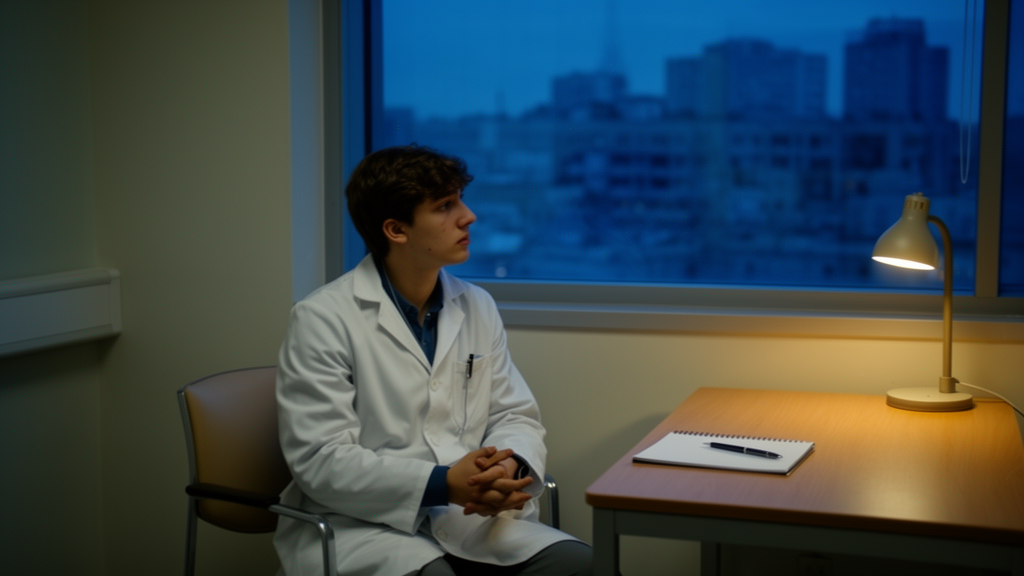
A second-year psychiatry trainee returned from a short period of educational leave, her mind fixed on an upcoming post-graduate specialist examination, and was told that a patient under her team’s care had died by suicide. The account, published as a reflection in the journal Academic Psychiatry by Ushna Usman, describes what happened in the days that followed: not an investigation into error, because there was no error to investigate, but an encounter with a form of guilt that arises precisely when no one has done anything wrong. The patient had been under the care of a well-experienced consultant specialist psychiatrist, and no single decision or individual could reasonably be identified as responsible for the death. Yet the trainee, and the medical students she supervised who had also come to know the patient, found themselves searching for someone to blame, and finding only themselves.
The circumstances of the reflection are specific. The author had been on leave to prepare for a post-graduate specialist exam as part of her psychiatry training, spending the preceding days thinking about how to approach the examination and the next stage of her career. She returned expecting to resume the familiar rhythm of clinical work and tutoring. Instead, she was confronted with a death by suicide. As a second-year trainee working under a senior specialist consultant, she was also serving as a clinical tutor for medical students, providing educational supervision during their psychiatry rotation. The patient had been part of the students’ clinical experience; they had engaged with the patient multiple times during their placement as part of their learning. The death therefore landed on two levels at once: on a junior doctor still consolidating her own clinical identity, and on a teacher responsible for learners encountering, perhaps for the first time, the possibility that a patient they had met could die this way.
The clinical picture, as she describes it, offered no foothold for accountability. There had been no obvious clinical error. Care had been appropriate. And yet the guilt arrived anyway, and she is candid that she knew it was not rational. She characterizes it as something more instinctive: the tendency of doctors to look backwards after a devastating outcome and ask what they could have done differently. She found herself replaying her clinical interactions with the patient, wondering whether something had been missed, whether another question might have been asked, whether some detail that she failed to recognize at the time might have changed the outcome. She knew the patient had been under the care of a well-experienced consultant and that the clinical decisions had been made appropriately, yet she still found herself looking for a reason, an explanation for what had happened.
The students were struggling in parallel, and their distress had its own distinctive shape. They worried that they might have missed something or failed to raise a concern that only seemed obvious in hindsight. The author recognized the feeling immediately, because she was experiencing her own uncertainty while simultaneously being expected to help the students navigate theirs. Their anxiety was, in her assessment, understandable: they had encountered a patient as learners and were now looking back at that encounter with the knowledge of how the story ended. That asymmetry, between what a clinician or a student can know in the moment and what becomes visible after an outcome is known, became the conceptual core of the conversations that followed.
What is notable about her response as a tutor is what she chose not to do. She did not simply reassure the students that they had done nothing wrong. Their distress was real, she writes, and dismissing it would not make it disappear. At the same time, she did not want their understandable anxiety to harden into a belief that they had been responsible for a suicide they could have helped prevent. So she steered a middle course, talking with them about what it actually means to review a patient as a medical student. She drew a distinction that carries real technical weight in clinical education: the difference between not knowing and failing to know. The students were learners, not independent clinicians. They were not expected to predict suicide or to carry sole responsibility for the safety of a patient under specialist psychiatric care.
The discussion of hindsight in the reflection is the closest it comes to a transferable principle, and it is worth stating carefully. When the outcome of a clinical course is known, the events preceding it can appear, in retrospect, to have been warning signs all along. But clinical encounters do not happen with the benefit of hindsight. A question that seems crucial afterwards may not have appeared crucial at the time, when the information available was incomplete and the possibilities still open. The author also told the students something she says she was still learning herself: that feeling guilty does not necessarily mean that you are responsible. She had no reason to believe she had caused the patient’s death, yet she still found herself blaming herself.
From this she draws one of the essay’s central observations about medical training. Doctors are trained to take responsibility for their decisions. But when something terrible happens, the same sense of responsibility can become internalized even when there is no culpability. The reflection does not argue that reflection itself is the problem. The difficulty, as she frames it, is that there is a point at which reflection can become self-punishment. She realized the students were standing at exactly that boundary. They wanted to know whether they had failed. What they needed, she concluded, was help understanding that an adverse outcome does not automatically mean that somebody had failed.
The experience also changed her understanding of what a clinical tutor is. Before this, she had imagined the tutor as someone who stood slightly outside the student’s experience, providing knowledge and reassurance from a position of detachment. That day, she was not outside it. She was affected too, trying to help students manage their guilt while managing her own. In some ways this made the conversation more difficult; in others, she writes, it brought more honesty to the reflection. She could understand why the students were replaying their clinical encounters with the patient, because she was replaying the clinical care. The difference was that she had to help them find a way forward, and, she adds, perhaps had to find a way forward for herself as well.
The reflection closes on a distinction that gives the piece its title. Being a doctor, she writes, does not mean being able to prevent every tragedy. It means taking responsibility for what is within our control, learning honestly from what happens, and recognizing what lies beyond it. The patient’s death by suicide remained difficult to accept, and there was no satisfying explanation that could make it easier for her or for the students. But something stayed with her. None of them, she says, needed to be told simply to stop feeling guilty. They needed to understand where the guilt came from, what it was trying to tell them, and when it was no longer helpful. She had returned from educational leave thinking about what she needed to learn for an exam. Instead, she learned something difficult to teach in a curriculum: the difference between responsibility and blame. As a trainee she was learning how to care for patients; as a tutor, how to care for learners. Sometimes, she realized, the two require the same thing: acknowledging uncertainty, resisting the hindsight that turns into self-blame, and finding a way to continue caring without carrying responsibility for everything that happens.
Subject of Research: A psychiatry trainee's reflective account of guilt, hindsight and responsibility among trainees and medical students after a patient's suicide
Article Title: When There is No One to Blame
Article References: Usman, U. (2026). When There is No One to Blame. Academic Psychiatry. https://doi.org/10.1007/s40596-026-02470-1
Image Credits: AI Generated
DOI: 10.1007/s40596-026-02470-1
Keywords: psychiatry, medical education, clinical trainees, guilt, hindsight bias, patient suicide, responsibility, blame, clinical tutoring, reflection, learner wellbeing, Academic Psychiatry
News Source: Glenn Wilkins. (October 28, 2026). No One to Blame: A Psychiatry Trainee Learns Guilt Is Not Culpability. Scienmag.