• HOME
  • NEWS
  • EXPLORE
    • CAREER
      • Companies
      • Jobs
    • EVENTS
    • iGEM
      • News
      • Team
    • PHOTOS
    • VIDEO
    • WIKI
  • BLOG
  • COMMUNITY
    • FACEBOOK
    • INSTAGRAM
    • TWITTER
Friday, January 16, 2026
BIOENGINEER.ORG
No Result
View All Result
  • Login
  • HOME
  • NEWS
  • EXPLORE
    • CAREER
      • Companies
      • Jobs
        • Lecturer
        • PhD Studentship
        • Postdoc
        • Research Assistant
    • EVENTS
    • iGEM
      • News
      • Team
    • PHOTOS
    • VIDEO
    • WIKI
  • BLOG
  • COMMUNITY
    • FACEBOOK
    • INSTAGRAM
    • TWITTER
  • HOME
  • NEWS
  • EXPLORE
    • CAREER
      • Companies
      • Jobs
        • Lecturer
        • PhD Studentship
        • Postdoc
        • Research Assistant
    • EVENTS
    • iGEM
      • News
      • Team
    • PHOTOS
    • VIDEO
    • WIKI
  • BLOG
  • COMMUNITY
    • FACEBOOK
    • INSTAGRAM
    • TWITTER
No Result
View All Result
Bioengineer.org
No Result
View All Result
Home NEWS Science News Chemistry

NMR confirms molecular switches retain function in 2D-array

Bioengineer by Bioengineer
May 13, 2020
in Chemistry
Reading Time: 2 mins read
0
IMAGE
Share on FacebookShare on TwitterShare on LinkedinShare on RedditShare on Telegram

IMAGE

Credit: Tomas Bellon / IOCB Prague

Prague, 15 May 2020 – Researchers led by Jiri Kaleta of IOCB Prague have synthesized regular 2D assemblies of isotopically labelled molecular switches and measured the properties of their isomerization, revealing that formation of such an assembly doesn’t hamper the photochemical switching properties of the embedded molecules. The isotopic labels came into use when measuring the switching properties using an analytic technique dependent on the labels. The team published the results in the Journal of the American Chemical Society.

Self-organization of individual molecular machines, such as motors, rotors, and switches, into regular and well-defined two- (2D) or three-dimensional (3D) arrays is a promising path towards a new generation of smart materials. Two-dimensional assemblies seem to be particularly interesting because of their possible application in fields such as optics (OLEDs) and nanoelectronics (memory devices, frequency filters, etc.).

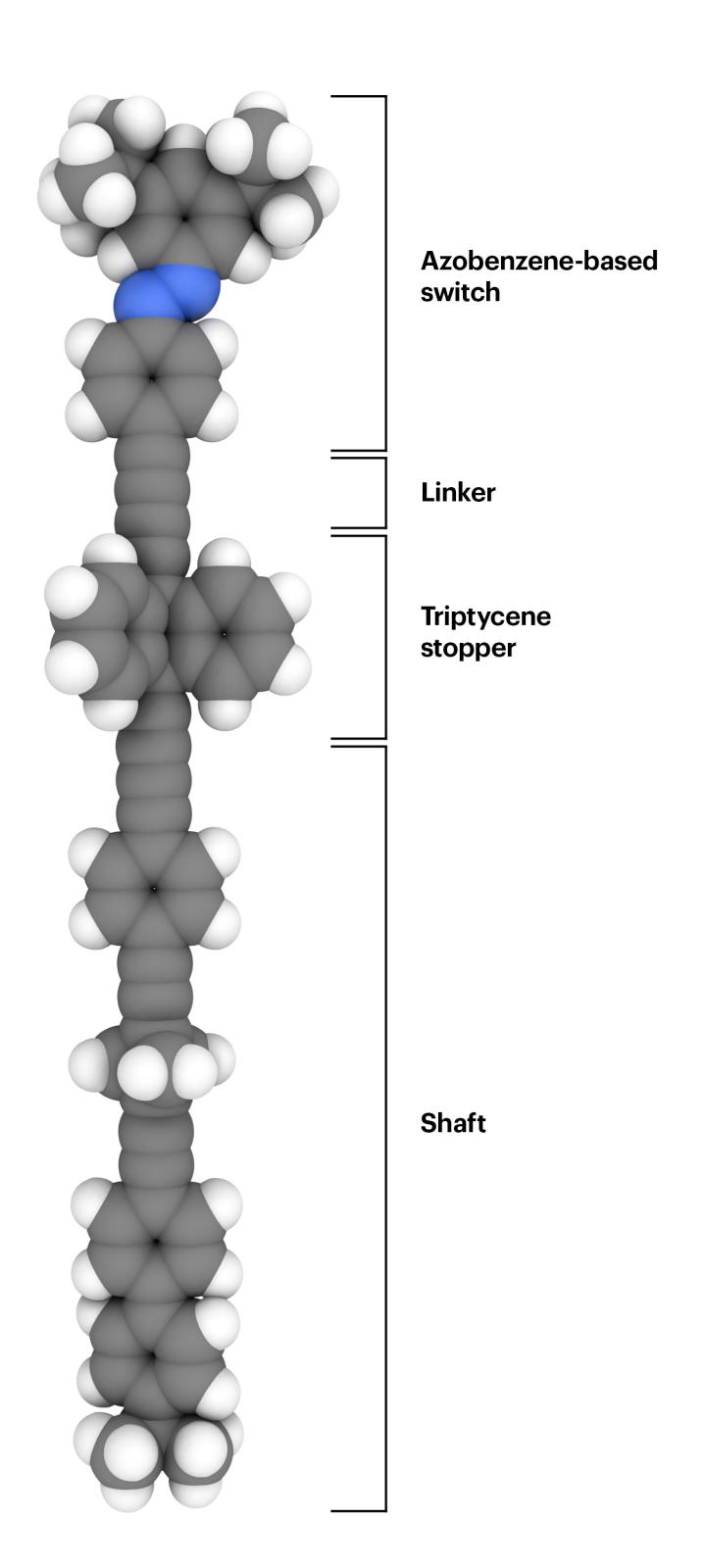
In collaboration with researchers from the Faculty of Science, Charles University in Prague and the University of Colorado, the IOCB Prague team obtained these assemblies with a method previously tested on other molecular machines in accordance with their ongoing research in the 2D arrays of such supramolecular systems. The researchers mounted the molecular switch moieties (substituted azobenzenes) onto rod-like molecules and distributed them on the porous nanocrystals of a tris(o-phenylenedioxy)cyctlotriphosphazene (TPP) matrix. The regularly distributed straight pores enforced the regular spread and parallel orientation of these structures.

The researchers labelled the switches 15N, which allowed them to use solid-state 15N NMR spectroscopy to detect the cis/trans isomerization. A suite of other analytical techniques confirmed the regular structure of the assemblies. Comparison of thermal steps in solution and supramolecular surface inclusions revealed that switching of individual molecules is not compromised by the close proximity of neighbors.

Binding the molecular switches to the surface of a solid material produces several key advantages. Unlike in bulk crystals, the switch segments of the molecules have enough space to change their configuration. And unlike in a solution, the molecules are part of a solid periodical system, giving more control of their position, which may lead to the potential use of such materials in applications where their specific position plays a role, e.g. memory devices.

###

The original paper: Santos Hurtado, C.; Bastien, G.; Masat, M.; Stocek, J. R.; Dracinsky, M.; Roncevic, I.; Cisarova, I.; Rogers, C. T.; Kaleta, J., Regular Two-Dimensional Arrays of Surface-Mounted Molecular Switches: Switching Monitored by UV-vis and NMR Spectroscopy. Journal of the American Chemical Society 2020. DOI: 10.1021/jacs.0c01753

Video: https://youtu.be/Ya6qAoupOx0

Media Contact
Dusan Brinzanik
[email protected]

Original Source

https://www.uochb.cz/en/news/171/

Related Journal Article

http://dx.doi.org/10.1021/jacs.0c01753

Tags: Chemistry/Physics/Materials SciencesNanotechnology/Micromachines
Share12Tweet8Share2ShareShareShare2

Related Posts

Selective GlcNAc to GalNAc Epimerization via Kinetic Control

Selective GlcNAc to GalNAc Epimerization via Kinetic Control

January 15, 2026
blank

Thermal [2+2] Cycloaddition Builds Gem-Difluoro Bicycloalkanes

January 13, 2026

Cobalt-Catalyzed Thioester Coupling via Siloxycarbene

January 12, 2026

Advancing Alkene Chemistry: Homologative Difunctionalization Breakthrough

January 8, 2026
Please login to join discussion

POPULAR NEWS

  • Enhancing Spiritual Care Education in Nursing Programs

    155 shares
    Share 62 Tweet 39
  • PTSD, Depression, Anxiety in Childhood Cancer Survivors, Parents

    147 shares
    Share 59 Tweet 37
  • Robotic Ureteral Reconstruction: A Novel Approach

    77 shares
    Share 31 Tweet 19
  • Study Reveals Lipid Accumulation in ME/CFS Cells

    54 shares
    Share 22 Tweet 14

About

We bring you the latest biotechnology news from best research centers and universities around the world. Check our website.

Follow us

Recent News

UQCRC1 Deficiency Disrupts PINK1 Mitophagy in Parkinson’s

Mechanistic Residual Learning Enhances Battery Life Monitoring

Ethanol-Diesel Blending vs. Dual-Fuel Combustion: A Comparison

Subscribe to Blog via Email

Enter your email address to subscribe to this blog and receive notifications of new posts by email.

Join 71 other subscribers
  • Contact Us

Bioengineer.org © Copyright 2023 All Rights Reserved.

Welcome Back!

Login to your account below

Forgotten Password?

Retrieve your password

Please enter your username or email address to reset your password.

Log In
No Result
View All Result
  • Homepages
    • Home Page 1
    • Home Page 2
  • News
  • National
  • Business
  • Health
  • Lifestyle
  • Science

Bioengineer.org © Copyright 2023 All Rights Reserved.