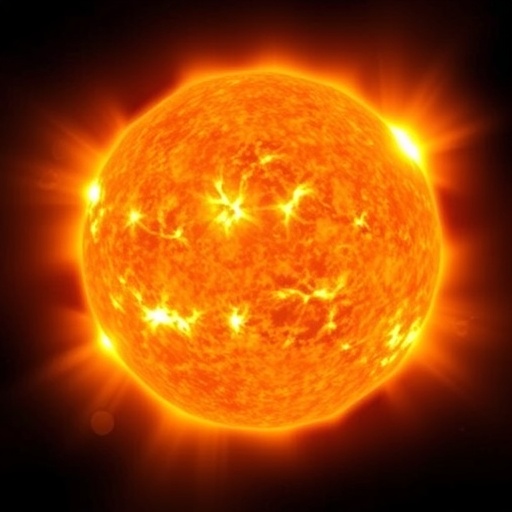
Every eleven years, the Sun undergoes a dramatic transformation: its magnetic field reverses polarity in a complex and powerful cycle. This process manifests visually on the solar surface through the emergence of sunspots—regions that appear darker and cooler than their surroundings due to intense magnetic activity. These sunspots typically emerge at mid-latitudes and drift towards the equator, tracing out a distinctive butterfly-shaped pattern before dissipating as the solar cycle resets. For decades, astronomers have studied this visible surface phenomenon, but the inner workings—the engine driving this magnetic metamorphosis—have remained elusive. Recent research, however, has illuminated this mystery by probing deep into the Sun’s interior, revealing where this magnificent magnetic dance begins.
Scientists at the New Jersey Institute of Technology (NJIT) have harnessed nearly 30 years of solar oscillation data to peer beneath the Sun’s blazing surface, uncovering the likely birthplace of its magnetic dynamo. Approximately 200,000 kilometers below the surface—that is about sixteen times the length of Earth lined end to end—lies the critical zone where the solar magnetic engine appears to operate. This discovery offers one of the clearest glimpses yet into the architecture and mechanics powering the solar cycle, fundamentally enhancing our understanding of space weather phenomena that directly affect Earth. Moreover, this breakthrough sets a precedent for studying similar magnetic cycles in stars throughout our galaxy.
Using state-of-the-art helioseismic techniques, the researchers analyzed subtle sound waves generated by turbulent plasma flowing within the Sun. These waves, recorded by instruments like NASA’s Michelson Doppler Imager (MDI) aboard the Solar and Heliospheric Observatory (SOHO), the Helioseismic and Magnetic Imager (HMI) on the Solar Dynamics Observatory (SDO), and the ground-based Global Oscillation Network Group (GONG), have been measured every 45 to 60 seconds since the mid-1990s. Collating billions of these measurements allowed the team to construct one of the most detailed, continuous records of solar internal vibrations ever assembled.
Helioseismology, akin to terrestrial seismology but dedicated to solar science, involves interpreting how sound waves traverse the Sun’s interior. As these waves ripple through layers of hot, magnetized plasma, their speeds and paths shift in response to variations in temperature, movement, and magnetic forces. By measuring these subtle changes, researchers can map plasma flows and rotation patterns deep beneath the surface. Crucially, this method reveals the presence of distinct bands of faster and slower rotation inside the Sun, whose behavior evolves throughout the solar cycle, offering a window into the internal magnetic dynamics.
One of the key revelations of this study is the identification of a butterfly-shaped flow pattern deep within the Sun’s interior, reflecting the surface migration of sunspots. These migrating rotational bands emerge prominently near a transitional layer called the tachocline—a thin, critical boundary between the Sun’s outer convection zone and its relatively stable interior radiative zone. The tachocline lies about 200,000 kilometers beneath the surface and is characterized by a sharp change in rotational velocity. This shearing region generates powerful differential flows that are believed to be essential for amplifying and organizing the Sun’s magnetic fields.
The scientific importance of the tachocline stems from its unique physical conditions: it separates the churning, turbulent outer layers, where plasma motion is chaotic and convection dominates, from the more staid inner layers, where energy transfer occurs primarily via radiation. This juxtaposition facilitates complex interactions between rotational shear and magnetic fields, enabling the conversion of kinetic energy into magnetic energy—a process central to the solar dynamo mechanism. Observational confirmation of this region’s role provides critical empirical support to longstanding theoretical models in solar physics.
Researchers observed that changes in rotation and magnetic structure originating near the tachocline take years to propagate upwards to the solar surface, culminating in the formation of sunspots and triggering solar activity. This gradual emergence aligns with the timing of the sunspot cycle and underscores the deep-seated origins of solar magnetism. Consequently, the findings corroborate the notion that the solar dynamo’s “engine room” lies far beneath the visible surface, challenging surface-focused solar activity models and emphasizing the need to consider the full depth of the convection zone — especially the tachocline — in predictive simulations.
Understanding the location and mechanisms of the solar dynamo is more than an academic pursuit; it carries profound practical implications. Solar eruptions driven by magnetic activity, such as solar flares and coronal mass ejections, sporadically release massive bursts of energy that can disrupt satellite operations, communication networks, GPS navigation, and even terrestrial power grids. Improved knowledge of the Sun’s internal magnetic engine enhances our capacity to model and predict space weather, ultimately safeguarding critical technological infrastructure and reducing the vulnerability of modern society to solar-induced disruptions.
This investigation represents a major leap in solar physics, enabled by decades of cumulative data and cutting-edge data analysis techniques. By integrating observations from space-borne and ground-based observatories, scientists have pieced together the dynamic interplay of plasma flows and magnetic fields within the Sun’s interior. They have elucidated how the solar cycle unfolds from deep within, providing a clearer causal sequence linking internal magnetic fluctuations to observable surface phenomena. Such advances demonstrate the power of long-term, high-resolution monitoring merged with sophisticated computational modeling.
The implications of this research extend beyond our own star. Many stars in the galaxy exhibit magnetic activity cycles akin to the Sun’s, yet their great distances have hindered detailed study. The Sun, by virtue of its proximity, acts as a Rosetta Stone for understanding stellar magnetism universally. This work provides an essential framework to decode magnetic cycles on other stars, unlocking a broader comprehension of stellar behavior, evolution, and the impact of magnetism throughout the cosmos.
Looking ahead, the NJIT team, led by Distinguished Professor Alexander Kosovichev alongside lead author Krishnendu Mandal, plans to deepen their exploration through numerical simulations and continued data analysis. Their goal is to unravel the evolving nature of the solar dynamo more precisely and to link these internal magnetic processes with measurable solar activity. Future research building upon this foundation may one day yield precise forecasts of solar cycles, granting humanity greater predictive powers over an inherently variable and often volatile star.
Although significant progress has been made, many aspects of the Sun’s internal magnetic evolution remain mysterious. The complex interaction of plasma dynamics, rotation, magnetism, and turbulent convection presents formidable challenges, demanding increasingly sophisticated observation and modeling strategies. Nonetheless, the fusion of helioseismic evidence with theoretical advances marks a transformative moment in solar science—one that promises to reshape our understanding of the Sun and inform our interactions with the space environment.
In sum, the recent helioseismic study conclusively ties the Sun’s magnetic cycle to processes occurring near the tachocline, demonstrating that this shearing boundary layer beneath the convection zone houses the solar dynamo. This discovery not only validates theoretical predictions but also underscores the necessity of incorporating the entire convection zone’s dynamic behavior, particularly around the tachocline, in any comprehensive space weather prediction framework. As solar and stellar physics forge ahead, such insights herald an era of enhanced understanding of magnetic phenomena that govern not just our Sun’s behavior, but the electromagnetic nature of stars throughout the universe.
Subject of Research: Solar dynamo and magnetic field generation within the Sun’s interior
Article Title: Helioseismic evidence that the solar dynamo originates near the tachocline
News Publication Date: 12-Jan-2026
Web References:
DOI: 10.1038/s41598-025-34336-1
NASA Michelson Doppler Imager (MDI): http://soi.stanford.edu/
Solar and Heliospheric Observatory (SOHO): https://soho.nascom.nasa.gov/
Helioseismic and Magnetic Imager (HMI): http://hmi.stanford.edu/
Solar Dynamics Observatory (SDO): https://science.nasa.gov/mission/sdo/
Global Oscillation Network Group (GONG): https://gong.nso.edu/
NJIT Center for Computational Heliophysics: https://research.njit.edu/cch/
NASA DRIVE Science Center: https://science.nasa.gov/heliophysics/dsc/coffies/
References:
Mandal, K., Kosovichev, A.G., et al. Helioseismic evidence that the solar dynamo originates near the tachocline. Scientific Reports (2026). DOI: 10.1038/s41598-025-34336-1
Image Credits: NASA
Keywords
Solar physics, solar dynamo, tachocline, helioseismology, sunspots, solar magnetic field, space weather, solar cycle, stellar physics, plasma dynamics, solar oscillations, magnetism, astrophysics
Tags: deep solar interior dynamicsmagnetic activity beneath Sun’s surfaceNJIT solar research discoverysolar cycle magnetic dynamosolar magnetic field polarity cyclesolar magnetic field reversalsolar magnetic metamorphosis mechanismsolar oscillation data analysisspace weather prediction researchSun’s interior magnetic enginesunspot butterfly patternsunspot formation and migration