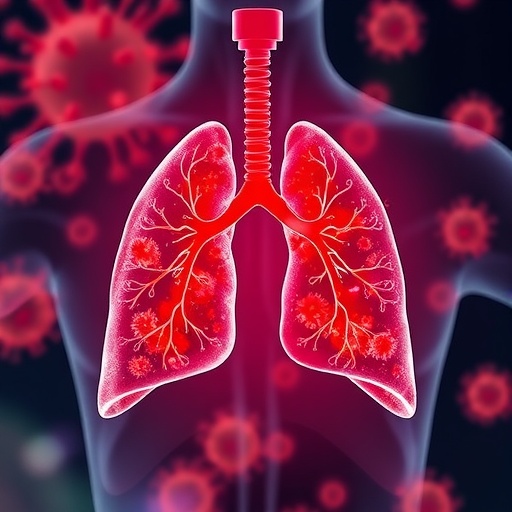

Credit: Credit: M. Høgh Jensen og M. Heltberg, NBI)
Special proteins are important for the function of cells and play an important role in processes and effectiveness of the immune system. Researchers from the Niels Bohr Institute have observed how concentrations that vary over time can affect cells and they have demonstrated the existence of a mechanism, which is a new way of controlling the production of proteins that are related to processes which are important in order to avoid serious diseases, including cancer and Alzheimer's. The results have been published in the scientific journal, Cell Systems.
The formation of certain proteins is crucial to how living organisms function. It has long been established that many of the most important proteins vary in concentration in certain time intervals. It is said that the concentration 'swings', but why is not properly understood. Now researchers from the Niels Bohr Institute have studied the special protein, NF-kB, which is formed inside the cells and it is extremely important for controlling disease. The protein regulates about 200 genes that are of importance for functional disorders and the immune system and it is therefore essential for the body's ability to fight diseases like cancer, Alzheimer's and diabetes.
In collaboration with research groups in Zurich and Chicago, researchers from the Niels Bohr Institute at the University of Copenhagen have studied what happens inside the individual cells when they are influenced from the outside by the protein, TNF, a so-called signalling protein that tells cells which proteins should be produced for the body to function as it should.
Fluctuations synchronised
"In the experiment, TNF is added to the protein from the outside in such a way that the concentration varies over time like a wave. In part because there are indications that it happens this way in nature and partly because we can then measure how the TNF protein affects the formation of the NF-kB proteins in the cell," explains Mogens Høgh Jensen, professor in Biocomplexity at the Niels Bohr Institute at the University of Copenhagen.
And the researchers detected a clear connection.
"We measured the same oscillations in the formation of the NF-kB protein inside the cell as well as the oscillation with the addition of the TNF protein outside the cell. The two oscillations were synchronised in their pendulum swings – just like the Dutch mathematician and physicist, Huygens proved 350 years ago, that two clocks placed in adjoining rooms synchronised the swing of their pendulums and fluctuated in sync. In the same way, the oscillations outside and inside of the cell affected each other and they simply became linked together and swung in sync. Thus you can control the production of important proteins using the mechanisms of physics," explains Mogens Høgh Jensen.
Control of the cell's genes
In the experiments, they also tried to confuse the cells by bringing them into different modes of oscillation.
"We discovered that if large enough oscillations are made in the TNF protein, you could get different oscillation modes of the NF-kB protein inside the cell, so that the synchronisation hopped between oscillations in single tempo and double tempo in the dynamic switching between the two modes. Of course there is still a lot we do not know, but it can provide a new opportunity to control what proteins are formed. This could therefore be important for future research and the fight against diseases," explains Mathias Heltberg, PhD student in Biocomplexity at the Niels Bohr Institute, University of Copenhagen.
Based on these oscillation modes, they could predict how the cell could align the production of a variety of proteins and could also control the meaning of the coincidences that are always present in a very simple way.
Mogens Høgh Jensen and Mathias Heltberg point out that what they have found is that this mechanism potentially can be used to control the cell's genetic response. This could have an enormous impact on how you fight some of the most challenging diseases and how future medicine can be developed to stimulate the immune system in the best way.
###
Contact:
Mogens Høgh Jensen, Professor in Biocomplexity at the Niels Bohr Institute, University of Copenhagen, +45 3532-5371, [email protected]
Mathias Heltberg, PhD student in Biocomplexity at the Niels Bohr Institute, University of Copenhagen, +45 2619-1889, [email protected]
Media Contact
Gertie Skaarup
[email protected]
45-28-75-06-20
http://www.nbi.ku.dk/english/press_and_media/
############
Story Source: Materials provided by Scienmag