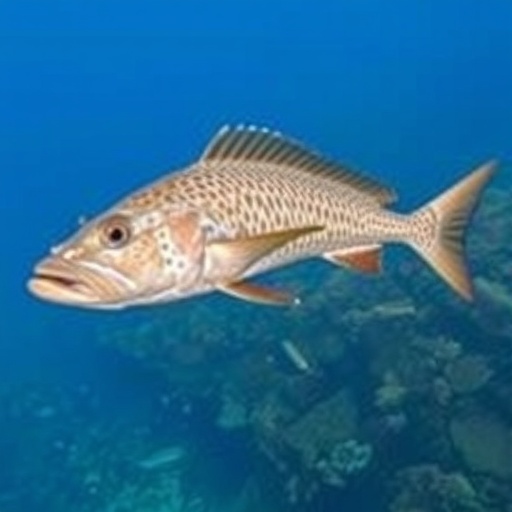
For years, anglers along the Gulf Coast have treasured the gag grouper (Mycteroperca microlepis) for its tenacious fight and mild, flavorful flesh. However, recent fishing regulations have dramatically shortened the traditional six-month fishing seasons, with only 41 days allowed in 2023, dropping further to 15 days in 2024 and just 14 days in 2025. These adjustments have raised eyebrows among fishermen and journalists alike, prompting questions about the health and sustainability of the species in one of its core habitats.
A groundbreaking study authored by researchers from the University of South Florida (USF) and the Florida Fish and Wildlife Conservation Commission (FWC) has introduced a novel statistical forecasting model that promises to revolutionize how fishery managers predict harvests and design fishing quotas, particularly for vulnerable stocks like the gag grouper. Published in the North American Journal of Fisheries Management, the model not only improves seasonal harvest predictions but also provides explicit probabilities of exceeding quota limits, a crucial element for precautionary fisheries management.
The gag grouper’s population dynamics pose unique challenges for management due to their migratory habits, habitat preferences, and fascinating biology. These groupers are protogynous hermaphrodites, meaning individuals begin life as females and some transition to male as they mature, with the largest and oldest individuals typically being males. Juvenile gag groupers start life in estuarine nurseries like Tampa Bay, gradually moving offshore as they age. This complex spatial and biological structure complicates population assessments and quota setting.
Historical fishing pressures coupled with environmental stressors led the National Oceanic and Atmospheric Administration (NOAA) to classify the Gulf gag grouper population as overfished in 2009, signaling a population decline below sustainable thresholds. While recovery efforts led to the lifting of this designation by 2014, a subsequent stock assessment in 2021 identified renewed population impairment, driving regulators to implement even stricter catch limits and shortened seasons to aid recovery.
One of the core difficulties in managing the gag grouper arises from the unreliability of traditional harvest prediction methods. Conventional approaches typically rely on historical catch data and often fail to account for dynamic changes in angler behavior triggered by regulatory shifts. Recognizing these limitations, the USF and FWC collaborators developed a statistical model incorporating not only historical data but also critical factors such as regulatory changes, season timing, and concurrent fishing opportunities for another prized species, the red snapper.
This model leverages data spanning nearly a decade—from 2015 onward—and represents a significant advance by quantifying risk explicitly. Fisheries managers can now evaluate the probability of exceeding quota limits for any proposed season length, helping balance the needs of conservation with economic and recreational interests. Its initial application predicted a 50 percent chance of achieving the 2025 annual catch target within just 12 days of fishing. Federal and state preliminary data validated the model’s accuracy when the season lasted 14 days and captured the quota nearly exactly.
The enhanced forecast reliability is a potential game-changer for fishery management councils responsible for setting season lengths. Notably, the model accommodates varying risk tolerances; conservative approaches can be adopted when stocks face high vulnerability, while increased harvest opportunities may be approved when populations show signs of recovery. This flexibility allows for much-needed nuance in managing a species as biologically distinctive and socioeconomically important as the gag grouper.
Another formidable challenge to managing the gag grouper is the skewed sex ratio within the population. Research from 2014 indicated that only 2–3 percent of the gag grouper population were males—significantly lower than historic levels around 17 percent. Given that the largest males are vital for reproductive success, the depletion of this segment threatens long-term sustainability. Subsequent studies by FWC in 2020 reinforced that existing regulations were insufficient to restore the male population to balanced proportions, emphasizing the urgency of data-driven management tools.
On a broader scale, the study’s authors underscore how environmental and technological factors are reshaping fishing pressure. Modern advancements—in particular, more powerful boat engines and sophisticated electronics—allow anglers to cover more water and locate fish more efficiently than ever before. Coupled with a growing angler population on the Gulf Coast, these developments could accelerate harvest rates beyond historical baselines, underlining the necessity for forecasting frameworks that dynamically adjust to changing conditions.
At the interface of science and policy, the implications of this research extend beyond the gag grouper. Tom Frazer, dean of the USF College of Marine Science and co-author of the study, highlighted the model’s potential to inform sustainable management across a spectrum of recreational fisheries. By embedding rigorous statistical approaches into decision-making processes, managers stand to benefit from improved accuracy, reduced uncertainty, and more transparent assessments of trade-offs between conservation and economic benefits.
This model also responds to the complex social dimensions of fisheries management. Decisions to shorten seasons or reduce quotas inevitably affect coastal economies heavily reliant on charter fishing, bait shops, and related businesses, as well as recreational anglers who cherish the cultural and sporting traditions tied to catching gag grouper. By enabling managers to quantify risks and adjust seasons with greater confidence, the model helps navigate the delicate balance between ecological sustainability and community livelihoods.
As fisheries management continues to embrace data-driven strategies, this study sets a precedent for integrating behavioral data, biological insights, and evolving technological realities into forecasting tools. The researchers plan to expand their analyses to capture the impacts of economic incentives and obtain a deeper understanding of how angler populations and gear innovations influence harvest intensity over time. Such ongoing efforts promise to refine predictive capacity further and contribute to robust stewardship of prized marine resources.
In summary, the cooperation between USF and FWC scientists exemplifies the power of interdisciplinary collaboration in addressing fisheries’ most pressing challenges. By moving beyond traditional forecasting paradigms to incorporate nuanced ecological, behavioral, and regulatory factors, their innovative model offers a pathway toward sustainable recreational fisheries that benefit both fish populations and fishing communities into the future.
Subject of Research: Animals
Article Title: Leveraging statistical models to improve preseason forecasting and in-season management of a recreational fishery
News Publication Date: 8-Jan-2026
Web References:
University of South Florida: https://www.usf.edu/
Florida Fish and Wildlife Conservation Commission: https://myfwc.com/
NOAA Fisheries gag grouper: https://www.fisheries.noaa.gov/species/gag-grouper
North American Journal of Fisheries Management: https://academic.oup.com/najfm/article/46/1/222/8417428
Image Credits: Credit: FWC Fish and Wildlife Research Institute
Keywords: Fisheries management, Aquaculture, Fisheries, Statistical modeling, Recreational fishery forecasting, Gag grouper, Protogynous hermaphroditism, Fisheries quotas, Angler behavior, Gulf Coast fisheries
Tags: conservation of overfished speciesfishery harvest prediction modelsFlorida Fish and Wildlife Conservation Commission researchgag grouper population managementGulf Coast fishing regulationsGulf Coast marine biologyNorth American Journal of Fisheries Managementprotogynous hermaphrodites in fishseasonal fishing season limitsstatistical forecasting in fisheriessustainable fishing quotasUniversity of South Florida fisheries study