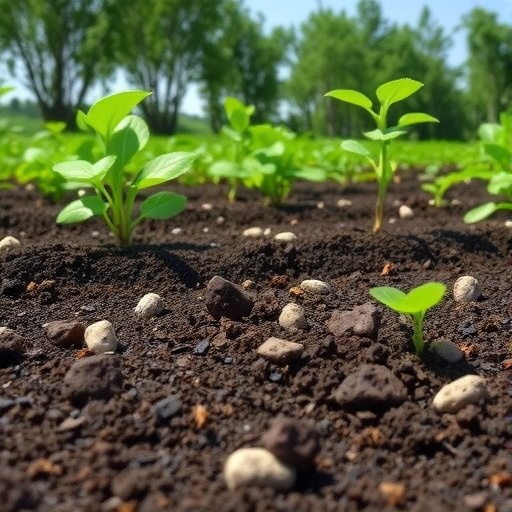
A groundbreaking study has illuminated the complex and contrasting roles of biochar in modulating nitrous oxide (N2O) emissions across divergent soil ecosystems. Biochar, a carbon-dense material derived from biomass pyrolysis, has garnered significant attention as a promising tool for carbon sequestration and sustainable agriculture. However, this latest research reveals that biochar’s efficacy in reducing greenhouse gases is profoundly influenced by soil type and hydrological conditions, unveiling a nuanced picture that challenges the common perception of biochar as a universal climate solution.
Nitrous oxide is a critically important greenhouse gas, with a global warming potential approximately 300 times greater than carbon dioxide over a century. Agricultural soils contribute substantially to global N2O emissions, primarily through microbial processes tied to nitrogen cycling. Consequently, developing targeted strategies to mitigate these emissions is essential for climate stabilization and the sustainability of food production systems worldwide. The new findings offer a vital piece in this complex puzzle, underscoring the necessity of context-specific approaches in soil management.
The research, led by a team of soil scientists and microbiologists, focused on two contrasting agricultural environments: acidic upland soils and flooded paddy fields. These distinct ecosystems represent fundamental differences in soil chemistry, moisture regimes, and microbial community structures, each shaping nitrogen cycling pathways in unique ways. Through meticulous isotope tracing and genomic analyses, the investigators delineated the microbial mechanisms that dictate N2O emissions in response to biochar amendments.
In acidic upland soils, biochar demonstrated a pronounced capacity to suppress N2O emissions. This suppression surpassed that achieved by traditional lime treatments commonly used to ameliorate soil acidity. The underlying processes were linked to biochar’s influence on soil microbial communities. The additive notably inhibited both bacterial and fungal nitrification and denitrification pathways responsible for N2O production. Simultaneously, biochar stimulated the expression of genes facilitating the complete reduction of N2O to dinitrogen (N2), a benign atmospheric gas, thus effectively redirecting nitrogen fluxes toward less harmful endpoints.
Such microbial shifts indicate biochar’s role not merely as a physical soil conditioner but as a biochemically active agent reshaping nitrogen transformation dynamics under acidic conditions. These findings highlight biochar’s potential in upland systems as a selective mitigation measure that harnesses the soil microbiome’s own regulatory capacity to curb potent greenhouse gas emissions. The study’s authors emphasize that this mechanistic clarity paves the way for implementing biochar in precision agriculture frameworks tailored to soil-specific challenges.
Conversely, the scenario in flooded paddy soils told a markedly different story. In these anaerobic, water-saturated environments, biochar application incited a substantial increase in N2O emissions. The study observed the simultaneous stimulation of multiple microbial pathways involved in nitrogen transformations, including denitrification, nitrifier denitrification, and dissimilatory nitrate reduction to ammonium. The enhanced availability of labile carbon from biochar and altered soil redox conditions collectively energized microbial metabolism, leading to intensified production and release of nitrous oxide rather than its consumption.
This divergence underscores the complexity of soil-plant-microbe interactions governing greenhouse gas fluxes. While biochar acts as a suppressor of N2O in some settings, it can inadvertently exacerbate emissions in others, particularly under the unique physicochemical milieu of flooded paddy fields. The researchers caution against broad-brush applications of biochar without due consideration of site-specific factors such as soil moisture, organic matter content, and resident microbial consortia.
Importantly, the research sheds light on the intricate interplay of environmental variables that modulate the response of nitrogen cycling microbial communities to biochar amendments. In upland soils, improved soil structure and enhanced carbon availability favored pathways that efficiently consume N2O, tipping the balance toward greenhouse gas mitigation. In contrast, the anoxic and high-moisture conditions in paddy soils created a milieu where microbial processes that generate N2O were simultaneously enhanced, amplifying emissions in a synergistic manner.
The implications for climate-smart agriculture are profound. This study signals a paradigm shift from viewing biochar as a one-size-fits-all amendment to adopting a nuanced, soil-type-specific deployment. The ecological mechanisms unveiled here inspire new avenues in the design of biochar-based soil management practices that optimize greenhouse gas mitigation while maintaining or enhancing agricultural productivity.
Researchers advocate for further investigations under field conditions to validate these laboratory findings and explore the long-term impacts of biochar application across diverse agroecosystems. Additionally, devising practical strategies to integrate biochar use with existing soil management regimes will be crucial. These might include combining biochar with other amendments, optimizing application rates, or tailoring biochar physicochemical properties to specific environmental contexts.
By unraveling the microbial and biochemical pathways modulated by biochar, this study contributes a crucial foundation for refining agricultural practices that support both climate and food security goals. Advancing this line of research will be instrumental in developing intelligent, targeted interventions that leverage soil microbiomes to their fullest potential, ultimately fostering resilient, low-emission farming landscapes worldwide.
The research community is thus called to embrace the complexity and heterogeneity of soil systems as integral to finding sustainable climate solutions. Biochar remains an important tool in the arsenal against agricultural greenhouse gas emissions, but its deployment demands an informed, site-specific approach that reconciles environmental variability with scientific innovation.
Subject of Research: Not applicable
Article Title: Biochar’s contrasting effects on N2O emissions in acidic upland and flooded paddy soils
News Publication Date: 22-Jan-2026
Web References:
DOI: 10.48130/nc-0025-0021
References:
Chu C, Elrys AS, Dai S, Wen T, Xu J, et al. 2026. Biochar’s contrasting effects on N2O emissions in acidic upland and flooded paddy soils. Nitrogen Cycling 2: e009. doi: 10.48130/nc-0025-0021
Image Credits: Cheng Chu, Ahmed S. Elrys, Shenyan Dai, Teng Wen, Jin Xu, Zucong Cai, Jinbo Zhang, Anne B. Jansen-Willems, Kristina Kleineidam & Christoph Müller
Keywords: Black carbon
Tags: biochar effects on greenhouse gasesbiochar impact on nitrous oxide emissionsbiochar in acidic upland soilsbiochar in flooded paddy fieldsbiochar in sustainable agriculturecarbon sequestration with biocharclimate change mitigation through soil amendmentscontext-specific soil management strategieshydrological conditions and greenhouse gas emissionsnitrous oxide mitigation in agriculturesoil microbial processes and N2Osoil type influence on biochar efficacy