• HOME
  • NEWS
  • EXPLORE
    • CAREER
      • Companies
      • Jobs
    • EVENTS
    • iGEM
      • News
      • Team
    • PHOTOS
    • VIDEO
    • WIKI
  • BLOG
  • COMMUNITY
    • FACEBOOK
    • INSTAGRAM
    • TWITTER
Thursday, March 26, 2026
BIOENGINEER.ORG
No Result
View All Result
  • Login
  • HOME
  • NEWS
  • EXPLORE
    • CAREER
      • Companies
      • Jobs
        • Lecturer
        • PhD Studentship
        • Postdoc
        • Research Assistant
    • EVENTS
    • iGEM
      • News
      • Team
    • PHOTOS
    • VIDEO
    • WIKI
  • BLOG
  • COMMUNITY
    • FACEBOOK
    • INSTAGRAM
    • TWITTER
  • HOME
  • NEWS
  • EXPLORE
    • CAREER
      • Companies
      • Jobs
        • Lecturer
        • PhD Studentship
        • Postdoc
        • Research Assistant
    • EVENTS
    • iGEM
      • News
      • Team
    • PHOTOS
    • VIDEO
    • WIKI
  • BLOG
  • COMMUNITY
    • FACEBOOK
    • INSTAGRAM
    • TWITTER
No Result
View All Result
Bioengineer.org
No Result
View All Result
Home NEWS Science News

New study presents evaporation-driven transport-control of small molecules along nanoslits

Bioengineer by Bioengineer
May 20, 2021
in Science News
Reading Time: 2 mins read
0
IMAGE
Share on FacebookShare on TwitterShare on LinkedinShare on RedditShare on Telegram

IMAGE

Credit: UNIST

Microfluidic chips hold great promise for unparalleled applications in pathogen detection and cancer diagnosis. Such devices often require nanoscale thin films for the filtering of liquid samples, as well as power devices or chemical stimulus that control its flow direction. However, many challenges still remain with most precedent mechanisms, including complicated fabrication processes, limitations of materials, and undesired damage on samples.

A research team, led by Professor Taesung Kim in the Department of Mechanical Engineering at UNIST presented the evaporation-driven transport-control of small molecules in gas-permeable and low-aspect-ratio nanoslits, wherein both the diffusive and advective mass transports of solutes are affected by solvent evaporation through the nanoslit walls.

Unlike the existing method, the new technique has drawn considerable attention as a multi-functional core technology that enables the active and versatile control of small molecules, such as valving, concentrating, pumping, and filtering abilities on a chip, without damaging samples.

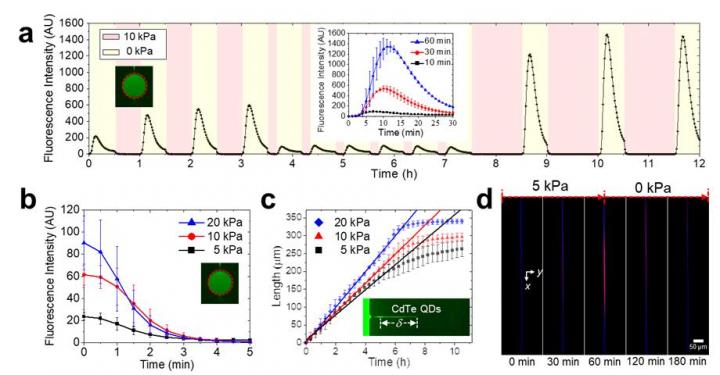
In this study, the research team experimentally characterized the effect of evaporation flux on the mass transport of small molecules in various nanoslit-integrated micro/nanofluidic devices. Their findings showed that the transport of small molecules along the nanoslit was largely governed by the evaporation flux and nanoslit length. They also performed numerical simulations to theoretically support the experimental results with the advection and diffusion model, thereby enabling the description of the transport with the nondimensionalized diffusion coefficient and evaporation flux.

They further demonstrated that evaporation-driven transport control in nanoslit-based micro/nanofluidic devices can be used as a molecule-valve, -concentrator, -pump, and -filter, showing remarkable potential for a variety of applications in micro/nanofluids.

Researchers also employed their previous cracking-assisted photolithography to fabricate a global, evaporation-controlled, micro/nanofluidic device (GECMN) integrated with a gas-permeable, PDMS-based nanoslit, which permitted diffusive mass transport but suppressed pressure-driven flow via high hydraulic resistance.

Their findings have been published in the online version of Nature Communications on February 26, 2021. This study has been supported by a National Research Foundation of Korea (NRF) grant, funded by the Korean Ministry of Science and ICT (MSIT).

###

Media Contact
JooHyeon Heo
[email protected]

Original Source

https://news.unist.ac.kr/evaporation-driven-transport-control-of-small-molecules-along-nanoslits/

Tags: Chemistry/Physics/Materials SciencesMechanical EngineeringResearch/DevelopmentTechnology/Engineering/Computer Science
Share12Tweet8Share2ShareShareShare2

Related Posts

Decoding the Phosphorus Puzzle: How Microplastics and Hydrochar Transform Nutrient Dynamics in Rice Paddies

Decoding the Phosphorus Puzzle: How Microplastics and Hydrochar Transform Nutrient Dynamics in Rice Paddies

March 26, 2026

Microtubules Found to Actively Ensure Accurate Chromosome Distribution During Cell Division

March 25, 2026

Aversive Learning Hijacks Brain Sugar Sensor

March 25, 2026

Isolated H2-Reduced Clusters Boost CO2-to-Methanol Catalysis

March 25, 2026
Please login to join discussion

POPULAR NEWS

  • blank

    Revolutionary AI Model Enhances Precision in Detecting Food Contamination

    96 shares
    Share 38 Tweet 24
  • Imagine a Social Media Feed That Challenges Your Views Instead of Reinforcing Them

    1003 shares
    Share 397 Tweet 248
  • Uncovering Functions of Cavernous Malformation Proteins in Organoids

    54 shares
    Share 22 Tweet 14
  • Promising Outcomes from First Clinical Trials of Gene Regulation in Epilepsy

    51 shares
    Share 20 Tweet 13

About

We bring you the latest biotechnology news from best research centers and universities around the world. Check our website.

Follow us

Recent News

In-Sensor Cryptography Links Physical Process to Digital Identity

Can Psychosocial Factors Influence Cancer Risk?

Depression Factors in Elderly: Pre vs. Post-COVID Analysis

Subscribe to Blog via Email

Enter your email address to subscribe to this blog and receive notifications of new posts by email.

Join 78 other subscribers
  • Contact Us

Bioengineer.org © Copyright 2023 All Rights Reserved.

Welcome Back!

Login to your account below

Forgotten Password?

Retrieve your password

Please enter your username or email address to reset your password.

Log In
No Result
View All Result
  • Homepages
    • Home Page 1
    • Home Page 2
  • News
  • National
  • Business
  • Health
  • Lifestyle
  • Science

Bioengineer.org © Copyright 2023 All Rights Reserved.