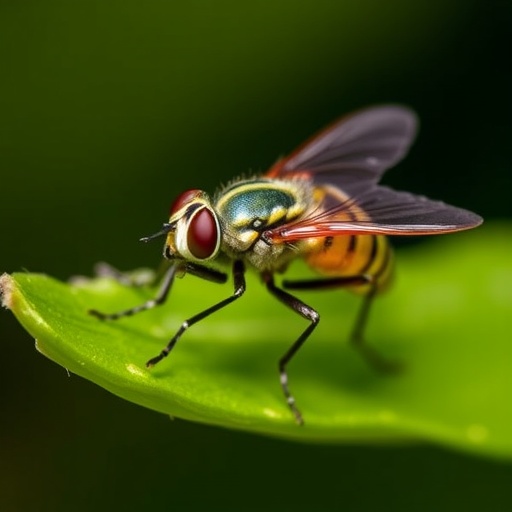
The intricate ballet of insect survival has long fascinated biologists, yet the precise genetic choreography that allows a tiny fruit fly to halt its own biological clock remains one of nature’s most compelling mysteries. Recently, a pioneering research team led by Professor Aya Takahashi at Tokyo Metropolitan University has pulled back the curtain on this phenomenon, known as reproductive diapause, revealing how these resilient organisms tune their development to survive the shifting seasons. By meticulously analyzing fruit fly populations across the Japanese archipelago, the researchers have identified a critical genetic link between the perception of time and the physiological decision to suspend reproduction. Their findings, published in the esteemed journal Molecular Ecology, offer a profound look into the evolutionary mechanics of adaptation, suggesting that the ability to survive winter is written deeply within the circadian machinery of the genome.
Reproductive diapause is far more than a simple pause in life; it is a sophisticated survival strategy where an organism actively delays its development to avoid unfavorable environmental conditions. While hibernation in mammals involves metabolic slowing, diapause in arthropods like the fruit fly Drosophila triauraria involves a complete arrest of reproductive organ growth. This biological “wait state” ensures that energy is conserved and that offspring are not brought into a world where food is scarce and temperatures are lethal. Understanding how a fly “knows” when to enter this state is vital for grasping how species migrate and occupy diverse climates. The Tokyo Metropolitan University team’s study highlights that this is not a one-size-fits-all binary switch but rather a highly calibrated sensory response that varies with geography and genetic inheritance.
The research journey took the team across the vast latitudinal range of Japan, from the chilly northern regions where winters are unforgiving to the subtropical southern islands where life moves at a different pace. By sampling Drosophila triauraria from these varied environments, they observed a striking correlation between the fly’s origin and its sensitivity to seasonal cues like day length and air temperature. In the north, flies exhibited an acute sensitivity to the shortening of days, entering diapause reliably as autumn approached to ensure survival. Conversely, their southern counterparts remained reproductively active even under short-day conditions, reflecting an evolutionary adaptation to environments where the threat of a harsh winter is significantly diminished or non-existent.
One of the most groundbreaking aspects of this study is its inclusion of male fruit flies, a demographic that is frequently overlooked in reproductive diapause research. Traditionally, scientists focused on female ovarian development as the primary indicator of diapause, but the Takahashi team chose a more holistic approach by examining how both sexes respond to environmental stressors. Their data revealed fascinating nuances, suggesting that males and females at mid-to-high latitudes might possess diverging life cycle sensitivities. This discovery implies that the evolutionary pressures acting on reproductive timing may differ between the sexes, leading to distinct physiological strategies for surviving the same climate. This gender-inclusive data set provides a much richer and more complex picture of insect ecology than previously documented.
To bridge the gap between observed behavior and biological cause, the researchers turned to the cutting-edge realm of genomics. They sequenced the genomes of 21 different fly strains, utilizing a “monophyletic window” approach to identify specific genetic variations associated with diapause. This rigorous method allowed them to filter through the noise of general genetic drift to pinpoint the actual drivers of adaptation. Their investigation led them straight to a gene known as timeless (tim), which is fundamentally involved in regulating the circadian rhythm, or the body’s internal 24-hour clock. This finding is revolutionary because it solidifies the connection between how an organism perceives the daily passage of time and how it makes long-term decisions about its seasonal life cycle.
The timeless gene acts as a molecular bridge, translating the external signal of changing day lengths into an internal command to halt reproductive development. By showing that variations in the expression of this gene correspond with the latitudinal differences in diapause sensitivity, the team has provided a concrete molecular basis for ecological adaptation. This adds significant weight to the growing scientific theory that the genes governing biological rhythms are the same ones that allow animals to survive seasonal extremes. It suggests that the clock that tells a fly when to wake up is the same clock that tells it when to stop aging and wait for spring, showcasing a remarkable efficiency in genetic design and evolutionary recycling.
Beyond the immediate scope of fruit flies, this research holds profound implications for how we understand the impacts of climate change on biodiversity. As global temperatures shift and seasonal boundaries become blurred, the finely tuned relationship between day length and temperature—which these flies rely on—may be disrupted. If the timeless gene or its regulatory pathways cannot adapt as quickly as the climate changes, many species may find themselves entering diapause too late or not at all, leading to catastrophic population collapses. By mapping the genetic architecture of these survival traits, the Tokyo Metropolitan University team is providing the baseline data needed to predict which species might thrive and which might perish in a rapidly warming world.
The technical precision of the “monophyletic window” approach used by the team represents a significant leap forward in evolutionary genomics. By focusing on genetic lineages rather than just individual mutations, they were able to handle smaller sample sizes with greater statistical confidence. This methodology is likely to become a standard in the field, allowing other researchers to investigate complex traits in species that are difficult to breed or capture in large numbers. The success of this study demonstrates that even in the age of big data, a targeted and intellectually rigorous approach can uncover the specific genes responsible for some of the most complex behaviors in the animal kingdom.
The study also serves as a reminder of the incredible complexity found within a creature as small as a fruit fly. These insects are not merely passive victims of their environment; they are highly sophisticated biological machines equipped with genetic sensors that rival human technology. The ability of Drosophila triauraria to integrate multiple environmental variables—day length, temperature, and latitudinal signals—into a single developmental decision is a feat of natural engineering. This research elevates our appreciation for the subtle ways in which life persists under pressure, reminding us that even the smallest fly carries within its DNA a map of the world and a clock that has been ticking for millions of years.
As we look toward the future of entomological and ecological research, the work of Professor Takahashi and her team provides a beacon for new inquiries into the molecular basis of survival. The identification of the timeless gene as a key player in diapause is likely just the beginning of a much larger story involving a network of genes that interact to sustain life. There is still much to learn about how these genetic signals are processed by the nervous system and converted into the hormonal changes that physically stop an organ from growing. Every answer provided by this study opens up a dozen new questions, fueling the drive to explore the unseen world of genetic triggers and environmental responses.
In conclusion, this research from Tokyo Metropolitan University stands as a testament to the power of combining traditional field ecology with modern genomic sequencing. By looking at the big picture of Japanese geography and the microscopic detail of the timeless gene, the team has bridged the gap between the landscape and the cell. Their work ensures that the fruit fly remains at the forefront of genetic research, serving as a vital model for understanding how all life on Earth anticipates the future. Whether it is a fly in a Japanese forest or a bird migrating across continents, the fundamental mechanisms of survival are being slowly but surely unraveled by such dedicated scientific inquiry.
This study was made possible through the support of JSPS KAKENHI grants, illustrating the importance of sustained investment in basic biological research. As the scientific community digests these findings, the focus will undoubtedly shift toward finding similar genetic pathways in other insects, potentially even pests or pollinators whose survival is critical to human agriculture. The story of the fruit fly’s diapause is not just a story about an insect; it is a story about the resilience of life and the elegant genetic codes that make that resilience possible. The “timeless” mystery of how life waits for the perfect moment to bloom is now one step closer to being fully understood.
Subject of Research: Reproductive diapause and genetic adaptation in Drosophila triauraria
Article Title: Geographic Divergence and the Genomic Basis of Reproductive Diapause in Drosophila triauraria
News Publication Date: 30-Jan-2026
Web References: http://dx.doi.org/10.1111/mec.70251
References: Molecular Ecology (2026); JSPS KAKENHI Grant Numbers 23K27221, 24KJ0181, 22H05073, 22KJ2552
Image Credits: Tokyo Metropolitan University
Keywords: Evolutionary biology, Insect physiology, Reproductive biology, Genomics, Biogeography, Entomology, Biological rhythms, Ecological adaptation
Tags: circadian biology in fruit fliesenvironmental influences on insect developmentevolutionary biology and adaptationfruit fly survival strategiesgenetic adaptation in Drosophilamolecular ecology of fruit fliespatterns of insect longevityphysiological responses to environmental changesreproductive diapause in insectsseasonal adaptation mechanismssurvival strategies in changing climatesTokyo Metropolitan University research