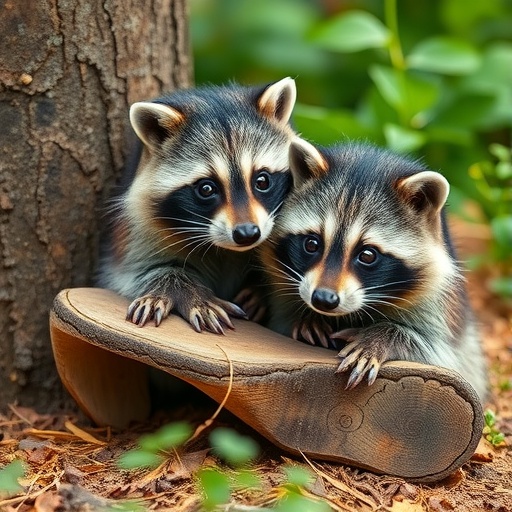
In the bustling urban landscapes of cities like Vancouver, raccoons have long been notorious for their ability to infiltrate compost bins and effortlessly unlock seemingly secured containers. Beyond mere opportunistic scavenging, new research conducted by scientists at the University of British Columbia (UBC) reveals that these masked foragers exhibit a deeper cognitive engagement with their environment, characterized by genuine curiosity and complex problem-solving skills. Published in the prestigious journal Animal Behaviour, this groundbreaking study challenges the traditional perception of raccoons as purely food-driven opportunists and introduces a novel perspective on their intrinsic motivation to seek information.
The study, led by UBC researchers Hannah Griebling and Dr. Sarah Benson-Amram, employed a sophisticated multi-access puzzle box designed with nine distinct access mechanisms, ranging from simple latches and sliding doors to more challenging knobs. Each puzzle box was baited with a single marshmallow, providing a limited food reward for the raccoons during 20-minute observational trials. Remarkably, even after the marshmallow was consumed, raccoons persisted in manipulating the puzzle box to unlock additional entry points, demonstrating behaviour not motivated by hunger but by an inherent drive to explore and acquire information—a phenomenon termed “information foraging.”
This intrinsic motivation to continue solving complex tasks beyond immediate sustenance suggests that raccoons possess a flexible and strategic problem-solving toolkit. Griebling elaborates that the raccoons’ continued interaction with the puzzle box, despite the absence of further tangible rewards, signifies an advanced level of cognitive engagement that parallels exploratory behaviours observed in other intelligent species. In essence, these animals optimize their foraging strategies to include not just caloric intake but also the acquisition of knowledge about their environment, which may contribute to their remarkable adaptability in urban settings.
One of the particularly intriguing findings of the study relates to how raccoons balance exploration and exploitation—two fundamental components of decision-making theory. When presented with relatively easy mechanisms, raccoons explored widely, experimenting with many different openings and varying the sequence of attempts. However, as the complexity and associated risk of failure increased, they shifted toward a more conservative approach, favoring more reliable and familiar solutions while still engaging in some degree of exploration. This reflects a classic trade-off observed in cognitive science, where agents weigh the potential benefits of seeking new information against the costs or risks it may entail.
Griebling draws a compelling analogy to human decision-making, comparing raccoons’ strategies to the choices people make when ordering at a restaurant. Faced with a menu, one might choose a known favorite dish or opt to try something new, balancing the desire for discovery with the potential risk of a less enjoyable experience. Similarly, raccoons modulate their problem-solving approach based on perceived difficulty and potential reward, demonstrating an adaptive capacity to optimize behaviour under varying environmental pressures. This insight not only deepens our understanding of animal cognition but also contributes to broader discussions on the universality of exploration-exploitation dynamics across species.
The study’s emphasis on the raccoons’ manual dexterity provides additional layers of understanding regarding their ecological success in urban landscapes. Raccoons’ forepaws, densely innervated with sensory receptors originally evolved for foraging in aquatic habitats, are remarkably well-suited for manipulating complex mechanisms such as latches and handles – often the same types used by humans on trash bins and storage compartments. This anatomical specialization, combined with cognitive flexibility, affords raccoons a significant adaptive advantage in navigating and exploiting anthropogenic environments, which are characterized by novel challenges and opportunities.
Moreover, the research team notes that Vancouver’s unique urban ecosystem – with its mosaic of greenspaces, accessible waterways, and a relatively tolerant human population – creates an ideal habitat where raccoons can deploy these cognitive and physical skills effectively. Their ability to solve puzzles for the sake of information, rather than immediate nutritional gain, suggests a sophisticated behavioral ecology that enables them to thrive in cities. This intelligence likely facilitates access to a diverse array of food sources, including those secured behind complex containment systems, thereby enhancing their survival and reproductive success.
Despite the experiment being conducted on captive raccoons housed in a research facility in Colorado, the researchers cautiously suggest the results likely generalize to wild populations. Previous field observations have documented similar problem-solving behaviors, although the captive environment allows for controlled evaluation of specific cognitive traits. The work highlights the importance of empirical research in illuminating behaviors traditionally relegated to folklore and anecdote, placing raccoons firmly on the map as a subject for serious cognitive ethology.
Dr. Sarah Benson-Amram emphasizes the significance of this study in establishing a scientific basis for understanding raccoon intelligence, which has long been acknowledged in folklore but remained underexplored scientifically. She points out that recognizing such cognitive capacities in raccoons opens new avenues for comparative studies on innovation and information-seeking across taxa. Furthermore, understanding the mechanisms underpinning urban adaptability in species like raccoons offers practical insights for managing wildlife-human interactions, a growing concern in many metropolitan areas worldwide.
The implications of raccoons’ information-foraging behavior extend beyond academic curiosity and have potential applications in wildlife management and conservation. As urban environments continue to expand and human-wildlife interfaces become more complex, insights into how animals strategize to navigate anthropogenic landscapes can inform mitigation strategies. For example, species such as bears, which are also known for their problem-solving abilities related to human food resources, might benefit from management approaches informed by this raccoon study, ultimately reducing human-animal conflicts.
This research contributes a compelling narrative to the broader field of animal cognition, illustrating how exploration and exploitation trade-offs manifest in a species renowned for its urban adaptability. The study’s integration of behavioral ecology, neuroethology, and urban wildlife management exemplifies the interdisciplinary nature of contemporary animal behaviour research. By framing raccoon intelligence in the context of optimal foraging theories and decision-making frameworks, the findings resonate with both scientific and public audiences, promising to ignite interest and further study.
In conclusion, the UBC study illuminates the cognitive sophistication underlying raccoons’ seemingly mischievous behaviour, revealing a deliberate and adaptive information-foraging strategy that transcends simple hunger-driven actions. Their capacity to navigate complex tasks, modulate risk exposure, and persist in problem-solving positions raccoons as notable urban survival experts. This research not only enriches our understanding of animal intelligence but also underscores the nuanced relationships between wildlife and the rapidly evolving urban ecosystems they inhabit.
Subject of Research: Animals
Article Title: Raccoons optimally forage for information: exploration–exploitation trade-offs in innovation
News Publication Date: 1-Apr-2026
Web References: http://dx.doi.org/10.1016/j.anbehav.2026.123491
Image Credits: Photo credit: Hannah Griebling
Keywords: Animal learning, Animal psychology, Exploration-exploitation trade-off, Urban wildlife cognition, Problem-solving, Information foraging, Behavioral ecology
Tags: animal behavior and cognitionanimal curiosity researchanimal problem solvinginformation foraging in wildlifeintrinsic motivation in animalsmulti-access puzzle box studynon-food driven animal behaviorpuzzle-solving in mammalsraccoon cognitive skillsraccoons in urban environmentsUniversity of British Columbia wildlife studyurban raccoon behavior