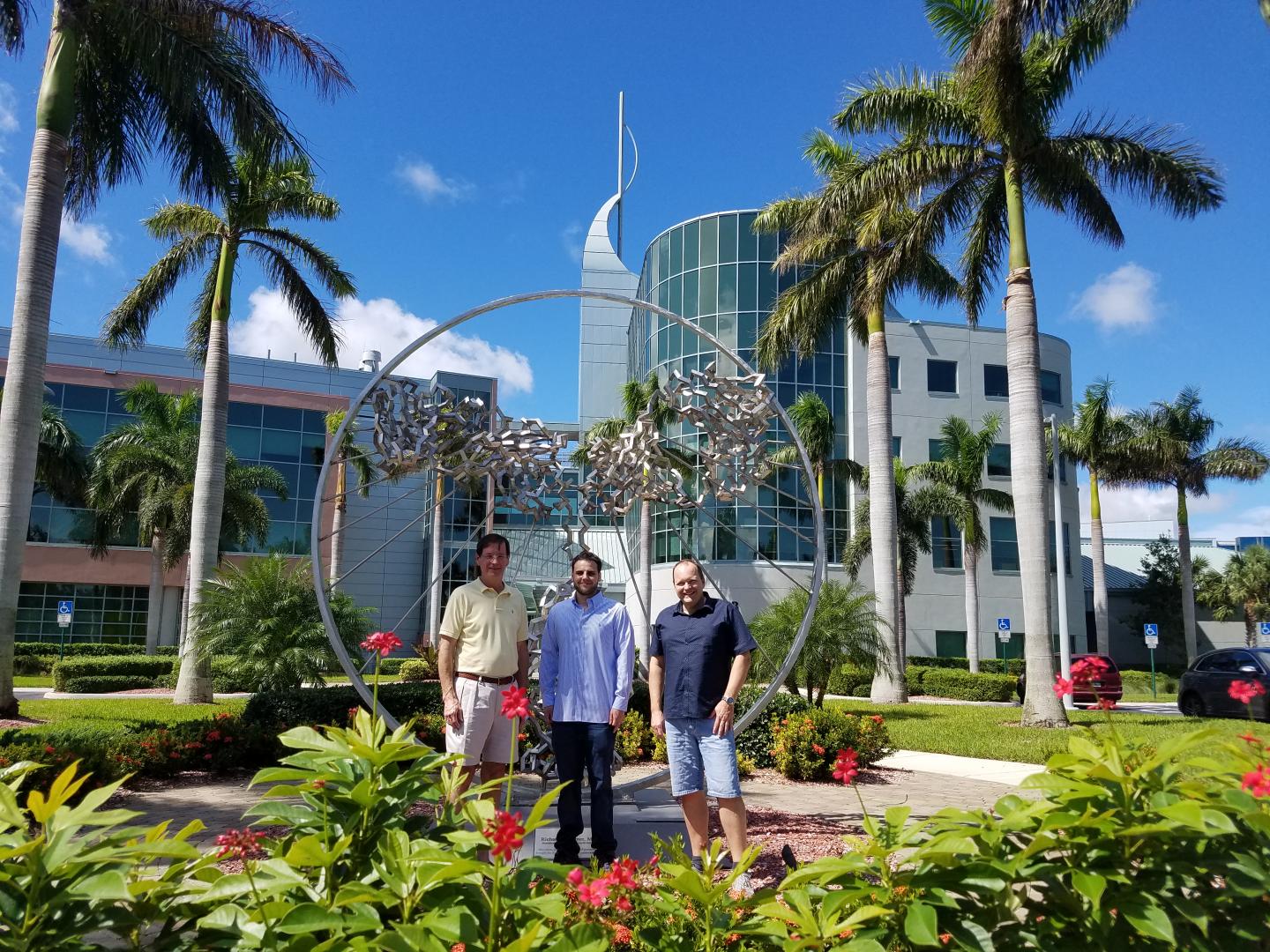
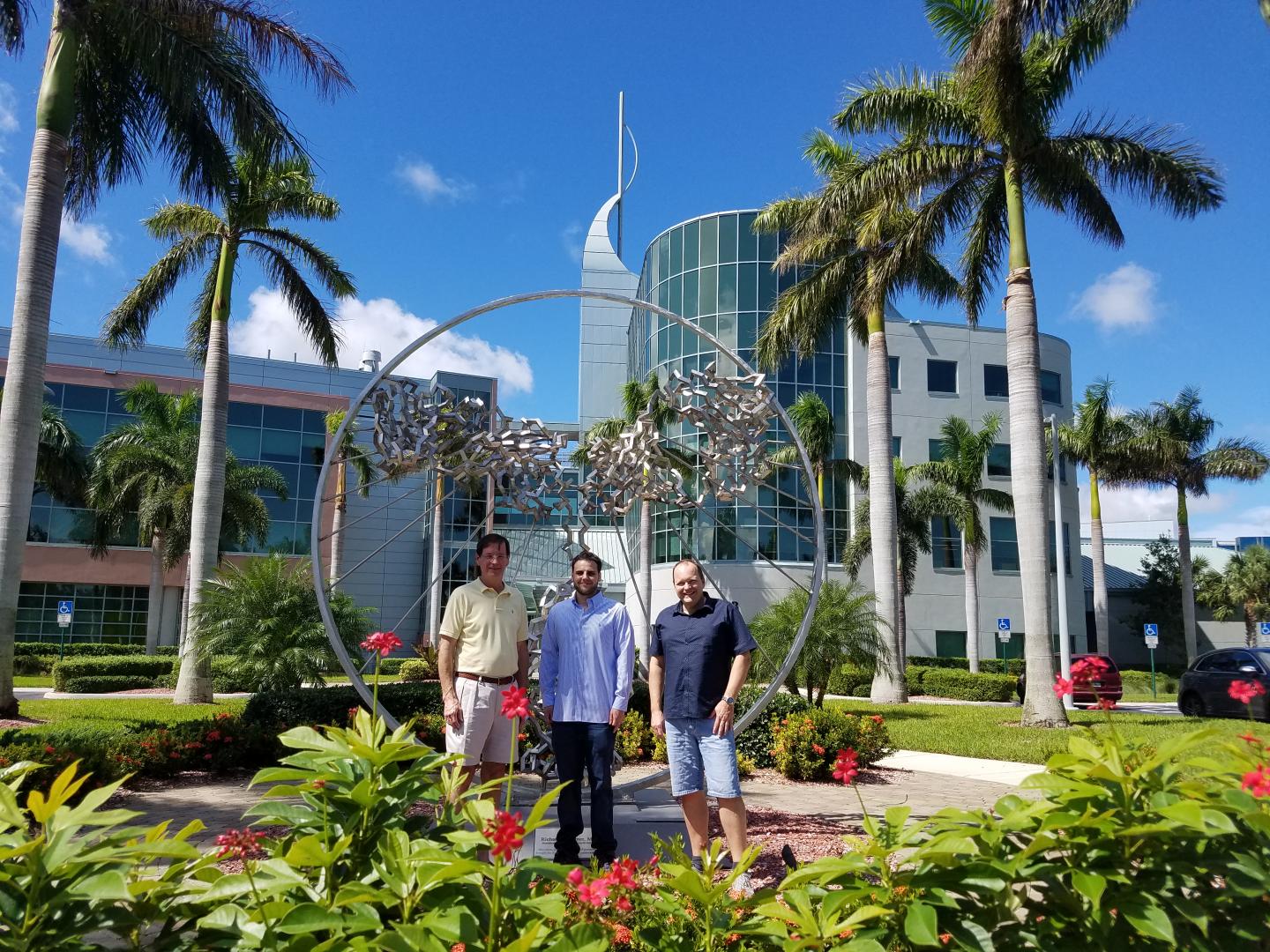
Credit: The Scripps Research Institute
JUPITER, FL – October 24, 2017 – Scientists from the Florida campus of The Scripps Research Institute (TSRI) have created a new class of antibody-drug conjugates (ADCs), using a versatile "double decker" technology that ties antibodies and a drug together to produce highly potent pharmaceuticals for cancer therapy.
The new ADC technology advances a class of pharmaceuticals that use antibodies to selectively deliver drugs to cancer cells without harming healthy cells and tissues.
The study, published online today in the journal Nature Communications, was led by TSRI Associate Professor Christoph Rader and TSRI Professor William R. Roush.
"Our new ADCs are built something like a double-decker bus," Rader said. "The upper deck is a targeting antibody that locks onto a cancer cell, while the lower deck is a catalytic antibody that carries the drug. This is yet another exciting application of an incredibly versatile class of catalytic antibodies originally developed by TSRI's Carlos F. Barbas III and Richard A. Lerner in the 1990s."
The name for this new technology is dual variable domain antibody-drug conjugates or DVD-ADCs.
Antibodies are large immune system proteins that recognize unique molecular markers on cancer cells called tumor antigens. On their own, antibodies are usually not potent enough to eradicate cancer. However, their high specificity for tumor antigens makes them ideal vehicles for drug delivery straight to cancer cells.
The new DVD-ADCs were used against HER2-driven breast cancer, as well as multiple myeloma and non-Hodgkin lymphoma, and the technology proved highly effective against all three types of cancers in both cell and animal model studies.
Not only is the new technology highly efficient, Rader explained, but it uses a modular assembly so it's relatively simple to apply to different cancers and possibly to other diseases.
"The advantage is we can produce ADCs at a fast rate in a single step," said Graduate Student Alex Nanna, first author of the study. "The DVD-ADC format brings everything together in a very efficient way."
The DVD-ADCs take advantage of an unusually reactive amino acid residue, a natural lysine of the catalytic antibody. "We can tie drugs with high precision and stability to this residue and, what's more, we can use it to monitor attachment because the antibody loses its catalytic activity when the drug attaches to the lysine. It's a very clean and unique way to confirm successful ADC formation," Rader said.
The technology also eliminates the need to purify the antibody during initial production, postponing that process until the ADC is assembled. "From a manufacturing point of view, this is a substantial advantage." Rader said.
There are currently only four FDA-approved ADCs for cancer therapy, of which two have been added this year alone.
"There is new excitement in this field," Rader said. "One ADC was recently approved in acute lymphoblastic leukemia and there's a rich clinical and preclinical pipeline."
In addition to Rader, Roush and Nanna, other authors of the study, "Harnessing a catalytic lysine residue for the one-step preparation of homogeneous antibody-drug conjugates," include TSRI's Xiuling Li (now with Pfizer), Even Walseng (now with the National Cancer Institute), Lee Pedzisa and Rebecca S. Goydel; and David Hymel and Terrence R. Burke Jr. of the National Cancer Institute.
###
The study was supported by the National Institutes of Health (grant U01 CA174844), the Klorfine Foundation, the Holm Charitable Trust, the Celia Lipton Farris and Victor W. Farris Foundation and the Division of Medicinal Chemistry of the American Chemical Society.
About The Scripps Research Institute
The Scripps Research Institute (TSRI) is one of the world's largest independent, not-for-profit organizations focusing on research in the biomedical sciences. TSRI is internationally recognized for its contributions to science and health, including its role in laying the foundation for new treatments for cancer, rheumatoid arthritis, hemophilia, and other diseases. An institution that evolved from the Scripps Metabolic Clinic founded by philanthropist Ellen Browning Scripps in 1924, the institute now employs more than 2,500 people on its campuses in La Jolla, CA, and Jupiter, FL, where its renowned scientists–including two Nobel laureates and 20 members of the National Academies of Science, Engineering or Medicine–work toward their next discoveries. The institute's graduate program, which awards PhD degrees in biology and chemistry, ranks among the top ten of its kind in the nation. In October 2016, TSRI announced a strategic affiliation with the California Institute for Biomedical Research (Calibr), representing a renewed commitment to the discovery and development of new medicines to address unmet medical needs. For more information, see http://www.scripps.edu.
Media Contact
Stacey Singer DeLoye
[email protected]
561-228-2551
@scrippsresearch
http://www.scripps.edu
Related Journal Article
http://dx.doi.org/10.1038/s41467-017-01257-1