• HOME
  • NEWS
  • EXPLORE
    • CAREER
      • Companies
      • Jobs
    • EVENTS
    • iGEM
      • News
      • Team
    • PHOTOS
    • VIDEO
    • WIKI
  • BLOG
  • COMMUNITY
    • FACEBOOK
    • INSTAGRAM
    • TWITTER
Wednesday, April 1, 2026
BIOENGINEER.ORG
No Result
View All Result
  • Login
  • HOME
  • NEWS
  • EXPLORE
    • CAREER
      • Companies
      • Jobs
        • Lecturer
        • PhD Studentship
        • Postdoc
        • Research Assistant
    • EVENTS
    • iGEM
      • News
      • Team
    • PHOTOS
    • VIDEO
    • WIKI
  • BLOG
  • COMMUNITY
    • FACEBOOK
    • INSTAGRAM
    • TWITTER
  • HOME
  • NEWS
  • EXPLORE
    • CAREER
      • Companies
      • Jobs
        • Lecturer
        • PhD Studentship
        • Postdoc
        • Research Assistant
    • EVENTS
    • iGEM
      • News
      • Team
    • PHOTOS
    • VIDEO
    • WIKI
  • BLOG
  • COMMUNITY
    • FACEBOOK
    • INSTAGRAM
    • TWITTER
No Result
View All Result
Bioengineer.org
No Result
View All Result
Home NEWS Science News Chemistry

New record: 3D-printed optical-electronic integration

Bioengineer by Bioengineer
June 13, 2019
in Chemistry
Reading Time: 2 mins read
0
IMAGE
Share on FacebookShare on TwitterShare on LinkedinShare on RedditShare on Telegram

IMAGE

Credit: ©Science China Press

Optoelectronic integration offers a promising strategy to simultaneously obtain the merits of electrons and photons when they serve as information carriers, including high-density communication and high-speed information processing, paving the way for the next-generation integrated circuits (ICs). The ever-increasing demand on bandwidth and information density in ICs call for the micro/nano functional devices capable of being fabricated in three-dimensional (3D) ICs, which is desirable for their improved performance in data processing under lower consumption. In such highly integrated circuits, however, selective electrical modulation of specific micro/nanoscale optical devices, including light sources and waveguides, is a key requirement for yielding more functional and more compact integrated elements, but hindered by the normal used nonlinearity found in electro-optic materials.

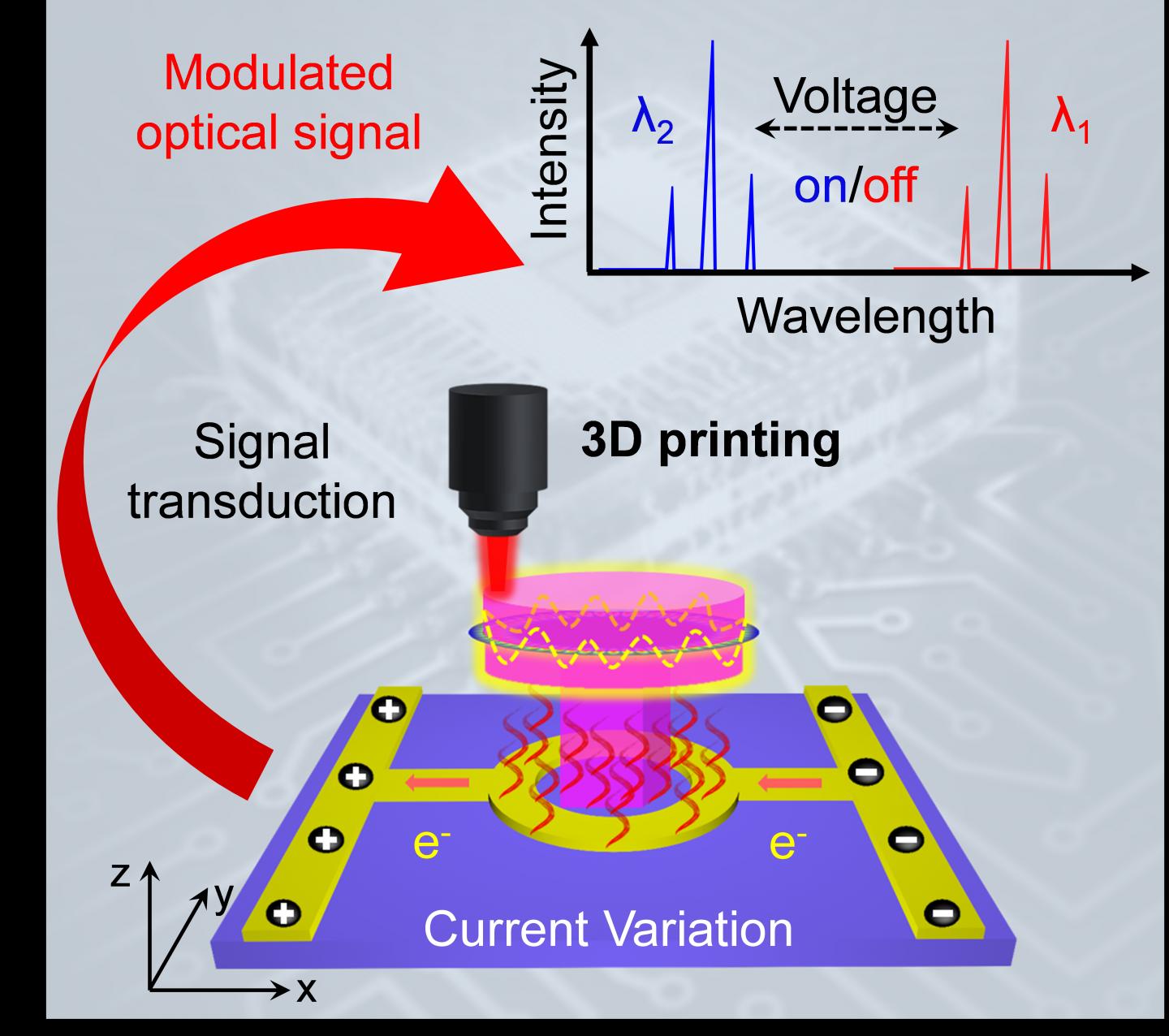
Femtosecond laser direct writing (FsLDW), as one of the 3D printing techniques, enables the direct and addressable construction of 3D-integrated optoelectronic devices utilizing organic compounds with two-photon polymerized features. With doping flexibility, the polymerized microstructures can be readily incorporated with organic dye molecules to produce functional devices, like coherent laser sources. Besides, organic polymers possess excellent responsiveness to external stimuli, including temperature. Their large thermo-optic coefficient enables the realization of the electrical tuning of resonant wavelength with high efficiency when they are fabricated into microcavity structures. The incorporation of thermo-responsive polymeric microlaser with underneath electrical microheater in the 3D fabrication manner can be used as an effective hybrid microlaser module with selective electric modulation towards optical-electronic integration.

Very recently, Professor Yong Sheng Zhao’s group in the Institute of Chemistry, Chinese Academy of Sciences demonstrated an in situ electrically modulated microlaser module based on 3D-printed dye-doped polymeric microdisks, which is published in Science China Chemistry.

The thermo-optic effect of the polymer matrix enabled the tuning of lasing modes from the microdisk upon heating. The shape designability of FsLDW allows the fabrication of higher-level microstructures to manipulate light signals, including the waveguide coupled microdisks for light remote control and the coupled double-microdisk resonators for laser mode selection. The latter microstructure was further integrated with an underneath electrical microheater.

As a result, the cavity resonant wavelength can be shifted on the basis of resistance heating controlled optical length change through the thermo-optic effect of polymeric matrix material, which enabled an electrical modulation of the output wavelength of the 3D-printed microlaser module.

###

This work was supported financially by the Ministry of Science and Technology of China (Grant No. 2017YFA0204502), and the National Natural Science Foundation of China (Grant Nos. 21533013 and 21790364).

See the article: Liu Y, Lin X, Wei C, Zhang C, Yao J, Zhao YS. 3D-printed optical-electronic integrated devices. Sci. China Chem., 2019, DOI: 10.1007/s11426-019-9503-0.
https://doi.org/10.1007/s11426-019-9503-0

Media Contact
Zhao Yong Sheng
[email protected]

Related Journal Article

http://dx.doi.org/10.1007/s11426-019-9503-0

Tags: Chemistry/Physics/Materials Sciences
Share13Tweet8Share2ShareShareShare2

Related Posts

Creating Desktop Particle Accelerators to Open New Frontiers in Scientific Research

Creating Desktop Particle Accelerators to Open New Frontiers in Scientific Research

April 1, 2026
Photochargeable Semiconductor Powers Efficient Amine Coupling

Photochargeable Semiconductor Powers Efficient Amine Coupling

April 1, 2026

From Cells to Smart Gels: Advancing Frontiers in Motion Science

March 31, 2026

Tides Amplify Biochar’s Carbon Capture Efficiency in Coastal Wetlands

March 31, 2026
Please login to join discussion

POPULAR NEWS

  • blank

    Revolutionary AI Model Enhances Precision in Detecting Food Contamination

    96 shares
    Share 38 Tweet 24
  • Imagine a Social Media Feed That Challenges Your Views Instead of Reinforcing Them

    1006 shares
    Share 398 Tweet 249
  • Promising Outcomes from First Clinical Trials of Gene Regulation in Epilepsy

    51 shares
    Share 20 Tweet 13
  • Popular Anti-Aging Compound Linked to Damage in Corpus Callosum, Study Finds

    43 shares
    Share 17 Tweet 11

About

We bring you the latest biotechnology news from best research centers and universities around the world. Check our website.

Follow us

Recent News

Cutting-Edge “Smart” Drugs Revolutionize Cancer Treatment

KIST-IAE Collaborative Team Surpasses Performance Limits in Lithium-Air Batteries with Innovative Two-Dimensional Catalyst

Brain Metastases Show Unique Macrophage Spatial Patterns

Subscribe to Blog via Email

Enter your email address to subscribe to this blog and receive notifications of new posts by email.

Join 78 other subscribers
  • Contact Us

Bioengineer.org © Copyright 2023 All Rights Reserved.

Welcome Back!

Login to your account below

Forgotten Password?

Retrieve your password

Please enter your username or email address to reset your password.

Log In
No Result
View All Result
  • Homepages
    • Home Page 1
    • Home Page 2
  • News
  • National
  • Business
  • Health
  • Lifestyle
  • Science

Bioengineer.org © Copyright 2023 All Rights Reserved.