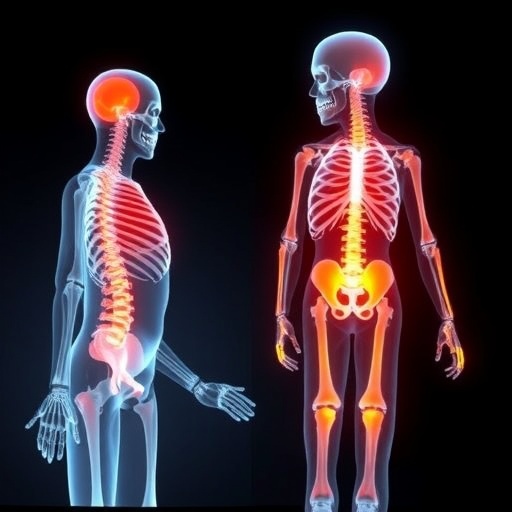
In a groundbreaking advancement that could transform osteoporosis screening among aging populations, researchers have unveiled a newly developed and rigorously validated risk-assessment model tailored specifically for older Chinese adults. Published in the prestigious journal BMC Geriatrics, this model is the culmination of a large-scale retrospective study aiming to bridge critical gaps in the prediction and early diagnosis of osteoporosis, a silent yet debilitating skeletal disease disproportionately affecting the elderly.
Osteoporosis, characterized by weakened bones and an increased risk of fractures, presents a significant health burden worldwide, with China facing a particularly steep demographic challenge due to its rapidly aging population. Current predictive tools, largely developed in Western contexts, often lack the accuracy or cultural relevance when applied to Chinese seniors, highlighting an urgent need for regionally appropriate assessment frameworks. The research team led by Xu, Ni, Zhang, and their colleagues responded to this necessity by analyzing vast quantities of patient data to create a model that could reliably estimate individual risk profiles.
Their retrospective dataset, one of the largest ever assembled in this field, provided a robust foundation for the model’s creation. By mining electronic health records, demographic information, and clinical outcomes of thousands of older adults, the team was able to identify key risk factors uniquely predictive of osteoporosis within this demographic. These variables include not only conventional indicators such as age and sex, but also nuanced lifestyle and biochemical markers influenced by regional dietary habits, genetic predispositions, and environmental exposures.
The model leverages advanced statistical techniques and machine learning algorithms to weigh each risk factor’s contribution dynamically, offering a personalized risk score rather than a one-size-fits-all assessment. This allows practitioners to pinpoint individuals at high risk with unprecedented precision, enabling targeted preventative interventions such as lifestyle modification guidance, pharmacological treatments, and bone density monitoring. This approach stands in stark contrast to the blunt screening methods often employed, which can lead to overtesting or missed diagnoses.
Validation of the model was a critical component of the research design. The team rigorously tested its predictive power through multiple independent cohorts, confirming consistency and robustness across diverse Chinese subpopulations. Sensitivity and specificity metrics surpassed those of existing models, reflecting enhanced accuracy in classifying patients who later developed osteoporosis. This level of validation underpins the model’s strong potential for clinical deployment.
From a technical standpoint, the study illustrates the powerful synergy achievable by integrating large-scale real-world data with contemporary computational methods. The researchers meticulously curated data inputs to address confounding factors and applied cross-validation strategies to mitigate overfitting risks. Moreover, feature selection was optimized through iterative refinement, ensuring that only variables with significant predictive value were retained. Such methodological rigor ensures the model’s generalizability beyond the initial datasets.
The clinical implications of this work are profound. Early and accurate risk assessment is vital in osteoporosis care because the disease often advances silently until fractures occur, sometimes with devastating consequences, including loss of mobility and independence. A reliable screening tool allows healthcare providers to initiate preventive measures at much earlier stages, ultimately reducing fracture incidence, healthcare costs, and improving quality of life among elderly populations.
Furthermore, this research contributes indirectly to the growing field of personalized medicine. By acknowledging heterogeneity within the Chinese older adult population and designing a model tailored to its specific risk landscape, the study exemplifies how genetic, environmental, and lifestyle diversity can be harnessed to create more effective health interventions. Such approaches will be indispensable as global societies grapple with aging demographics and chronic disease burdens.
Functionally, the model’s implementation can be integrated into existing clinical workflows via electronic health systems, enabling seamless risk calculations during routine check-ups. The user-friendly algorithm can be employed by general practitioners and specialists alike, democratizing osteoporosis screening accessibility. Additionally, it opens avenues for developing companion digital tools like mobile applications that empower individuals to self-assess risk, fostering proactive health behavior.
Given the model’s success, future research directions include prospective longitudinal studies to monitor its predictive validity over time and explore its adaptability in other East Asian populations with similar genetic and environmental contexts. Exploring integration with bone mineral density scan data and biomarkers for even finer risk categorization might also enhance its utility.
The research team acknowledges limitations typical of retrospective analyses, such as potential biases inherent in electronic health records and the need for continual model updates as environmental and population health dynamics evolve. However, the transparent methodology and detailed reporting encourage replication and refinement in varied clinical settings.
In summary, this cutting-edge osteoporosis risk-assessment model represents a pivotal step forward in geriatric medicine for China, embedding advanced data analytics within culturally attuned healthcare practices. Its potential to identify high-risk individuals early, streamline clinical decision-making, and ultimately reduce osteoporosis-related morbidity and mortality, positions it at the forefront of age-related disease management innovation. The study reinforces how precision health tools, underpinned by big data, can tackle some of the most pressing challenges posed by population aging worldwide.
By addressing an unmet need with scientific rigor and technological sophistication, Xu, Ni, Zhang, and colleagues have provided an invaluable resource for clinicians, researchers, and public health policymakers dedicated to enhancing the lives of older adults. Their contribution heralds a new era in osteoporosis care, driven by personalized risk modeling and large-scale data integration, with far-reaching implications beyond China’s borders.
Subject of Research: Osteoporosis risk assessment and prediction in Chinese older adults
Article Title: Development and validation of an osteoporosis risk-assessment model for Chinese older adults: a large-scale retrospective study
Article References:
Xu, M., Ni, X., Zhang, Lx. et al. Development and validation of an osteoporosis risk-assessment model for Chinese older adults: a large-scale retrospective study. BMC Geriatr (2026). https://doi.org/10.1186/s12877-026-07423-9
Image Credits: AI Generated
Tags: aging population bone healthculturally relevant osteoporosis modelselectronic health records osteoporosisfracture risk elderly Chinesegeriatric bone disease risklarge-scale osteoporosis researchosteoporosis demographic challenges Chinaosteoporosis early diagnosis Chinaosteoporosis prediction toolsosteoporosis risk assessment model Chinaosteoporosis screening elderly Chineseretrospective study osteoporosis China