


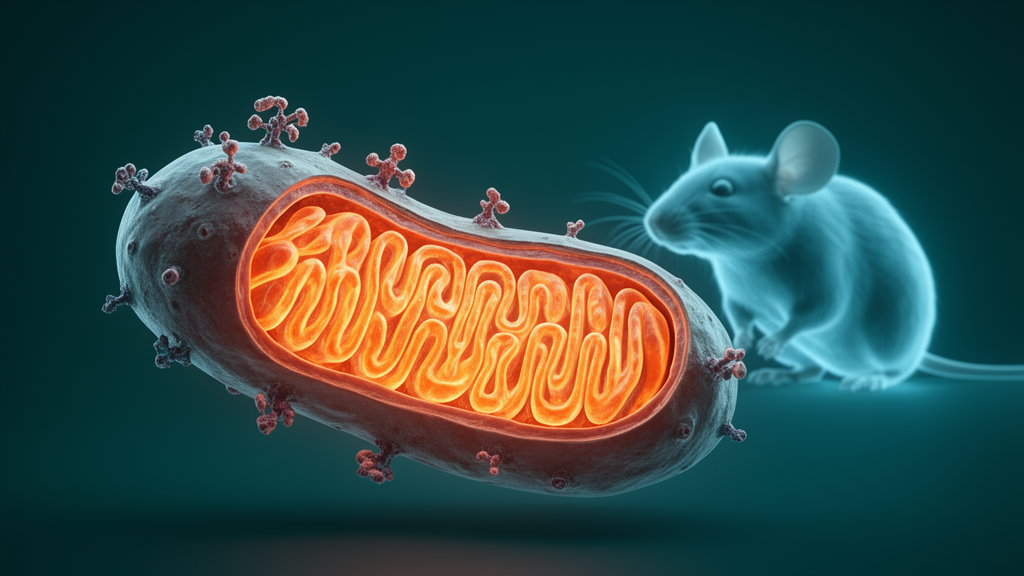
Scientists have created the first living animal model of a rare and severe mitochondrial disease, and the results are already reshaping how researchers think about the disorder. A knock-in mouse carrying the recurrent human RMND1 mutation p.(Asn238Ser) develops a devastating multisystem illness marked by stunted growth, heart failure, kidney dysfunction and premature death between 25 and 90 days of life.
RMND1 is a highly conserved protein of unknown function whose molecular role remains incompletely understood. Bi-allelic pathogenic variants in the gene have been reported in more than 50 patients, who present either with severe neonatal encephalopathy featuring seizures, hypotonia, deafness and lactic acidosis, or with a childhood-onset multisystem disease involving failure to thrive, developmental delay, sensorineural hearing loss, cardiac problems such as bradycardia and cardiomyopathy, and kidney disease. Patient muscle biopsies and fibroblasts typically show combined oxidative phosphorylation defects or isolated complex IV deficiency. Until now, however, the lack of a relevant animal model has left the protein’s physiological role poorly defined.
To build the model, researchers introduced the c.713 A>G mutation, which changes asparagine 238 to serine, into mouse embryonic stem cells by homologous recombination and bred the animals onto a C57BL/6J background. When heterozygous carriers were crossed, only 15 percent of pups were homozygous mutants, far below the expected Mendelian ratio, and litters were unusually small, pointing to embryonic lethality. The mutant pups that were born weighed the same as wild-type littermates during the first week of life, but after postnatal day 7 they fell dramatically behind. Fewer than half survived to weaning, and the survivors remained severely growth-retarded.
At 22 days of age, the mutant animals showed clear signs of multisystem disease. Echocardiography revealed severe bradycardia with reduced stroke volume, diastolic volume and cardiac output, a picture consistent with heart failure. Blood chemistry told a parallel story: blood urea nitrogen was significantly elevated, indicating kidney dysfunction, and alanine transaminase levels were raised, consistent with liver disease. Grip tests showed weaker front and hind limbs, although strength normalized when corrected for body weight, and open-field testing suggested mild limb muscle weakness.
The biochemical analysis exposed the depth of the energetic crisis inside the animals’ tissues. Complex I activity was significantly reduced in heart, muscle and brain; complex III activity fell in the liver; and complex IV activity dropped in every tissue examined except the brain. Western blotting confirmed reduced steady-state levels of complexes I, III and IV across most tissues, and blue-native PAGE of mutant hearts showed impaired assembly of complexes I and IV and of the supercomplexes containing them, with in-gel activity assays confirming reduced function of both enzymes.
The most novel findings came from quantitative proteomics on mutant hearts. The analysis revealed extensive metabolic remodeling and, strikingly, coordinated changes in mitoribosomal proteins: several proteins of the 39S large subunit, including uL16m, uL23m, uL29m, mL54 and mL63, were significantly decreased, whereas most detected proteins of the 28S small subunit were increased. Factors involved in mitoribosome assembly, maturation and quality control were also altered. Immunoblot validation confirmed the changes for uL16m, uL29m, mS25 and uS5m. Yet when the researchers ran sucrose-gradient sedimentation on mutant liver extracts, they found no gross redistribution of the large subunit, small subunit or 55S monosome markers, indicating that RMND1 dysfunction perturbs mitoribosomal protein homeostasis without blocking bulk subunit formation.
Similar, though tissue- and genotype-dependent, alterations appeared outside the heart. In mutant liver, all four examined mitoribosomal proteins were reduced when normalized to vinculin, but after correcting for the liver’s reduced mitochondrial content using the outer membrane marker VDAC, uL29m remained decreased while uS5m was significantly increased. Patient-derived fibroblasts carrying different RMND1 mutations showed variable changes in uS5m, mS40 and uL29m, and HeLa cells in which RMND1 was knocked down by roughly 40 percent also altered these proteins. Sucrose gradients in the human cell models likewise showed no significant redistribution, reinforcing the conclusion that RMND1 supports mitoribosomal protein balance and possibly late-stage maturation of the large subunit rather than being strictly required for particle assembly.
Proteomics flagged dysregulated cardiomyopathy pathways, and the GDF15/GH/IGF1 pathway was altered in the heart of the mutant mice. Gdf15 mRNA was significantly increased in heart, muscle and liver, and plasma GDF15 was elevated, while hepatic Igf1 expression and plasma IGF1 were both significantly reduced.
Consistent with activation of the mitochondrial integrated stress response, ATF4 protein was increased in heart and liver, while ATF5 was unexpectedly decreased in heart, muscle and liver. Proteomic analysis further revealed alterations in pathways related to oxidative stress and mitochondrial quality control in the mutant heart. The authors caution that the divergent ATF4 and ATF5 responses may reflect the rapid disease progression and the relatively late stage at which tissues were analyzed, and that direct measurements of mitochondrial translation in the mutant tissues will be needed to determine how much of the OXPHOS defect stems from impaired protein synthesis rather than enhanced turnover of misassembled respiratory chains.
The researchers conclude that RMND1 dysfunction compromises the accumulation and assembly of respiratory chain complexes and supercomplexes while disturbing the abundance and balance of mitoribosomal proteins in a tissue- and genotype-dependent manner.
Subject of Research: An in vivo knock-in mouse model of RMND1-related mitochondrial disease showing OXPHOS deficiency and altered mitoribosomal protein homeostasis.
Article Title: RMND1 dysfunction causes OXPHOS deficiency and alters mitoribosomal protein homeostasis in vivo
Article References: Pesini, A., Sanchez-Quintero, M. J., Lopez-Gomez, C., Barriocanal-Casado, E., Hidalgo-Gutierrez, A., Nyvltova, E., Rorbach, J., Kleiner, G., Ting, M. T., Garcia, C., Dec-Prat, L., Tanji, K., Damoci, C. B., McFarland, R., Taylor, R. W., Minczuk, M., Barrientos, A., & Quinzii, C. M. (2026). RMND1 dysfunction causes OXPHOS deficiency and alters mitoribosomal protein homeostasis in vivo. EMBO Molecular Medicine. https://doi.org/10.1038/s44321-026-00534-1
Image Credits: AI Generated
DOI: 10.1038/s44321-026-00534-1
Keywords: RMND1, mitochondrial disease, OXPHOS deficiency, mitoribosome, knock-in mouse model, respiratory chain, GDF15, IGF1, integrated stress response, cardiomyopathy, proteomics, mitochondrial translation
News Source: Juliet Wilcox. (October 28, 2026). New Mouse Model Reveals How RMND1 Mutations Disrupt Mitochondrial Energy Production. Scienmag.



