• HOME
  • NEWS
  • EXPLORE
    • CAREER
      • Companies
      • Jobs
    • EVENTS
    • iGEM
      • News
      • Team
    • PHOTOS
    • VIDEO
    • WIKI
  • BLOG
  • COMMUNITY
    • FACEBOOK
    • INSTAGRAM
    • TWITTER
Sunday, April 12, 2026
BIOENGINEER.ORG
No Result
View All Result
  • Login
  • HOME
  • NEWS
  • EXPLORE
    • CAREER
      • Companies
      • Jobs
        • Lecturer
        • PhD Studentship
        • Postdoc
        • Research Assistant
    • EVENTS
    • iGEM
      • News
      • Team
    • PHOTOS
    • VIDEO
    • WIKI
  • BLOG
  • COMMUNITY
    • FACEBOOK
    • INSTAGRAM
    • TWITTER
  • HOME
  • NEWS
  • EXPLORE
    • CAREER
      • Companies
      • Jobs
        • Lecturer
        • PhD Studentship
        • Postdoc
        • Research Assistant
    • EVENTS
    • iGEM
      • News
      • Team
    • PHOTOS
    • VIDEO
    • WIKI
  • BLOG
  • COMMUNITY
    • FACEBOOK
    • INSTAGRAM
    • TWITTER
No Result
View All Result
Bioengineer.org
No Result
View All Result
Home NEWS Science News Health

New method helps make orthotopic brain-tumor imaging clearer and faster

Bioengineer by Bioengineer
June 8, 2018
in Health
Reading Time: 2 mins read
0
Share on FacebookShare on TwitterShare on LinkedinShare on RedditShare on Telegram
IMAGE

Credit: ZHENG Hairong

Nowadays, tumors inside the complex central nervous system remain one of the most challenging cancers to diagnose.

Different from conventional brain-imaging techniques, nearinfrared (NIR) fluorescence imaging demonstrates particular merits including being nonhazardous, offering fast feedback, and having higher sensitivity.

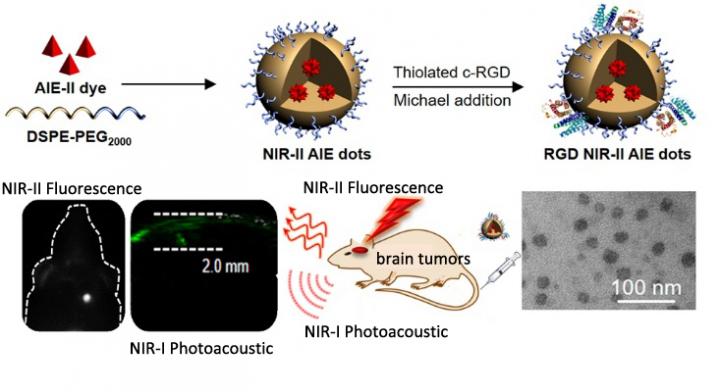
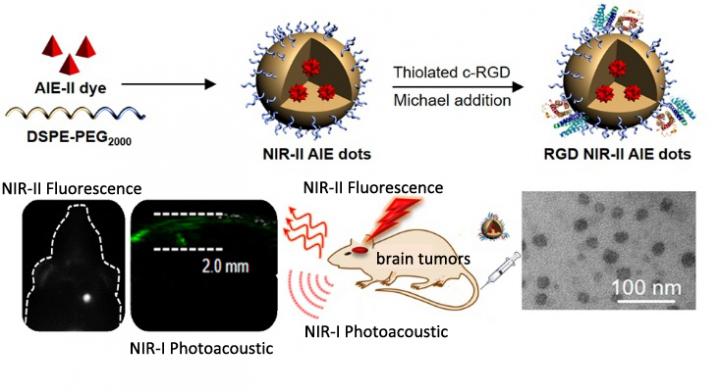
A research team led by Prof. ZHENG Hairong from the Shenzhen Institutes of Advanced Technology (SIAT) of the Chinese Academy of Sciences, in collaboration with Prof. LIU Bin from the University of Singapore, reported the first NIR-II fluorescent molecule with aggregation-induced-emission (AIE) characteristics for dual fluorescence and photoacoustic imaging. Their findings were published in Advanced Materials.

Fluorescence imaging in the second NIR window (NIR-II), compared with the first NIR window (NIR-I), exhibits salient advantages of deeper penetration and higher spatiotemporal resolution, owing to further reduced photon scattering, absorption, and tissue autofluorescence in biological tissues.

Scientists designed a new donor-acceptor (D-A)-tailored NIR-II emissive AIE molecule, and formulated dots showed a high NIR-II fluorescence quantum yield up to 6.2%, owing to the intrinsic aggregation-induced emission nature of the designed molecule.

The AIE dots have been successfully used for dual NIR-II fluorescence and NIR-I photoacoustic imaging for precise noninvasive brain-tumor diagnosis. Based on the same dots, the experiments revealed that NIR-II fluorescence imaging showed a high resolution.

Meanwhile, NIR-I PA imaging intrinsically exhibited higher penetration depth than that of NIR-II fluorescence imaging, which allowed clear delineation of tumor depth in the brain.

The synergetic bimodal imaging with targeting c-RGD-decorated bright AIE nanoparticles showed precise brain-tumor diagnosis with good specificity and high sensitivity, which yielded a high S/B of 4.4 and accurately assessed the depth of tumor location inside brain tissue.

The study demonstrates the promise of NIR-II AIE molecules and their dots in dual NIR-II fluorescence and NIR-I photoacoustic imaging for precise brain cancer diagnostics.

###

The research was supported by National Basic Research Program of China (973 Program), National Natural Science Foundation of China, Guangdong Province Magnetic Resonance Imaging and Multimode Systems Key Laboratory.

Media Contact

ZHANG Xiaomin
[email protected]
86-755-865-85299

http://english.cas.cn/

Original Source

http://english.cas.cn/ http://dx.doi.org/10.1002/adma.201800766

Share14Tweet8Share2ShareShareShare2

Related Posts

Machine Learning Identifies Fall Risk in Parkinson’s

April 12, 2026

SGLT2 Inhibitors Safe, Effective for Diabetes in Elderly

April 12, 2026

PPARs’ Impact on Diabetic Kidney Disease Development

April 12, 2026

Medication Literacy Tool Developed for Older Chinese Patients

April 12, 2026
Please login to join discussion

POPULAR NEWS

  • Scientists Investigate Possible Connection Between COVID-19 and Increased Lung Cancer Risk

    55 shares
    Share 22 Tweet 14
  • Boosting Breast Cancer Risk Prediction with Genetics

    47 shares
    Share 19 Tweet 12
  • Popular Anti-Aging Compound Linked to Damage in Corpus Callosum, Study Finds

    45 shares
    Share 18 Tweet 11
  • Imagine a Social Media Feed That Challenges Your Views Instead of Reinforcing Them

    1012 shares
    Share 400 Tweet 250

About

We bring you the latest biotechnology news from best research centers and universities around the world. Check our website.

Follow us

Recent News

Prebiotic Xylooligosaccharides Improve Liver Disease via Gut

Machine Learning Identifies Fall Risk in Parkinson’s

SGLT2 Inhibitors Safe, Effective for Diabetes in Elderly

Subscribe to Blog via Email

Enter your email address to subscribe to this blog and receive notifications of new posts by email.

Join 79 other subscribers
  • Contact Us

Bioengineer.org © Copyright 2023 All Rights Reserved.

Welcome Back!

Login to your account below

Forgotten Password?

Retrieve your password

Please enter your username or email address to reset your password.

Log In
No Result
View All Result
  • Homepages
    • Home Page 1
    • Home Page 2
  • News
  • National
  • Business
  • Health
  • Lifestyle
  • Science

Bioengineer.org © Copyright 2023 All Rights Reserved.