In the lush, untamed reaches of southern Ecuador’s Cordillera del Cóndor, an extraordinary discovery has unfolded, shining a new light on the mysteries hidden within tropical Andean ecosystems. A team of researchers has unveiled a new species of glassfrog, christened Nymphargus dajomesae, which not only enriches our understanding of biodiversity but also celebrates a symbolic link between biological innovation and human achievement. This newly identified amphibian honors Neisi Dajomes, Ecuador’s trailblazing Olympian, who made history by securing the nation’s first-ever gold medal at the Tokyo 2020 Games. The glassfrog discovery, meticulously documented by Mylena Masache—the young Ecuadorian biologist spearheading the research—alongside co-authors, was published in the esteemed open-access journal PLOS One on April 8, 2026.
Glassfrogs, belonging to the family Centrolenidae, are a fascinating clade of approximately 167 species inhabiting the Neotropical rainforests stretching from Central to South America. Renowned for their distinctive translucent ventral skin, glassfrogs provide a rare window into amphibian internal anatomy, with some species boasting nearly transparent undersides that reveal the beating heart, digestive tract, and other vital organs. This translucency is not merely a biological quirk but a subject ripe for evolutionary and ecological inquiry, presenting potential adaptive advantages such as camouflage, predator deterrence, and thermoregulation strategies.
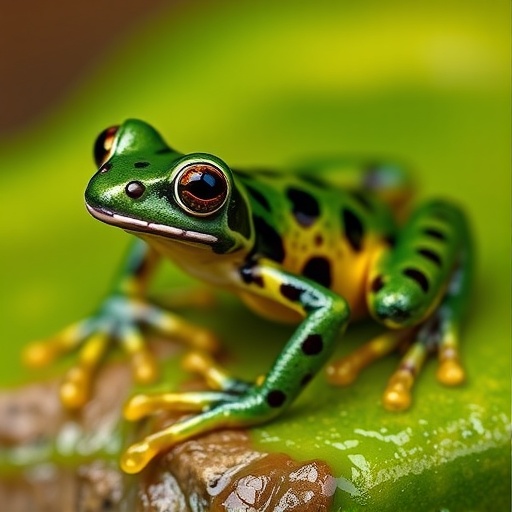
The team’s field expeditions in 2017 and 2018 at El Quimi Nature Reserve, a remote and rugged mountain enclave in Ecuador, yielded the first glimpses of Nymphargus dajomesae. This species stands out with its uniformly green, pebble-textured dorsal skin, an adaptation presumably aiding in blending with the mossy and leafy substrates of its arboreal habitat. Contrary to the transparent undersides common to many glassfrogs, N. dajomesae exhibits an intriguing evolutionary modification: a white membrane beneath, densely populated with specialized light-reflective cells. This biophysical feature partially obscures the heart, esophagus, stomach, and kidneys, distinguishing this species from its kin and hinting at novel physiological functions or environmental interactions yet to be explored.
Diving deeper into its evolutionary lineage through DNA sequencing and phylogenetic analyses, Masache and colleagues pinpointed the species’ divergence during the Pliocene Epoch, roughly 4.5 million years ago. This timeline situates the glassfrog’s emergence amidst significant geological and climatic transformations that sculpted the Andean landscape, possibly driving the radiation and isolation of amphibian species in this biodiverse hotspot. Such an ancient lineage underscores the importance of conserving these habitats, not only for their rich extant fauna but as living museums of evolutionary history.
Unfortunately, the survival of Nymphargus dajomesae teeters on a precarious edge. The proximity of its known habitat to agricultural lands and substantial mining operations poses imminent conservation challenges. Mining activities, notorious for habitat degradation and pollution, have already contributed to the decline of local amphibian populations. Given amphibians’ sensitivity to environmental changes and pollutants, N. dajomesae may face threats from habitat destruction, chemical runoff, and ecosystem imbalance. These factors highlight the urgency for habitat protection measures and long-term ecological monitoring to prevent potential decline or extinction.
Equally striking is the biological wealth unearthed alongside the discovery of this new species. Surveys conducted at El Quimi Reserve revealed that over 85% of amphibian species encountered were previously undocumented, signaling a biogeographic reservoir of hidden biodiversity. This “lost world” designation implies that southeastern Ecuador, and neighboring ecosystems in northeastern Peru, harbor ecosystems of unparalleled amphibian diversity, waiting to be studied and safeguarded before they are irreversibly altered by human activities or climate change.
The significance of the discovery transcends scientific circles; it symbolizes a fusion of cultural and intellectual progress. The decision to name the species after Neisi Dajomes resonates as a celebration of female empowerment and achievement, spotlighting the vital roles women play in both sports and science. Dr. Diego Cisneros, a co-author of the study, highlighted the symbolic weight of this naming, illustrating how this humble frog becomes an emblem of societal recognition for women shaping the future. This confluence of biology and social narrative underscores the often-overlooked intersection between natural history and contemporary cultural milestones.
From a methodological perspective, the research employs rigorous observational techniques bolstered by genetic analysis, comparative morphology, and ecological fieldwork. The researchers’ approach embodies an integration of classical taxonomy and cutting-edge molecular biology to delineate species boundaries in a complex biogeographical context. These methodologies reinforce the limitations of visual identification alone within the glassfrog family, where cryptic species abound and subtle physiological or genetic distinctions are paramount.
This breakthrough, published under a Creative Commons license, not only advances the scientific repository but also democratizes access to pivotal biodiversity data, encouraging global collaborations and inviting further research into amphibian ecology and conservation. It bolsters arguments for continued and expanded field surveys in high-diversity tropical mountain systems, which remain alarmingly underexplored and underappreciated despite their crucial ecological roles.
The astonishing biodiversity documented in the El Quimi region serves as a clarion call to conservationists, scientists, and policy-makers worldwide. Protecting such biomes is essential not only for preserving individual species like Nymphargus dajomesae but also for maintaining ecological networks, evolutionary processes, and the broader planetary health. These findings contribute to a growing body of evidence that tropical montane forests act as cradles of speciation and reservoirs of unique genetic resources critical for future biological research and ecosystem resilience.
In conclusion, the description of Nymphargus dajomesae exemplifies the dynamic and interconnected nature of biodiversity science, symbolic culture, and conservation ethics. This new glassfrog is a scientific marvel cloaked in emerald green, its discovery bridging the realms of natural history and human achievement. As threats loom from expanding human activities, this discovery galvanizes efforts to illuminate, understand, and protect the fragile wonders of the Andean forests and their elusive amphibian inhabitants.
Subject of Research: Animals
Article Title: A secret from a hidden world: A new glassfrog of the genus Nymphargus (Anura: Centrolenidae) from Cordillera del Cóndor, Ecuador
News Publication Date: April 8, 2026
Web References: http://dx.doi.org/10.1371/journal.pone.0345097
References: Masache-Sarango MV, Cisneros-Heredia DF, Ron SR (2026) PLoS One 21(4): e0345097.
Image Credits: Masache-Sarango et al., 2026, PLOS One, CC-BY 4.0
Keywords: glassfrog, Nymphargus dajomesae, Andes biodiversity, amphibian conservation, Pliocene evolution, Ecuador, El Quimi Nature Reserve, taxonomy, molecular phylogenetics, tropical forests.
Tags: amphibian camouflage and thermoregulationCordillera del Cóndor amphibian researchEcuador Olympic gold medalist tributeevolutionary significance of glassfrogsMylena Masache biological researchNeisi Dajomes historic achievementNeotropical rainforest glassfrogsnew species of glassfrog discoveryNymphargus dajomesae biodiversity in EcuadorPLOS One amphibian studiestranslucent skin adaptation in amphibianstropical Andean ecosystem species