Credit: MIT
RESEARCH TRIANGLE PARK, N.C. — An Army project devised a novel approach for quantum error correction that could provide a key step toward practical quantum computers, sensors and distributed quantum information that would enable the military to potentially solve previously intractable problems or deploy sensors with higher magnetic and electric field sensitivities.
The approach, developed by researchers at Massachusetts Institute of Technology with Army funding, could mitigate certain types of the random fluctuations, or noise, that are a longstanding barrier to quantum computing. These random fluctuations can eradicate the data stored in such devices.
The Army-funded research, published in Physical Review Letters, involves identifying the kinds of noise that are the most likely, rather than casting a broad net to try to catch all possible sources of disturbance.
“The team learned that we can reduce the overhead for certain types of error correction on small scale quantum systems,” said Dr. Sara Gamble, program manager for the Army Research Office, an element of U.S. Army Combat Capabilities Development Command’s Army Research Laboratory. “This has the potential to enable increased capabilities in targeted quantum information science applications for the DOD.”
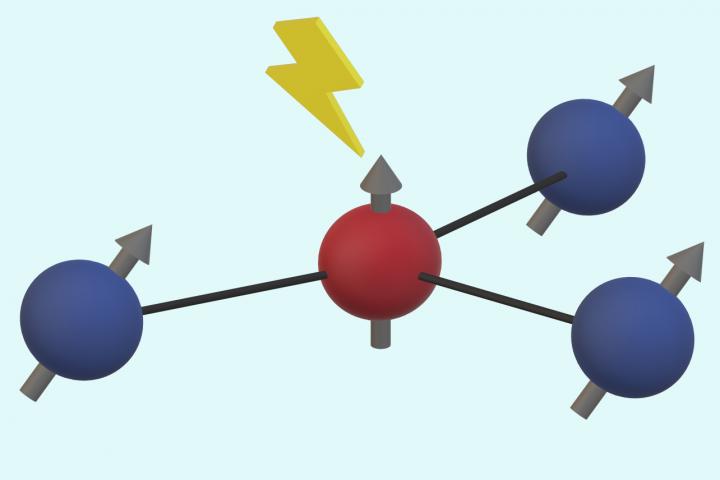
The specific quantum system the research team is working with consists of carbon nuclei near a particular kind of defect in a diamond crystal called a nitrogen vacancy center. These defects behave like single, isolated electrons, and their presence enables the control of the nearby carbon nuclei.
But the team found that the overwhelming majority of the noise affecting these nuclei came from one single source: random fluctuations in the nearby defects themselves. This noise source can be accurately modeled, and suppressing its effects could have a major impact, as other sources of noise are relatively insignificant.
The team determined that the noise comes from one central defect, or one central electron that has a tendency to hop around at random. It jitters. That jitter, in turn, is felt by all those nearby nuclei, in a predictable way that can be corrected. The ability to apply this targeted correction in a successful way is the central breakthrough of this research.
The work so far is theoretical, but the team is actively working on a lab demonstration of this principle in action.
If the demonstration works as expected, this research could make up an important component of near and far term future quantum-based technologies of various kinds, including quantum computers and sensors.
###
ARL is pursuing research in silicon vacancy quantum systems which share similarities with the nitrogen vacancy center quantum systems considered by the MIT team. While silicon vacancy and nitrogen vacancy centers have different optical properties and many basic research questions are open regarding which type(s) of application each may be ultimately best suited for, the error correction approach developed here has potential to impact both types of systems and as a result accelerate progress at the lab.
CCDC Army Research Laboratory is an element of the U.S. Army Combat Capabilities Development Command. As the Army’s corporate research laboratory, ARL discovers, innovates and transitions science and technology to ensure dominant strategic land power. Through collaboration across the command’s core technical competencies, CCDC leads in the discovery, development and delivery of the technology-based capabilities required to make Soldiers more lethal to win the nation’s wars and come home safely. CCDC is a major subordinate command of the U.S. Army Futures Command.
Media Contact
Lisa Bistreich-Wolfe
[email protected]
919-549-4372
Original Source
https:/
Related Journal Article
http://dx.