• HOME
  • NEWS
  • EXPLORE
    • CAREER
      • Companies
      • Jobs
    • EVENTS
    • iGEM
      • News
      • Team
    • PHOTOS
    • VIDEO
    • WIKI
  • BLOG
  • COMMUNITY
    • FACEBOOK
    • INSTAGRAM
    • TWITTER
Friday, June 26, 2026
BIOENGINEER.ORG
No Result
View All Result
  • Login
  • HOME
  • NEWS
  • EXPLORE
    • CAREER
      • Companies
      • Jobs
        • Lecturer
        • PhD Studentship
        • Postdoc
        • Research Assistant
    • EVENTS
    • iGEM
      • News
      • Team
    • PHOTOS
    • VIDEO
    • WIKI
  • BLOG
  • COMMUNITY
    • FACEBOOK
    • INSTAGRAM
    • TWITTER
  • HOME
  • NEWS
  • EXPLORE
    • CAREER
      • Companies
      • Jobs
        • Lecturer
        • PhD Studentship
        • Postdoc
        • Research Assistant
    • EVENTS
    • iGEM
      • News
      • Team
    • PHOTOS
    • VIDEO
    • WIKI
  • BLOG
  • COMMUNITY
    • FACEBOOK
    • INSTAGRAM
    • TWITTER
No Result
View All Result
Bioengineer.org
No Result
View All Result
Home NEWS Science News Chemistry

New energy-efficient algorithm keeps UAV swarms helping longer

Bioengineer by Bioengineer
June 11, 2019
in Chemistry
Reading Time: 3 mins read
0
IMAGE
Share on FacebookShare on TwitterShare on LinkedinShare on RedditShare on Telegram

In a twist on survival of the fittest, new research in UAV swarms applies genetic algorithms to maximize not individual but whole swarm working lifetime
IMAGE

Credit: Wuhui Chen

WASHINGTON, D.C., June 11, 2019 — A new energy-efficient data routing algorithm developed by an international team could keep unmanned aerial vehicle swarms flying — and helping — longer, report an international team of researchers this month in the journal Chaos, from AIP Publishing.

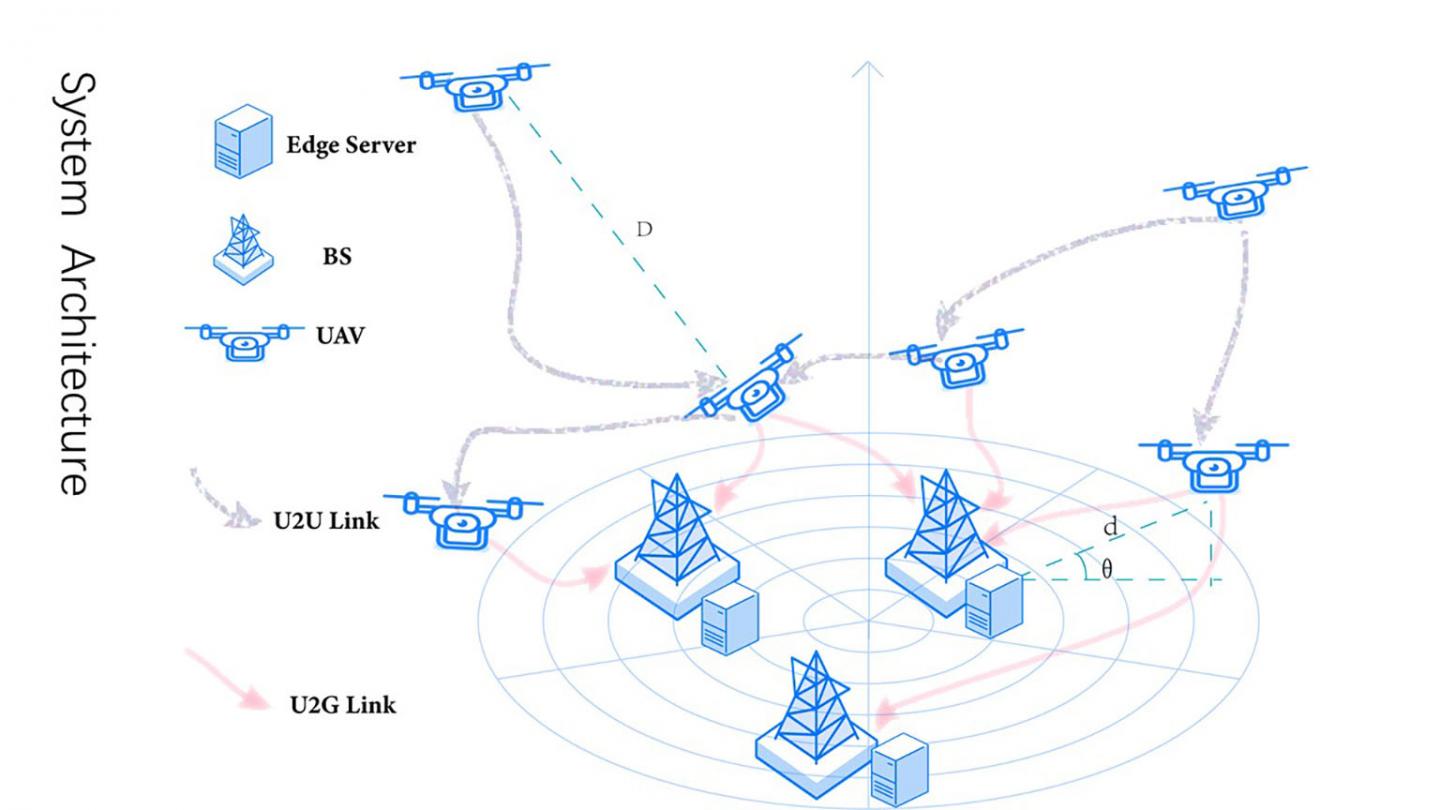
UAV swarms are cooperative, intercommunicating groups of UAVs used for a wide and growing variety of civilian and military applications. In disaster response, particularly when local communications infrastructure is destroyed, UAV swarms linked to one or more local base stations act as eyes in the sky, providing first responders with crucial damage and survivor information.

“The battery capacity of UAVs is a critical shortcoming that limits their usage in extended search and rescue missions,” said co-author Wuhui Chen, a researcher at China’s Sun Yat-Sen University.

Much of a UAV’s energy use can be related to high bandwidth and long transmission times — think of the drain on the battery of your phone in such cases. To address this, Chen and colleagues have developed a UAV swarm data routing algorithm that uses the strength of the group to maximize real-time transmission rates and minimize individual UAV battery challenges.

Their new hybrid computational approach combines linear programming and a genetic algorithm to create a “multi-hop” data routing algorithm. A genetic algorithm solves chaotic optimization problems using an analogue of natural selection, the process that drives biological evolution.

In real time, the new adaptive LP-based genetic algorithm (ALPBGA) identifies the lowest communications energy route within a swarm and simultaneously balances out individual UAV power use, for example, by determining which UAV will beam information to a base station.

“By balancing power consumption among the UAVs, we significantly enhance the ability of the whole system,” said Patrick Hung, a co-author at the University of Ontario Institute of Technology in Canada. “Our simulations show that our approach can outperform the existing state of the art methods.”

These computer simulations show that, especially as swarm size increases from 10 to hundreds of UAVs, ALPBGA reduces the number of UAVs that stop communicating by 30% to 75% compared to existing leading UAV swarm communication algorithms.

“We believe the results of our research will inspire others to design more energy-efficient UAV communication systems,” said Chen, who plans to extend the ALPBGA research to optimize it within the context of different swarm flying trajectories.

###

The article, “Energy-efficient data routing in cooperative UAV swarms for medical assistance after a disaster,” is authored by Yuanhao Yang, Xiaoyu Qiu, Shenghui Li, Junbo Wang, Wuhui Chen, Patrick C. K. Hung and Zibin Zheng. The article will appear in Chaos on June 11, 2019 (DOI: 10.1063/1.5092740). After that date, it can be accessed at https://doi.org/10.1063/1.5092740.

ABOUT THE JOURNAL

Chaos is devoted to increasing the understanding of nonlinear phenomena in all disciplines and describing their manifestations in a manner comprehensible to researchers from a broad spectrum of disciplines. See http://chaos.aip.org.

Media Contact
Larry Frum
[email protected]

Related Journal Article

http://dx.doi.org/10.1063/1.5092740

Tags: Algorithms/ModelsChemistry/Physics/Materials SciencesComputer ScienceElectrical Engineering/ElectronicsMathematics/StatisticsSystems/Chaos/Pattern Formation/ComplexityTechnology/Engineering/Computer Science
Share13Tweet8Share2ShareShareShare2

Related Posts

AI and Physics Collaborate to Design Advanced Hydrogen Storage Materials

June 25, 2026

International Team Including Dresden Scientists Develops Novel Designer Proteins for Advanced Study of Living Tissue

June 25, 2026

New Study Uncovers Key Factors Driving Water Chemistry in Nanoscale Environments

June 25, 2026

Plasma Technology Extends Catalyst Lifespan in Hydrogen Production

June 24, 2026
Please login to join discussion

POPULAR NEWS

  • Saying Goodbye to PGY-6: Pediatric Fellowship Realities

    103 shares
    Share 41 Tweet 26
  • Multi-Hospital Study Reveals Long Covid Burden Is Twice as High as Current Estimates

    92 shares
    Share 36 Tweet 23
  • Detection of EDCs in Breast Milk and Infant Urine Up to Six Months Highlights Early Exposure Risks

    77 shares
    Share 31 Tweet 19
  • New Drug Candidate Developed at McMaster Shows Potential for Treating Brain Cancer

    58 shares
    Share 23 Tweet 15

About

We bring you the latest biotechnology news from best research centers and universities around the world. Check our website.

Follow us

Recent News

Tracking Lanthanide-Labeled Microplastics in Plants

POSTECH Researchers Slash Cost of Reconstituted Cell-Free Systems by 95%

AI and Physics Collaborate to Design Advanced Hydrogen Storage Materials

Subscribe to Blog via Email

Success! An email was just sent to confirm your subscription. Please find the email now and click 'Confirm' to start subscribing.

Join 82 other subscribers
  • Contact Us

Bioengineer.org © Copyright 2023 All Rights Reserved.

Welcome Back!

Login to your account below

Forgotten Password?

Retrieve your password

Please enter your username or email address to reset your password.

Log In
No Result
View All Result
  • Homepages
    • Home Page 1
    • Home Page 2
  • News
  • National
  • Business
  • Health
  • Lifestyle
  • Science

Bioengineer.org © Copyright 2023 All Rights Reserved.