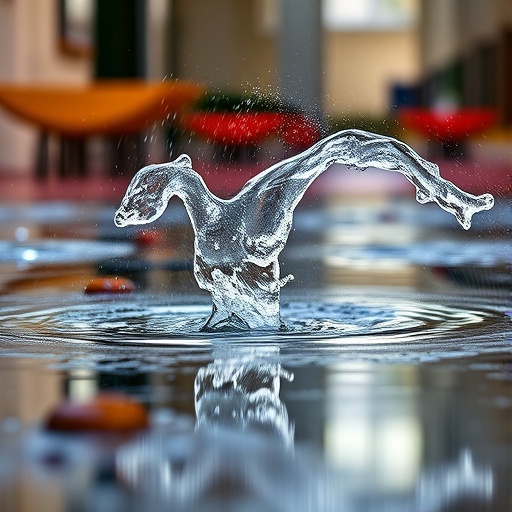
Water droplet dynamics continue to fascinate scientists due to their intricate interplay of forces and their potential applications in various fields ranging from material science to energy harvesting. A groundbreaking study recently published in Nature Physics has unveiled a novel mechanism enabling water puddles up to an unprecedented centimeter scale to spontaneously leap off surfaces. This finding dramatically expands our understanding of droplet behavior beyond the previously accepted three-millimeter threshold, where gravity had been believed to hold larger droplets firmly in place.
Traditionally, water droplets are seen to jump on surfaces for numerous reasons related to surface interactions and energy input such as thermal gradients or repellent coatings. In these cases, droplets may skitter or bounce, but typically only small droplets under three millimeters in diameter exhibit such self-propulsion. Larger drops are inhibited by gravitational forces. However, the team led by Associate Professor Jiangtao Cheng at Virginia Tech has discovered an entirely different driver for droplet jumping — the bursting of air bubbles trapped within the droplets themselves.
This phenomenon was inspired by an everyday natural observation during early morning dew formation on lotus leaves. Small water droplets on these leaves often contain trapped gaseous bubbles generated via the plants’ oxygen release. When these microscopic bubbles burst, the energy released propels the droplets upward, causing them to jump instinctively from surfaces. This had been overlooked as a potential mechanism for overcoming gravitational limits on droplet motion until now.
Building on this natural inspiration, Cheng and his colleagues, including first author Wenge Huang, used experimental and theoretical methods to unravel the physics behind bubble-induced droplet propulsion. Their research revealed that when a bubble trapped beneath the water’s surface bursts, approximately 90 percent of the instantaneous energy release timestamps at the droplet’s base, efficiently converting the energy into mechanical upward force. This energy distribution pattern allows droplets up to one centimeter in diameter to leap into the air, a scale previously considered unattainable for such autonomous motion.
The team’s experiments demonstrated that the size of the bubble inside the droplet governs the height of the resulting jump. Larger bubbles produce stronger propulsion forces, pushing droplets higher and breaking the traditional limits imposed by gravity. Intriguingly, even small droplets containing sizable air bubbles can experience enhanced jumping performance, leveraging bubble bursting dynamics to amplify the mechanical energy imparted to the droplet.
One key factor facilitating this jumping behavior is the use of lotus-leaf-like superhydrophobic surfaces. These surfaces repel water remarkably well, minimizing adhesion forces and enabling the rapid detachment of droplets once sufficient propulsion is generated. The synergy between bubble bursting and repellent surface characteristics ensures efficient energy transfer from the collapsing bubble to droplet motion without significant dissipative losses.
From an applied science perspective, these findings open exciting avenues for engineering droplet actuations in various technological domains. Self-propelled water droplets could revolutionize cleaning technologies by actively removing contaminants from surfaces through autonomous jumping, reducing reliance on external mechanical forces or chemical agents. In condensation heat transfer systems, the rapid removal of droplets enhances thermal efficiency, potentially leading to advances in industrial cooling and energy conversion processes.
Moreover, the phenomenon holds promise in the realm of hydrogen production and energy harvesting. Since the jumping droplets are fueled purely by mechanical energy release from bubble collapse — requiring no external fuel source — harnessing this energy could enable the design of novel microscale energy harvesters that are both sustainable and efficient. Larger jumping droplets enabled by bubble bursting can increase energy output, scaling these devices to practical power levels.
In the context of environmental sensing, Cheng’s group previously demonstrated that water droplet interactions could be utilized for biosensing applications, such as COVID-19 detection. Larger droplets propelled by bursting bubbles could collect more surface particles, enhancing sensitivity and expanding the scope of droplet-based sensing technologies. This dynamic interaction between fluid mechanics and surface chemistry could lead to breakthroughs in diagnostic tools and environmental monitoring.
Furthermore, additive manufacturing technologies stand to benefit from this discovery. The ability of bursting bubbles to precisely actuate droplets at the microscale makes it possible to deliver printed material with exceptional spatial accuracy. This precision could significantly advance 3D printing capabilities at micro- and nano-scales, enabling the fabrication of complex structures with superior resolution and minimal material wastage.
At a fundamental level, this study sheds new light on fluid-structure interactions, detailing the complex interplay between cavitation phenomena, fluid jets, and droplet motion. Unlike conventional propulsion mechanisms, the bubble bursting-driven droplet jumping is a passive process powered by intrinsic fluid dynamics, representing an elegant natural engineering solution. The results enrich the broader understanding of energy transfer and multiphase fluid dynamics, opening pathways for future explorations.
Professor Cheng summarized the impact of the work by highlighting how their research achieved passive jumping of water puddles at a scale never before accomplished. By investigating the coupling of bubble bursting, fluidic jetting, and droplet motion, the team identified a previously unknown water wave impact mechanism, providing a promising blueprint for next-generation droplet actuations and directional particle printing in additive manufacturing processes.
This innovative research not only challenges preconceived notions of droplet limitations but also propels forward interdisciplinary applications spanning physics, engineering, energy science, and environmental technology. As the scientific community delves further into these mechanisms, ripple effects across industrial and technological sectors are anticipated, underscoring the transformative potential of seemingly simple natural phenomena.
Subject of Research: Fluid dynamics and bubble bursting-induced droplet propulsion
Article Title: Unprecedented Centimeter-Scale Water Puddle Jumping Driven by Bubble Bursting on Superhydrophobic Surfaces
News Publication Date: 26-Feb-2026
Web References:
– https://dx.doi.org/10.1038/s41467-026-69512-y
– https://me.vt.edu/people/faculty/cheng-jiangtao.html
– https://www.nature.com/articles/s41567-024-02522-z
– https://news.vt.edu/articles/2020/07/cheng-zhou-dropletbiosensing.html
– https://www.science.org/doi/10.1126/sciadv.abo7698
Image Credits: Photo courtesy of Jiangtao Cheng.
Keywords
Physics, Water chemistry, Energy, Energy transfer, Hydrogen energy, Engineering, Mechanical engineering
Tags: air bubble bursting in water dropletscentimeter scale water puddlesdroplet behavior beyond gravity limitsearly morning dew droplet studyenergy harvesting from water dropletslotus leaf water interactionmaterial science applications of droplet dynamicsnovel water physics mechanismsself-propelled water dropletsspontaneous droplet jumpingsurface interaction of water dropletswater droplet dynamics