Lithium-air batteries, also known as lithium-oxygen batteries, are candidates for the next generation of high-energy electricity storage devices. Their theoretical energy storage capacity is ten times that of conventional lithium-ion batteries of the same weight, but they are not yet chemically stable enough to provide a reliable solution. Now a newly launched collaborative research project in which a team from the University of Oldenburg, Germany, led by chemist Professor Dr. Gunther Wittstock is participating is testing a new concept to extend the life of these battery cells.
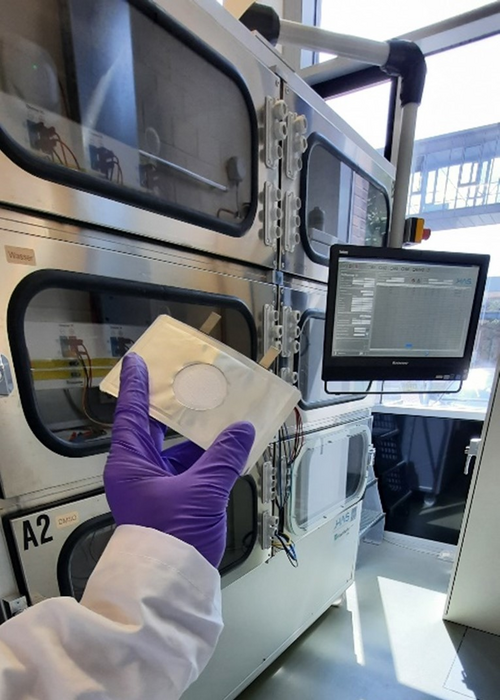
Credit: Fraunhofer IFAM
Lithium-air batteries, also known as lithium-oxygen batteries, are candidates for the next generation of high-energy electricity storage devices. Their theoretical energy storage capacity is ten times that of conventional lithium-ion batteries of the same weight, but they are not yet chemically stable enough to provide a reliable solution. Now a newly launched collaborative research project in which a team from the University of Oldenburg, Germany, led by chemist Professor Dr. Gunther Wittstock is participating is testing a new concept to extend the life of these battery cells.
The project, entitled “Alternative materials and components for aprotic lithium-oxygen batteries: chemistry and stability of inactive components – AMaLiS 2.0”, is led by IOLITEC Ionic Liquids Technologies, a company based in Heilbronn, Germany. The MEET (Münster Electrochemical Energy Technology) Battery Research Center at the University of Münster and the Fraunhofer Institute for Manufacturing Technology and Advanced Materials IFAM in Bremen are also taking part. The project will receive around 1.1 million euros in funding from the Federal Ministry of Education and Research over a three-year period.
Lithium-air batteries basically work in the same way as conventional battery types, but in this type of battery the reaction of lithium ions with oxygen from the air at the positive electrode is used to generate electricity. The big advantage is that lithium-air batteries can store almost as much energy per kilogram as fossil fuels. This means that they have a similar specific energy to today’s batteries but weigh much less, which makes them attractive for use in electric cars as well as in stationary energy storage. “However, before we get that far there are still a number of technical problems to be solved,” Wittstock underlines. One of these challenges is the lack of electrolyte that are chemically stable at both the positive and the negative electrode. These conductive fluids or solids are located in the area between the two electrodes.
Oxygen from the air is reduced in lithium-air batteries
In lithium-air batteries, one of the electrodes is made of metallic lithium while the other – called the gas diffusion electrode – consists of a porous porous network and conducting material where oxygen (O2) from the air is reduced in an oxidation-reduction reaction. When the battery is discharging, positively charged lithium ions move across the electrolyte from one electrode to the gas diffusion electrode, where they combine with oxygen and electrons from an external electrical circuit to form lithium oxide. This generates an electric current which can be used to provide energy for electrical devices. During charging, lithium and oxygen separate once more and the ions and electrons travel in the opposite direction.
To increase the stability of the lithium-air battery, the project team aims to design a membrane that separates the positive electrode from the negative electrode, thus allowing different electrolytes to be used on either side. “This would significantly expand the options for electrolytes,” says IOLITEC’s project coordinator Dr Thomas Schubert. The scientists plan to test a separator with a special coating on each side that protects both the lithium electrode and the gas diffusion electrode.
The Oldenburg team led by Wittstock is using various methods, including surface spectroscopy and scanning electrochemical microscopy (SECM), to investigate the processes on the surfaces of the separator and electrodes. IOLITEC is developing the separating layer together with a team from MEET Battery Research Center at the University of Münster which is headed by Verena Küpers. “We are testing different coatings that are specifically adapted to the challenges posed by each type of electrode,” Küpers explains.
The MEET team also carries out test measurements. At the Fraunhofer IFAM, a team led by Dr Daniela Fenske is developing a new type of gas diffusion electrode made of nanostructured titanium carbide. “It will be combined with a special membrane that prevents parasitic air components such as carbon dioxide or water vapour from entering the cell,” Fenske explains. The researchers’ end goal is to develop a prototype that proves that a stable, rechargeable system is achievable. For this, the construction of a flat cell with a surface area of 25 square centimetres is planned.