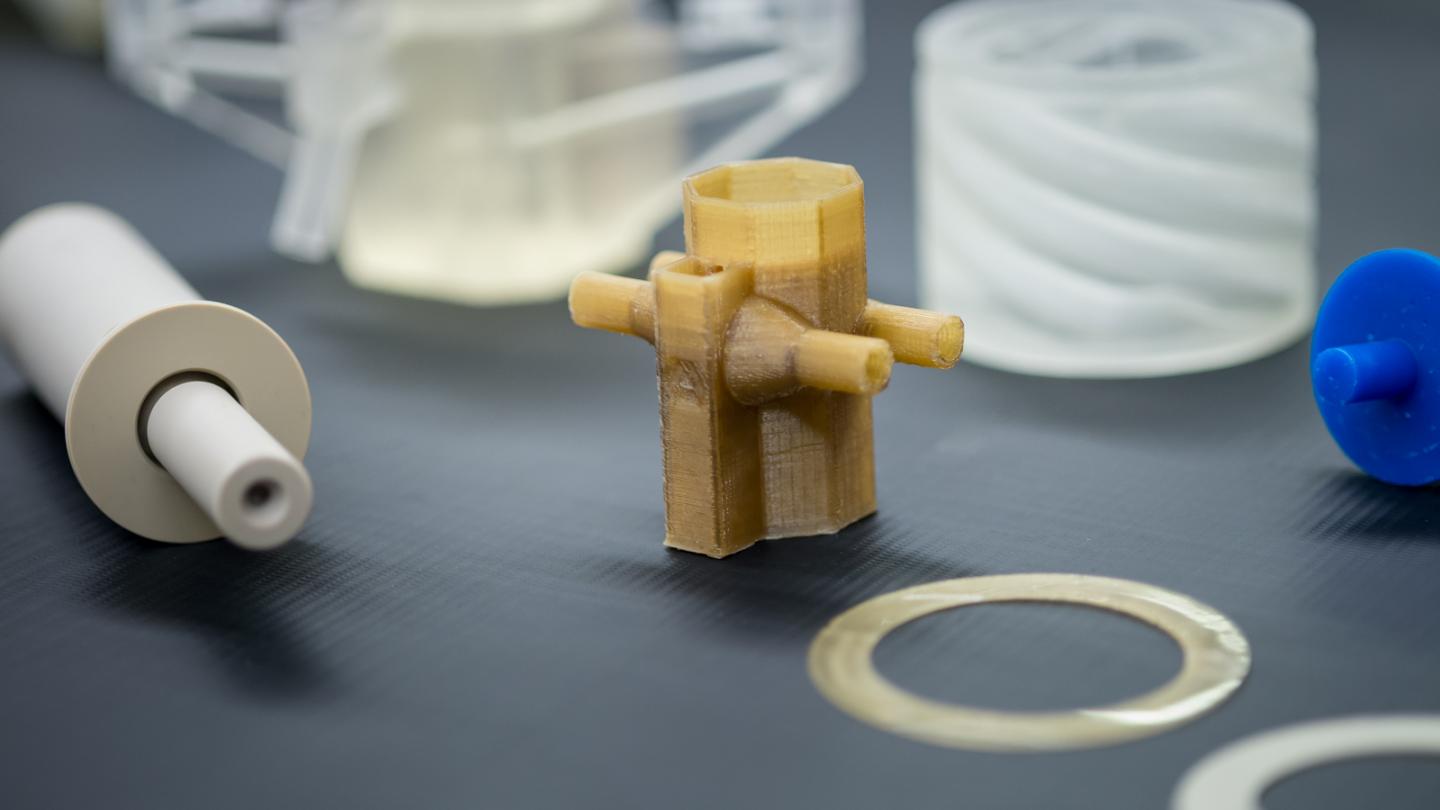
Credit: Argonne National Laboratory
Molybdenum-99 (Mo-99) is an important medical isotope used to help radiologists detect heart disease, bone decay and some types of hard-to-find cancers. Scientists at the U.S. Department of Energy’s (DOE) Argonne National Laboratory have discovered a novel way to squeeze even more out of it.
Enriched molybdenum, from which Mo-99 can be made, is expensive, costing about $1,000 per gram. Commercial producers lacked an easy, cost-effective way to recycle the enriched material — until now. (Note that Mo-99 decays into technetium-99m, which radiologists then use to develop the actual pharmaceuticals used in medical procedures.)
For the first time in the U.S., Argonne scientists have scaled up the recycling of isotopically enriched molybdenum, Mo-98 or 100, to engineering scale using new 3D printed parts. This new approach makes the laboratory’s recycling method — pioneered in 2015 by Mo-99 program manager Peter Tkac and others — faster, more reliable and more cost effective.
Unlocking the benefits of 3D printing
When Tkac and colleagues first discovered how to recycle enriched molybdenum, the process proved tedious. The team converted the used enriched molybdenum, along with other chemicals, to an acidic solution. They then purified the enriched molybdenum in multiple stages using funnels and test tubes.
“Our original method would have been very difficult to automate,” said Tkac.
A year later, Tkac began working with Peter Kozak and others to automate the process, which relies on corrosive chemicals. The team replaced funnels and test tubes with 3D-printed acrylic contactors, which spin and separate chemicals using centrifugal force. The researchers said these contactors are what make recycling enriched molybdenum cheaper and more efficient.
“We printed each contactor as one piece with streamlined features and fewer external connections,” said Kozak. “This allows us to push the liquid through the system as quickly and reliably as possible.”
The new process effectively separated the enriched molybdenum from potassium and other contaminants, as described in a December 26 article in the Journal of Solvent Extraction and Ion Exchange.
Yet, a problem arose. The hydrochloric acid corroded the 3D-printed plastic after about 15 hours of operation.
“Our experiment was successful,” said Kozak. “But if you want to move into full production, you need material that will survive a lot longer than that.”
Looking for PEEK performance
Kozak and Tkac soon found a more durable material called polyether ether ketone (PEEK). PEEK is a better choice because it resists the recycling method’s mineral acids and many organic solvents.
But PEEK material, the team found, also shrinks as is it printed, causing the material to warp. To compensate, Kozak tweaked the printer’s fan speed and temperature, which helped him print PEEK materials that are stronger and more flexible than the original acrylic plastic. With PEEK material, the team found the best of both worlds: efficient, quick, and cost-effective recycling of enriched molybdenum that is strong enough to hold up against the chemicals that separate molybdenum from other materials.
###
Other involved Argonne scientists include Alex Brown and Brian Saboriendo. The research was supported by the DOE National Nuclear Security Administration’s Office of Defense Nuclear Nonproliferation and Office of Material Management and Minimization.
Argonne National Laboratory seeks solutions to pressing national problems in science and technology. The nation’s first national laboratory, Argonne conducts leading-edge basic and applied scientific research in virtually every scientific discipline. Argonne researchers work closely with researchers from hundreds of companies, universities, and federal, state and municipal agencies to help them solve their specific problems, advance America’s scientific leadership and prepare the nation for a better future. With employees from more than 60 nations, Argonne is managed by UChicago Argonne, LLC for the U.S. Department of Energy’s Office of Science.
The U.S. Department of Energy’s Office of Science is the single largest supporter of basic research in the physical sciences in the United States and is working to address some of the most pressing challenges of our time. For more information, visit https:/
Media Contact
Lynn Tefft Hoff
[email protected]
630-252-1750
Original Source
https:/
Related Journal Article
http://dx.