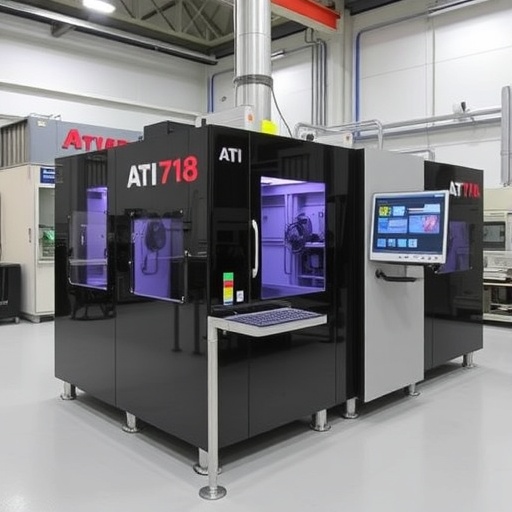
In the rapidly evolving realm of additive manufacturing, the quest for materials that meet stringent performance criteria under complex conditions remains relentless. Addressing this challenge head-on, a groundbreaking study has unveiled a pioneering computational framework designed to bring unprecedented precision and reliability to the heat treatment processes of ATI 718Plus alloy, a superalloy renowned for its critical applications in aerospace and power generation industries. This advance, published in npj Advanced Manufacturing, promises to revolutionize how engineers approach the qualification and optimization of additively manufactured components, where variability has until now posed significant hurdles.
Additive manufacturing, often lauded for its geometric freedom and material efficiency, introduces inherent complexities due to microstructural heterogeneities formed during layer-wise fabrication. Specifically, ATI 718Plus, with its complex alloy composition tailored for high-temperature resilience, exhibits sensitive responses to heat treatment schedules that significantly influence its mechanical and thermal properties. The need for a systematic, data-driven approach that can manage uncertainty and rapidly qualify heat treatments has never been more urgent, as conventional trial-and-error methods prove costly and time-consuming.
The research team, led by Zhang, Q., Niu, C., and Olson, G.B., developed an integrated computational framework that synergizes advanced uncertainty quantification techniques with robust process modeling. This approach does not merely simulate the heat treatment process in isolation; instead, it acknowledges the multifaceted sources of variability spanning additive manufacturing induced microstructures to thermal treatment parameters. By doing so, it delivers a comprehensive understanding of how these uncertainties propagate and affect the ultimate microstructure-property-performance nexus.
At the heart of this framework lies a sophisticated probabilistic methodology that leverages stochastic modeling and machine learning algorithms. These tools enable the efficient exploration of the vast parameter space governing heat treatments, capturing nonlinear dependencies and complex interactions that traditional deterministic methods often miss. This probabilistic insight allows engineers to identify optimal heat treatment windows with a high confidence level, fundamentally reducing the industry’s reliance on exhaustive physical experimentation.
The framework is meticulously calibrated against extensive empirical data, ensuring its predictive capabilities are not only theoretically sound but also practically relevant. Experimental validations involving additively manufactured ATI 718Plus specimens subjected to varied heat treatment schedules demonstrated strong concordance between predicted outcomes and observed microstructural features, including grain size distribution, phase precipitation, and defect mitigation. Such validation affirms the model’s utility in providing actionable insights for real-world applications.
One of the most consequential outcomes of this computational innovation is its potential to significantly shorten the time-to-certification for additively manufactured components. By expediting the qualification of heat treatment procedures, manufacturers can accelerate the integration of high-performance ATI 718Plus parts into safety-critical systems. This is a vital advancement in sectors like aerospace propulsion, where material failure is not an option and component lifecycle optimization directly translates to enhanced operational efficiency and safety.
Moreover, the framework’s modular and extensible architecture implies that it can be adapted beyond ATI 718Plus to other complex alloys and manufacturing processes. Its capacity to incorporate evolving data sets and update uncertainty quantifications in real-time presents a dynamic platform that aligns with the future of digital twin technologies in manufacturing. This adaptability means the tool is not static but continuously improves as more data becomes available, fostering an ecosystem of smart manufacturing.
Technically, the research addresses several hurdles intrinsic to additive manufacturing post-processing. For instance, the uneven temperature gradients and thermal histories during heat treatment commonly induce residual stresses and unpredictable microstructural phases. The computational framework integrates thermal-fluid dynamics simulations coupled with mesoscale microstructural evolution models to emulate these phenomena accurately, providing a holistic perspective on the heat treatment process landscape.
Additionally, the uncertainty quantification component utilizes Bayesian inference techniques to robustly update the model as new experimental or in-situ sensor data are incorporated. This iterative learning cycle reduces epistemic uncertainties, empowering manufacturers with confidence intervals around predicted material behaviors. Consequently, decision-making can incorporate risk assessments, ushering in a new era of probabilistic certification standards over traditional deterministic benchmarks.
Beyond the industrial applications, this study significantly contributes to the academic discourse on integrated manufacturing science. It bridges the gap between computational materials science, uncertainty analysis, and process engineering in a manner that is both theoretically rigorous and immediately translatable. The explicit coupling of multi-physics simulations with statistical learning methods exemplifies the interdisciplinary approach essential for future advancements in advanced manufacturing.
The visualization and interpretability of the framework also embody cutting-edge data science principles. Interactive dashboards and high-fidelity graphical outputs allow engineers to intuitively explore parameter sensitivities and predict failure modes, facilitating more informed experimental designs. This user-centric aspect ensures the model’s accessibility not just to computational scientists but also to process engineers and quality assurance specialists.
Furthermore, the study underscores the pivotal role of additive manufacturing in enabling next-generation engineering designs, contingent upon robust post-processing qualification strategies. By dissecting the complex interdependence of process parameters and material behavior, the framework equips industries with a strategic advantage. This innovation is poised to catalyze a paradigm shift from conservative over-engineering towards optimized, performance-driven design philosophies.
In conclusion, the integrated computational framework introduced by Zhang, Niu, and Olson represents a formidable leap forward in the qualification of additively manufactured ATI 718Plus alloy. Its sophistication in uncertainty quantification, coupled with the capability for rapid heat treatment process qualification, addresses one of the most pressing bottlenecks in additive manufacturing technology readiness. The implications for aerospace, power generation, and beyond are profound, promising enhanced reliability, reduced costs, and accelerated innovation cycles in high-performance alloy deployment.
As this methodology matures and finds broader adoption, it is expected to serve as a cornerstone in the digital transformation of materials engineering. Future iterations may incorporate real-time process monitoring data, harnessing artificial intelligence and cloud computing infrastructures to further augment precision and agility. Ultimately, this work exemplifies how integrated computational tools can unlock the full potential of additive manufacturing, propelling industrial capabilities to unprecedented heights.
Subject of Research:
Qualification and uncertainty quantification of heat treatment processes for additively manufactured ATI 718Plus superalloy.
Article Title:
An integrated computational framework for uncertainty quantification and rapid qualification of heat treatment for additively manufactured ATI 718Plus alloy.
Article References:
Zhang, Q., Niu, C. & Olson, G.B. An integrated computational framework for uncertainty quantification and rapid qualification of heat treatment for additively manufactured ATI 718Plus alloy. npj Adv. Manuf. 3, 4 (2026). https://doi.org/10.1038/s44334-025-00064-7
Image Credits: AI Generated
DOI: https://doi.org/10.1038/s44334-025-00064-7
Tags: additive manufacturing challengesaerospace material performanceAI-driven heat treatment optimizationATI 718Plus superalloy advancementscomputational framework for heat treatmentdata-driven approaches in engineeringinnovative methods for alloy processinglayer-wise fabrication complexitiesmechanical properties of heat-treated alloysoptimizing heat treatment schedulesrevolutionary manufacturing techniquesuncertainty quantification in manufacturing