• HOME
  • NEWS
  • EXPLORE
    • CAREER
      • Companies
      • Jobs
    • EVENTS
    • iGEM
      • News
      • Team
    • PHOTOS
    • VIDEO
    • WIKI
  • BLOG
  • COMMUNITY
    • FACEBOOK
    • INSTAGRAM
    • TWITTER
Thursday, February 5, 2026
BIOENGINEER.ORG
No Result
View All Result
  • Login
  • HOME
  • NEWS
  • EXPLORE
    • CAREER
      • Companies
      • Jobs
        • Lecturer
        • PhD Studentship
        • Postdoc
        • Research Assistant
    • EVENTS
    • iGEM
      • News
      • Team
    • PHOTOS
    • VIDEO
    • WIKI
  • BLOG
  • COMMUNITY
    • FACEBOOK
    • INSTAGRAM
    • TWITTER
  • HOME
  • NEWS
  • EXPLORE
    • CAREER
      • Companies
      • Jobs
        • Lecturer
        • PhD Studentship
        • Postdoc
        • Research Assistant
    • EVENTS
    • iGEM
      • News
      • Team
    • PHOTOS
    • VIDEO
    • WIKI
  • BLOG
  • COMMUNITY
    • FACEBOOK
    • INSTAGRAM
    • TWITTER
No Result
View All Result
Bioengineer.org
No Result
View All Result
Home NEWS Science News

Neural network has learned to identify tree species

Bioengineer by Bioengineer
January 28, 2021
in Science News
Reading Time: 2 mins read
0
IMAGE
Share on FacebookShare on TwitterShare on LinkedinShare on RedditShare on Telegram

IMAGE

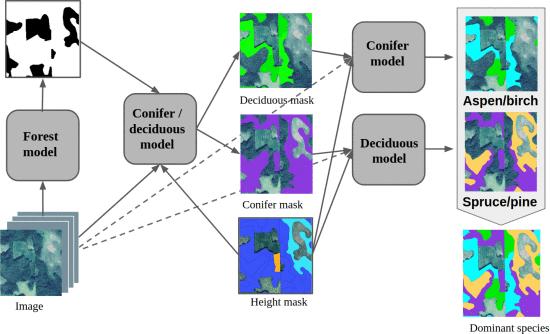
Credit: Svetlana Illarionova et al., IEEE Journal of Selected Topics in Applied Earth Observations and Remote Sensing.

Skoltech scientists have developed an algorithm that can identify various tree species in satellite images. Their research was published in the IEEE Journal of Selected Topics in Applied Earth Observations and Remote Sensing.

Identifying tree species is essential for efficient forest management and monitoring. Satellite imagery is an easier and cheaper way to deal with this task than other approaches that require ground observations of vast and remote areas.

Researchers from the Skoltech Center for Computational and Data-Intensive Science and Engineering (CDISE) and Skoltech Space Center used a neural network to automate dominant tree species’ identification in high and medium resolution images. A hierarchical classification model and additional data, such as vegetation height, helped further enhance the predictions’ quality while improving the algorithm’s stability to facilitate its practical application.

“Commercial forest taxation providers and their end-users, including timber procurers and processors, as well as the forest industry entities can use the new technology for quantitative and qualitative assessment of wood resources in leased areas. Also, our solution enables quick evaluations of underdeveloped forest areas in terms of investment appeal,” explains Svetlana Illarionova, the first author of the paper and a Skoltech PhD student.

There are plans to integrate the developed algorithms in the Geoalert platform to automate the production of forest engineering materials marketed via Parma-GIS.

###

Skoltech is a private international university located in Russia. Established in 2011 in collaboration with the Massachusetts Institute of Technology (MIT), Skoltech is cultivating a new generation of leaders in science, technology, and business researching breakthrough fields. It is promoting technological innovation intending to solve critical problems that face Russia and the world. Skoltech is focusing on six priority areas: data science and artificial intelligence, life sciences, advanced materials and modern design methods, energy efficiency, photonics, and quantum technologies, and advanced research. Web: https://www.skoltech.ru/.

Media Contact
Ilyana Zolotareva
[email protected]

Original Source

https://www.skoltech.ru/en/2021/01/neural-network-has-learned-to-identify-tree-species/

Related Journal Article

http://dx.doi.org/10.1109/JSTARS.2020.3048372

Tags: AgricultureComputer ScienceForestryMultimedia/Networking/Interface DesignResearch/DevelopmentRobotry/Artificial IntelligenceSoftware EngineeringTechnology/Engineering/Computer ScienceTheory/Design
Share12Tweet8Share2ShareShareShare2

Related Posts

AI-Enhanced Optical Photoacoustic Microscopy for 3D Cancer

AI-Enhanced Optical Photoacoustic Microscopy for 3D Cancer

February 5, 2026

Mitophagy’s Role in Pancreatic Cancer Therapy

February 5, 2026

AI-Enabled Stethoscope Proves Twice as Effective at Detecting Valvular Heart Disease in Clinical Settings

February 5, 2026

Study Finds No Link Between COVID-19 Vaccination and Decline in Birth Rates

February 5, 2026
Please login to join discussion

POPULAR NEWS

  • Robotic Ureteral Reconstruction: A Novel Approach

    Robotic Ureteral Reconstruction: A Novel Approach

    81 shares
    Share 32 Tweet 20
  • Digital Privacy: Health Data Control in Incarceration

    63 shares
    Share 25 Tweet 16
  • Study Reveals Lipid Accumulation in ME/CFS Cells

    57 shares
    Share 23 Tweet 14
  • Breakthrough in RNA Research Accelerates Medical Innovations Timeline

    53 shares
    Share 21 Tweet 13

About

We bring you the latest biotechnology news from best research centers and universities around the world. Check our website.

Follow us

Recent News

AI-Enhanced Optical Photoacoustic Microscopy for 3D Cancer

Mitophagy’s Role in Pancreatic Cancer Therapy

AI-Enabled Stethoscope Proves Twice as Effective at Detecting Valvular Heart Disease in Clinical Settings

Subscribe to Blog via Email

Enter your email address to subscribe to this blog and receive notifications of new posts by email.

Join 73 other subscribers
  • Contact Us

Bioengineer.org © Copyright 2023 All Rights Reserved.

Welcome Back!

Login to your account below

Forgotten Password?

Retrieve your password

Please enter your username or email address to reset your password.

Log In
No Result
View All Result
  • Homepages
    • Home Page 1
    • Home Page 2
  • News
  • National
  • Business
  • Health
  • Lifestyle
  • Science

Bioengineer.org © Copyright 2023 All Rights Reserved.