Thanks to a metabolic adjustment, the cells can remain functional despite damage to the mitochondria
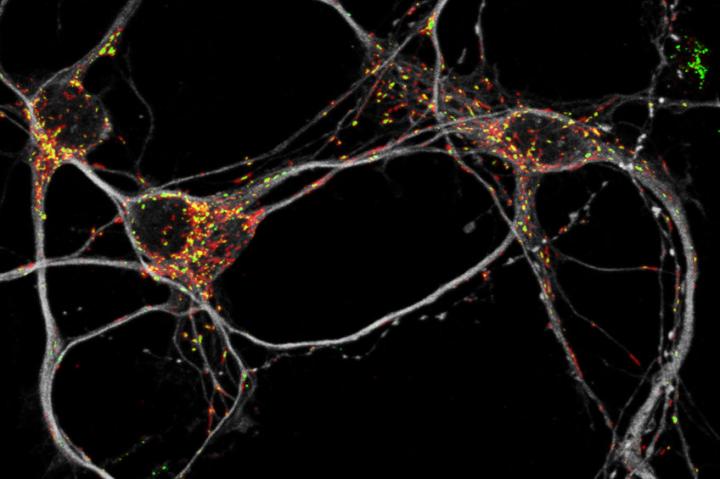
Credit: MPI f. Biology of Ageing/ E. Motori
Mitochondria are the power plants of our cells and play an important role in providing energy for normal function of the tissues in our body. Nerve cells are particularly dependent on mitochondria for their activity and decreased mitochondrial function is seen in both inherited and more common age-associated forms of degenerative diseases. A long-standing view has been that neurons, in contrast to other cell types, cannot adjust their metabolism to compensate for mitochondrial dysfunction, and therefore irreversibly degenerate. In a new study, researchers from the Max Planck Institute for Biology of Aging in Cologne, Germany, and the Karolinska Institute in Stockholm, Sweden, challenge this dogma by showing that neurons have the potential to counteract degeneration and promote survival by adapting their metabolism.
In our increasingly ageing society, neurodegenerative diseases are posing a significant burden. A growing body of evidence has linked mitochondrial dysfunction to some of the most devastating forms of neurodegeneration, such as Parkinson´s disease, different ataxias and several peripheral neuropathies. However, despite the urge to find strategies to prevent or arrest neurodegeneration, our understanding of the precise events underlying neuronal death caused by mitochondrial dysfunction is very limited. “We generally tend to consider neurons as terminally differentiated cells with very limited or no capacity to adapt their energy metabolism to challenging conditions”, says Elisa Motori, a lead author of this study. “For some neurological diseases there is ample evidence that mitochondrial dysfunction can be tolerated for lengthy periods of time. We therefore asked the question whether degenerating neurons may activate a program of metabolic resilience.”
The researchers devised an innovative approach to purify degenerating neurons from the mouse brain and analyze the global protein content (proteome) of these neurons. “Unexpectedly, the proteomic data showed the existence of a precisely coordinated, neuron-specific metabolic program that becomes activated in response to mitochondrial dysfunction”, continues Motori.
Metabolic rewiring
In particular, the authors identified a form of metabolic rewiring (Krebs cycle anaplerosis) that makes neurons resistant to an otherwise very rapidly progressing degeneration. This type of metabolic adaptation was previously only thought to occur in peripheral tissues or supporting cells (glia cells) in the brain. “The finding that neurons can induce anaplerosis was not only intriguing, but we could further demonstrate that it had a protective role. When we blocked anaplerosis neurons died at a much faster pace and the disease became more severe.” explains Elisa Motori.
The identification of certain forms of metabolic rewiring in dysfunctional neurons provide new mechanistic insights into the processes leading to neurodegeneration. Based on these new findings, the authors hope that it may be possible to develop therapeutic approaches to prolong neuronal survival and improve function in patients with mitochondrial diseases and other types of neurodegeneration.
###
Original publication
Motori, E., Atanassov, I., Kochan, S.M.V., Folz-Donahue, K., Sakthivelu, V., Giavalisco, P., Toni, N., Puyal, J., and Larsson, N.-G.
Neuronal metabolic rewiring promotes resilience to neurodegeneration caused by mitochondrial dysfunction.
Science Advances 28 Aug 2020
Vol. 6, no. 35, eaba8271
Media Contact
Dr. Elisa Motori
[email protected]
Original Source
hthttps:/
Related Journal Article
http://dx.