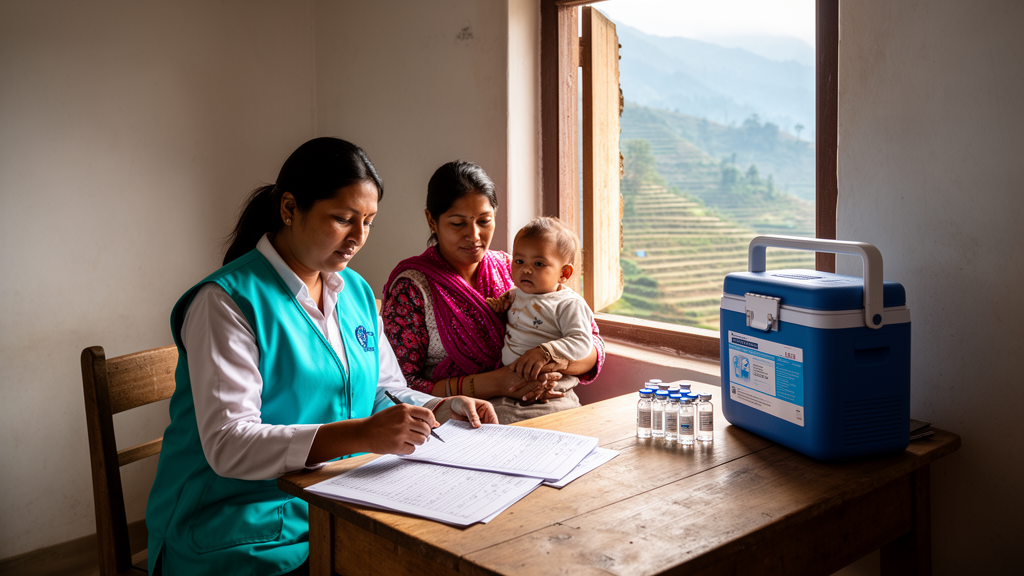
A concurrent mixed-methods implementation study across four provinces of Nepal has identified a compliance paradox in routine immunisation microplanning, where nearly universal reported annual planning coexists with substantial gaps in completing and using national planning tools. Reporting in the International Journal for Equity in Health, researchers found that while 97.4 percent of surveyed health facilities reported preparing or updating an annual microplan, closer examination of facility records revealed that several core analytical and equity-focused components were frequently omitted or left unused.
Immunisation microplanning is designed to help local health services identify underserved populations, schedule vaccination sessions, calculate vaccine requirements, and leverage local data to correct coverage disparities. In Nepal, health facilities are provided with a national microplanning package consisting of a catchment area section and ten standardized national forms intended to structure operational delivery. However, empirical evidence regarding whether primary health workers systematically complete and apply each component of this national planning package has remained limited.
To investigate microplanning practices and operational fidelity, a research team led by Abhiyan Gautam conducted a cross-sectional study from November 4 to November 30, 2025. The investigation incorporated both quantitative assessments and qualitative evaluations across facility, municipal, district, provincial, and federal administrative levels. In total, the study surveyed 230 health facilities and conducted 96 key informant interviews, analyzing qualitative data through NVivo guided by the Consolidated Framework for Implementation Research.
Beyond self-reported annual preparation from the broader survey of 230 facilities, trained researchers conducted an in-depth review of catchment records and the ten national forms alongside responsible health workers in a purposive subsample of 52 health facilities representing 26 local governments. This purposively selected group was chosen to include facilities displaying both stronger and weaker microplanning track records, enabling the investigators to assess item-level documentation and demonstrated practical utilization rather than relying solely on administrative reporting.
The subsample review demonstrated marked disparities between basic operational schedules and analytical microplanning tools. While vaccine and logistics documentation was confirmed in 39 to 47 of the 52 evaluated facilities, and session planning was documented in 39 facilities, equity-oriented components were completed far less often. Specifically, social mapping and centre-level dropout analysis were each documented in only 23 facilities. Annual implementation reviews were found in 22 facilities, documented resource alignment and demonstrated vulnerable-group planning were each identified in 19 facilities, and problem categorisation was recorded in only 18 facilities.
Key informant interviews illuminated multiple systemic challenges underlying these incomplete records, including form complexity, uneven form-specific training, high staff turnover, limited technical supervision, and delayed municipal budget disbursements. Participants further highlighted discrepancies between data sources and minimal community participation in the planning process. Based on these descriptive findings, the authors concluded that high reported compliance can mask critical deficits in planning execution, recommending that future prospective evaluations test targeted interventions such as form-specific training, technical supervision, data reconciliation, enhanced community engagement, and stronger ties between operational plans and local municipal budgets.
In evaluating the scope and limitations of the investigation, the authors highlighted that the quantitative findings remain descriptive, capturing conditions across the four selected provinces during the November 2025 study period. Because the detailed examination of the catchment section and ten national forms relied on a purposive subsample of 52 facilities across 26 local governments, the results reflect practices within the assessed settings rather than establishing universal prevalence or causal effects. By deliberately selecting health facilities with stronger and weaker microplanning track records, the researchers structured the subsample to observe item-level completion and practical utilization across varying operational environments, providing a realistic assessment of frontline documentation fidelity.
The findings emphasize a fundamental operational tension between administrative reporting and the analytical objectives of microplanning. Although microplanning is intended to assist health services in identifying underserved populations, planning sessions and vaccine requirements, and leveraging local data to correct coverage gaps, actual implementation diverged sharply across components. The high rate of annual updating reported across 224 of the 230 facilities stood in sharp contrast to the purposive subsample audit, where analytical and equity-focused tools were frequently neglected. This gap indicates that routine administrative compliance does not necessarily ensure that primary health workers perform critical problem categorisation, centre-level dropout analysis, or vulnerable-group planning.
To address the structural challenges identified through the Consolidated Framework for Implementation Research, the authors underscored that future prospective studies are needed to test targeted implementation strategies. Key informants across facility, municipal, district, provincial, and federal levels noted that staff face complex forms, uneven form-specific training, high turnover, and limited technical supervision, compounded by delayed municipal budgets and mismatched data sources. To determine how these multi-level barriers can be overcome, future trials must evaluate whether providing hands-on form-specific training, reinforcing technical supervision, reconciling conflicting data sources, fostering active community participation, and establishing closer links between facility microplans and local municipal budgets can convert nominal compliance into effective immunisation microplanning.
Subject of Research: Immunisation microplanning implementation and form completion in Nepal
Article Title: The compliance paradox in immunisation microplanning: a concurrent mixed-methods study of reported uptake and gaps in form completion and use in four provinces of Nepal
Article References: Gautam, A., Upadhyaya, M. K., Shahabuddin, A., Lal, B. K., Lama, U., Koirala, U. K., Mahaseth, S., Basnet, A., Adhikari, R., Setiawan, B., Dhungana, A., Joshi, P. C., Gautam, M., Maharjan, S., Thapa, A., Ayer, N., Khadka, K., Bhujel, D., & Fazil, K. F. A. (2026). The compliance paradox in immunisation microplanning: a concurrent mixed-methods study of reported uptake and gaps in form completion and use in four provinces of Nepal. International Journal for Equity in Health. https://doi.org/10.1186/s12939-026-03110-8
Image Credits: AI Generated
DOI: 10.1186/s12939-026-03110-8
Keywords: immunisation microplanning, Nepal health facilities, vaccine logistics, session planning, compliance paradox, social mapping, dropout analysis, vulnerable-group planning, implementation research, mixed-methods study, Consolidated Framework for Implementation Research, health worker training, resource alignment, technical supervision, community participation, routine immunization, local health governance
News Source: Courtney Benton. (November 12, 2026). Nepal Immunisation Microplanning Shows High Reported Uptake but Gaps in Completion. Scienmag.