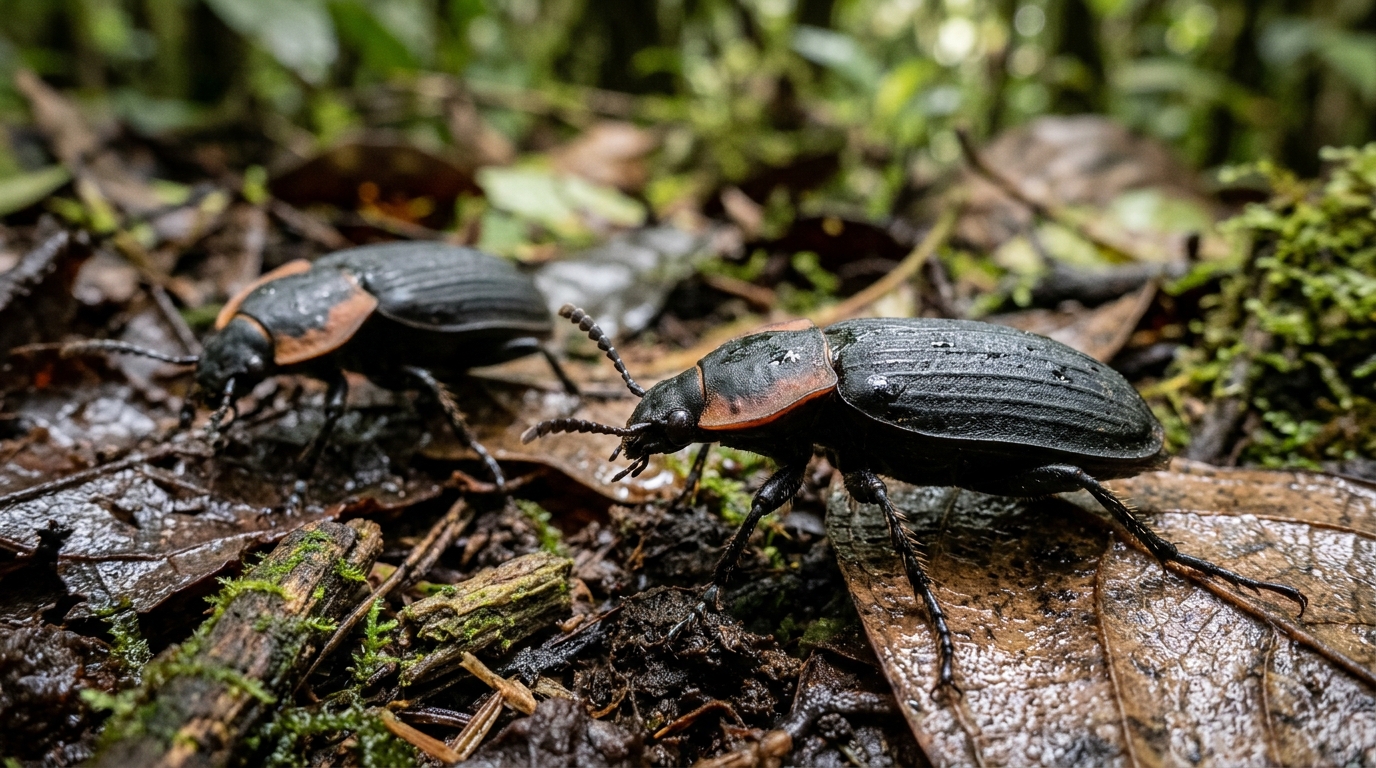
Carrion-associated beetles rely on specialized volatile organic compounds emitted by decaying organic matter to find critical feeding substrates and mating locations, according to experimental findings published in The Science of Nature. In a detailed study conducted at the Federal University of Lavras in Minas Gerais, Brazil, an entomological research team demonstrated that two Neotropical beetle species of recognized forensic importance exhibit clear, contrasting behavioral preferences for distinct phases of post-mortem decay. Laboratory olfactometry assays revealed that males of the silphine carrion beetle Oxelytrum discicolle preferentially orient toward volatile chemical bouquets collected from domestic pig carcasses at an advanced decomposition stage, whereas both sexes of the scarabaeid beetle Deltochilum rubripenne selectively navigate toward odor extracts released during the initial fresh stage of decomposition. Across all experimental bioassays, the presence or absence of prior colonization by other carcass-associated arthropods did not significantly alter the directional choices made by either beetle species, demonstrating that the overarching stage of tissue degradation provides the primary chemical cues guiding initial resource detection under the conditions evaluated.
Understanding how necrophagous and predatory insects locate ephemeral vertebrate remains provides critical insights into the chronological mechanisms driving ecological succession, which underpins the biological estimation of post-mortem intervals in forensic investigations. Following an organism’s death, internal and external microbial communities rapidly metabolize cellular structures through autolysis and putrefaction, releasing an ever-changing blend of volatile organic compounds that serve as directional semiochemicals for arriving arthropod populations. During the initial hours of decomposition, microbial metabolism generates chemical profiles dominated by volatile amines and sulfur-containing compounds that signal newly available substrates to early colonizers. These distinct temporal shifts in gaseous emissions act as chemical signposts across trophic levels, allowing specialized carrion insects to identify stages that best match their specific nutritional requirements, predatory opportunities, and physiological adaptations for reproductive success.
The two beetle species evaluated in this investigation inhabit Neotropical forest habitats across Brazil and represent divergent functional guilds within the carrion community. Oxelytrum discicolle, a member of the family Staphylinidae and subfamily Silphinae, is known to colonize decomposing bodies where it exhibits a dual dietary role as a necrotrophage and an active predator of necrophagous fly larvae. In this species, pioneering males typically arrive at the carcass first, subsequently releasing volatile sex pheromones from the substrate to attract receptive females for mating and local oviposition. In contrast, Deltochilum rubripenne is a scarabaeine dung beetle that exhibits a generalist, copro-necrophagous feeding strategy, showing a marked preference for carrion over mammalian excrement without exhibiting any predatory behavior toward competing carcass fauna. Because of their differing life histories, the researchers hypothesized that predatory O. discicolle males would show enhanced attraction to advanced-stage carcasses bearing prior arthropod colonization due to elevated prey availability, whereas non-predatory D. rubripenne beetles would favor early, uncolonized carcasses to avoid direct larval competition.
To obtain native adult beetle populations for controlled laboratory testing, researchers established sampling grids within the protected Seasonal Semideciduous Forest and Cerrado savanna formations of the Quedas do Rio Bonito Ecological Park, situated at an altitude of approximately 919 meters. Field collections were executed during January and February 2024 using two large baited exclusion cages measuring 74 by 74 by 71 centimeters supplied with two kilograms of mixed animal muscle tissue composed of equal parts beef, pork, and chicken. These sampling stations were supplemented by five smaller field traps holding fifty grams of meat bait, with all collection structures shielded from rainfall by durable plastic sheets. Modified live-capture pitfall buckets placed beneath the elevated bait platforms trapped beetles unharmed without drowning fluids, allowing the captured specimens to be transferred directly to climate-controlled rearing chambers maintained at twenty-five degrees Celsius, seventy-five percent relative humidity, and a regulated twelve-hour photoperiod to establish stable experimental stocks.
In the laboratory, researchers established a thriving breeding colony of Oxelytrum discicolle using 124 wild-caught females and 92 males, housing individual mating pairs in two-liter containers with autoclaved soil, moistened filter paper, and fresh ground beef refreshed daily. Developing silphine larvae were separated upon hatching into individual containers supplied with meat and later transferred into autoclaved topsoil for pupation, successfully producing captive F1 and F2 generations. Conversely, field-collected Deltochilum rubripenne specimens did not reproduce under artificial laboratory conditions despite being supplied with sterilized red soil, moisture, and fresh meat inside ventilated plastic containers fitted with fine-mesh lids to exclude parasitic phorid flies. Consequently, researchers maintained 72 wild-caught D. rubripenne males and 72 females under identical environmental chambers for 120 days before testing, allowing the beetles to acclimate fully to standardized laboratory conditions prior to being subjected to behavioral bioassays.
The volatile stimuli used in the comparative trials were collected from twenty-eight euthanized domestic piglets weighing between 400 and 500 grams, sourced from a commercial facility in Oliveira, Brazil. To study the chemical effects of insect succession, half of the piglet bodies were left exposed to natural outdoor arthropod colonization beneath protective metal cages, while the remaining carcasses were sealed inside breathable mesh cages with apertures of 0.5 millimeters or less to completely prevent arthropod access while preserving ambient environmental aeration. Carcasses exposed for approximately twenty-four hours represented the fresh decomposition stage, defined by intact epidermal boundaries and the onset of natural colonization, whereas carcasses exposed for ninety-six hours represented active decay, characterized by skin rupture, substantial tissue liquefaction, and heavy larval activity.
Volatiles were extracted from four individual piglet carcasses per treatment group using dynamic headspace push-pull aeration systems operated inside controlled laboratory rooms at twenty-five degrees Celsius. Each carcass was sealed inside a 41 by 33 centimeter polyester sampling bag receiving charcoal-filtered air at an inflow rate of 1.1 liters per minute while an outflow pump drew air across thirty milligrams of HayeSep-Q adsorbent polymer at 0.8 liters per minute for three hours. The volatile organic compounds trapped on the adsorbent matrix were eluted using one hundred microliters of high-purity dichloromethane and stored at minus twenty degrees Celsius. Dual-choice olfactometry bioassays were subsequently conducted in custom glass chambers to quantify beetle orientation toward distinct treatment pairings, with laboratory-reared O. discicolle males tested individually for five minutes following an eight-hour starvation period, while slower-moving D. rubripenne adults were evaluated in single-sex cohorts of four individuals observed across sixty-minute trials following forty-eight hours of food deprivation.
Statistical modeling of decisive insect choices demonstrated striking, stage-specific divergence in behavioral preference between the two beetle taxa. When presented with odors from colonized carcasses at different stages of decay, sixty-three percent of tested Oxelytrum discicolle males directed their movement toward the advanced decomposition stage rather than the fresh stage, establishing a statistically significant preference within generalized linear mixed-effects binomial models. However, when male O. discicolle were offered a subsequent choice between colonized and uncolonized advanced-stage carcasses, sixty percent selected the colonized extract and forty percent selected the uncolonized extract, a distribution that showed no statistically significant discrimination. This indicates that while advanced decomposition volatiles represent a potent behavioral attractant for silphine males seeking mating and prey substrates, the volatile modifications specifically contributed by prior arthropod colonizers are insufficient to drive significant orientation choices under these test conditions.
In contrast to the carrion specialist, Deltochilum rubripenne exhibited an unambiguous preference for volatile bouquets associated with early post-mortem intervals, with seventy-six percent of males and seventy percent of females selecting the fresh stage over the advanced decay stage in dual-choice tests. When exposed to fresh-stage carcasses with and without prior insect colonization, sixty-three percent of males and forty-eight percent of females chose the colonized carcasses, yielding no statistically significant discrimination based on colonization history for either sex. This marked behavioral preference for freshly deceased carcasses corresponds with the natural feeding ecology of D. rubripenne, which possesses specialized clypeal denticles enabling the mechanical consumption of relatively intact tissues and feeds primarily on fresh microbial blooms containing carbohydrates, minerals, and nitrogenous compounds. Volatile profiles emitted during early decay, such as trimethylpyrazine and aliphatic alcohols, closely mirror the chemical signatures found in fresh mammalian dung, explaining the strong attraction of this copro-necrophagous beetle to fresh organic matter.
The study authors emphasize that while previous literature has documented both beetle species occurring across broad successional windows in field surveys, their olfactory mechanisms are tuned to distinct chemical blends reflecting their specific ecological requirements. For Oxelytrum discicolle, the intense release of sulfur compounds like dimethyl trisulfide during advanced liquefaction provides an unmistakable chemical cue for establishing reproductive territories and securing abundant dipteran prey for emerging larvae. For Deltochilum rubripenne, detecting volatile nitrogen compounds immediately after death ensures rapid arrival at ephemeral resources before competitive insect biomass accumulates. Because decaying vertebrate remains are inherently unpredictable and short-lived in tropical environments, relying directly on robust stage-specific volatile organic compounds appears to provide a more dependable foraging strategy for Neotropical carrion beetles than attempting to resolve finer chemical modifications generated by previous colonizing arthropods.
Subject of Research: Stage-specific olfactory preferences of Neotropical carrion beetles responding to carcass volatiles
Article Title: Volatiles from decomposing bodies mediate stage-specific olfactory preferences in Neotropical carrion-associated beetles
Article References: dos Santos, L. C., Pitaluga, B., Garcia-Souza, E., Vieira, L., & Peñaflor, M. F. G. V. (2026). Volatiles from decomposing bodies mediate stage-specific olfactory preferences in Neotropical carrion-associated beetles. The Science of Nature, 113(6), Article 151. https://doi.org/10.1007/s00114-026-02198-w
Image Credits: AI Generated
DOI: 10.1007/s00114-026-02198-w
Keywords: Oxelytrum discicolle, Deltochilum rubripenne, forensic entomology, volatile organic compounds, decomposition stages, carrion beetles, olfactometry bioassays, Sus scrofa domesticus, chemical ecology, arthropod colonization, active decay, post-mortem interval, dimethyl trisulfide, semiochemicals, Silphinae, Scarabaeinae, ecological succession
News Source: Drew Townsend. (November 27, 2026). Neotropical Carrion Beetles Target Specific Decomposition Stages Using Carcass Odor Blends. Scienmag.