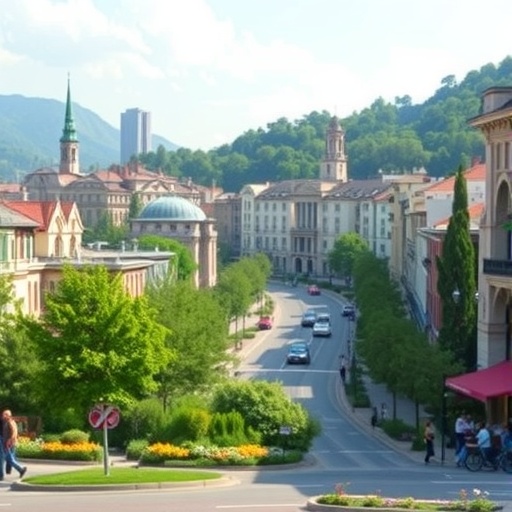
In an era where urbanization is accelerating at an unprecedented pace, the integration of natural elements into urban development has emerged as a promising strategy to enhance human well-being and address social equity concerns. The groundbreaking research by Gao, Zhang, zu Ermgassen, and colleagues, recently published in Nature Cities, provides a comprehensive analysis of nature-inclusive urban development, focusing on its multifaceted impacts on residents’ psychological health and perceptions of fairness within diverse communities.
The study acknowledges the escalating challenges posed by rapid urban growth, which often results in environmental degradation, reduced access to green spaces, and heightened social disparities. Against this backdrop, nature-inclusive design approaches aim to embed ecological features—such as parks, green roofs, urban forests, and water bodies—into the fabric of cities, creating environments that support both biodiversity and human health. Gao et al. investigate not only the ecological and aesthetic benefits of these interventions but also their social ramifications, an area that has received increasing attention yet remains underexplored at a rigorous empirical level.
At the heart of the research lies the hypothesis that improving access to natural spaces within urban contexts will produce dual benefits: enhancing subjective well-being and fostering stronger perceptions of fairness among inhabitants. Subjective well-being encompasses individuals’ self-reported happiness, mental health, and life satisfaction, while fairness perceptions relate to how equitably resources—here, green spaces—are distributed and whether residents feel included in urban development processes. These dimensions are crucial as cities strive to become inclusive environments that do not perpetuate or exacerbate existing social inequalities.
To test their hypothesis, the authors employed a mixed-methods approach, combining large-scale survey data analysis with spatial mapping techniques and ethnographic fieldwork. This methodological triangulation enabled them to capture both quantitative trends and qualitative nuances in how urban residents experience and interpret nature-inclusive developments. Innovative use of Geographic Information Systems (GIS) allowed for precise measurement of green space distribution relative to demographic factors such as income, ethnicity, and age, thereby shedding light on underlying equity patterns.
One of the key technical contributions of the study is the development of a novel metric framework that quantifies not only the physical availability of green space but also its perceived accessibility and quality. This distinction is critical; previous urban ecology studies often overemphasized the mere presence of vegetation without accounting for residents’ subjective experiences, which greatly influence actual usage and psychological benefits. By incorporating survey indicators on perceived safety, maintenance, and cultural relevance of natural areas, the authors paint a more comprehensive picture of urban nature’s role.
In analyzing the data, Gao and colleagues found robust evidence that nature-inclusive urban developments significantly elevate residents’ well-being. Cities with well-integrated green infrastructure, especially those featuring diverse plant species and multifunctional spaces, reported higher average happiness scores and lower instances of stress-related symptoms among inhabitants. These findings align with ecological psychology theories that underscore the restorative effects of natural environments on attentional capacity and emotional regulation, thereby substantiating the therapeutic potential of urban nature.
Simultaneously, the research reveals complex dynamics regarding fairness perceptions. While improved green space access broadly enhances perceived equity, disparities persist. Marginalized communities—often located in historically underserved neighborhoods—tend to report lower satisfaction with green space quality and limited influence over development decisions. This highlights the need for inclusive planning processes that actively engage diverse stakeholders to co-create nature-inclusive spaces that resonate with local cultural values and needs.
Importantly, the authors suggest that nature-inclusive development should not be conceived merely as an environmental upgrade but as a catalyst for social transformation. The study emphasizes the necessity of participatory governance models, where urban green initiatives are designed and managed collaboratively with community members, policymakers, and ecologists. Such democratic approaches can mitigate risks of green gentrification, which may inadvertently displace vulnerable populations by increasing real estate values around pristine natural amenities.
The paper also discusses innovative design strategies that promote equity. For example, polycentric green networks that connect multiple neighborhoods through ecological corridors can distribute benefits more evenly than isolated parks. Additionally, integrating green elements into everyday urban infrastructure—street trees, community gardens, green walls—ensures that nature permeates daily experiences for a wider segment of the population. The authors argue that these integrative techniques require interdisciplinary collaboration among urban planners, landscape architects, social scientists, and public health experts.
From a policy perspective, the study recommends that municipal governments adopt comprehensive frameworks that evaluate nature-inclusive initiatives not only through environmental indicators but through social equity and health outcome lenses. Such holistic assessment tools can guide resource allocation and prioritize interventions that maximize both biodiversity conservation and human flourishing. The authors advocate for adopting standardized metrics across cities to enable benchmarking and knowledge exchange, catalyzing a global movement toward equitable nature-based urbanism.
Gao et al. also underscore the importance of longitudinal monitoring to capture the evolving impacts of nature-inclusive development. Urban ecosystems and social compositions change over time, and adaptive management practices are essential to sustain benefits. The introduction of digital platforms and citizen science tools can facilitate ongoing community engagement and real-time feedback, fostering a dynamic relationship between residents and urban nature that evolves with shifting needs and priorities.
Furthermore, the integration of cutting-edge technologies enhances the feasibility and precision of nature-inclusive planning. Remote sensing, machine learning algorithms, and spatial analytics enable the identification of optimal sites for green interventions, prediction of ecological outcomes, and evaluation of social impacts. The study highlights successful pilot projects where data-driven methods informed equitable distribution of urban green spaces, illustrating a promising synergy between technology and participatory democracy.
This research provides a compelling call to reimagine cities not merely as concrete and asphalt landscapes but as vibrant socio-ecological systems that nurture human well-being and social justice. By demonstrating the measurable benefits of integrating nature inclusively into urban development, Gao and colleagues contribute critical evidence supporting policy shifts toward sustainable and fair urban futures. Their work inspires urban stakeholders worldwide to envision and implement greener, more equitable cities that serve all inhabitants.
The insights gained also have profound implications for global sustainability frameworks, including the United Nations’ Sustainable Development Goals, particularly SDG 11 (Sustainable Cities and Communities) and SDG 3 (Good Health and Well-being). Embedding nature into cities emerges as a low-cost, high-impact intervention that simultaneously addresses climate resilience, health disparities, and social cohesion, amplifying co-benefits across multiple domains.
As urban populations continue to swell, the urgency to implement scientifically informed, nature-inclusive planning grows even stronger. The evidence presented highlights that greenery in cities is no longer an optional luxury but a critical infrastructure integral to human health and social equity. Policymakers, urban designers, and citizens are encouraged to harness this knowledge and advocate for transformative change that integrates nature as a foundational pillar of urban life.
In conclusion, the pioneering study by Gao et al. elucidates the pathways through which nature-inclusive urban development fosters enhanced well-being and perceptions of fairness, underscoring the essential role of green spaces as social equalizers. The research synthesis provides a roadmap for cities aiming to cultivate environments that are not only ecologically sustainable but socially just and psychologically enriching. This heralds a paradigm shift toward a more harmonious coexistence between people and nature within the urban landscape.
Subject of Research: Impacts of nature-inclusive urban development on well-being and fairness perceptions
Article Title: Impacts of nature-inclusive urban development on well-being and fairness perceptions
Article References:
Gao, S., Zhang, W., zu Ermgassen, S.O.S.E. et al. Impacts of nature-inclusive urban development on well-being and fairness perceptions. Nat Cities (2026). https://doi.org/10.1038/s44284-026-00425-z
Image Credits: AI Generated
DOI: https://doi.org/10.1038/s44284-026-00425-z
Tags: biodiversity in citiesenvironmental justice in city designgreen roofs for urban sustainabilityimpact of parks on social cohesionintegrating water bodies in city landscapesnature-based solutions for urban areasnature-inclusive urban developmentpsychological benefits of urban greenerysocial equity in urban planningsustainable urban growth strategiesurban forests and community well-beingurban green spaces and mental health