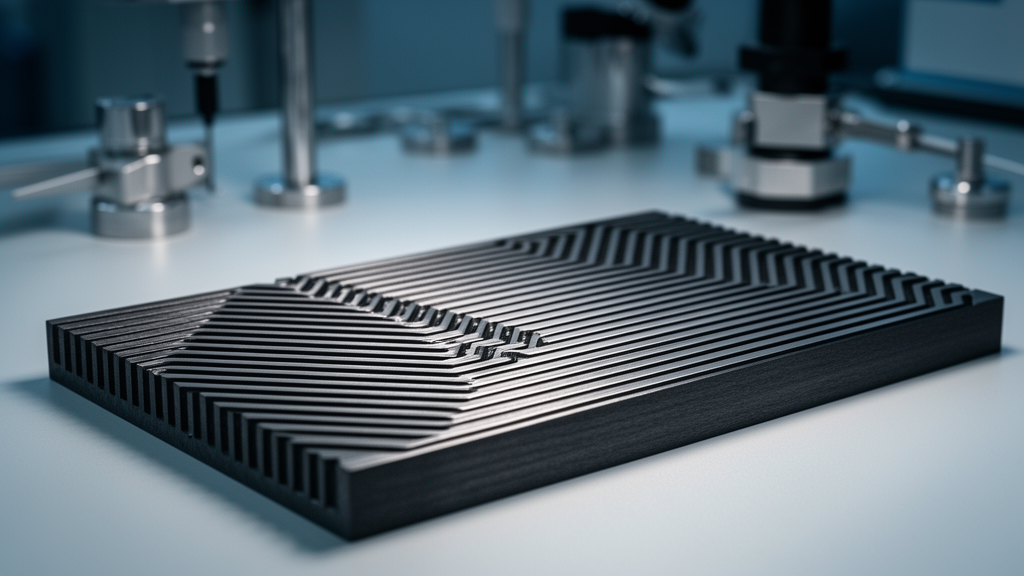
Proton exchange membrane fuel cells operate as clean, highly efficient energy conversion devices for transportation and stationary power generation, functioning at moderate temperatures between 70 and 80 degrees Celsius. Within these electrochemical systems, bipolar plates serve as critical multifunctional structures responsible for carrying electrical current, delivering structural rigidity, facilitating gas distribution, and managing generated heat and water across individual cells. While traditional designs often rely on metallic plates or synthetic carbon formulations, metallic components remain highly susceptible to corrosion in active operating environments, causing catalyst degradation and cell decay. Coating metallic plates introduces significant processing expenses and unresolved long-term durability bottlenecks that impede large-scale commercialization. Conversely, synthetic graphite and high-performance carbon nanomaterials require intricate, energy-intensive synthesis pathways. Addressing these challenges, researchers have developed an industrially viable, low-cost composite bipolar plate using locally sourced, pure flake-shaped natural graphite embedded in a recyclable polyphenylene sulfide thermoplastic matrix.
The study investigates whether natural graphite, despite its traditional vulnerability to mechanical trade-offs when used at elevated filler loadings, can satisfy stringent Department of Energy performance thresholds through controlled particle engineering and straightforward consolidation. Graphite-polymer composites offer inherent chemical stability and corrosion resistance, wherein the thermoplastic matrix acts as a durable binder while graphite flakes establish interconnected conductive networks. However, conventional formulations typically exhibit an inverse relationship between conductivity and mechanical integrity, as larger reinforcement flakes enhance electrical pathways but disrupt polymer continuity and degrade mechanical strength. To resolve this persistent trade-off without introducing hazardous processing chemicals or multi-step synthetic procedures, the investigators formulated a multimodal particle distribution. By combining large jumbo graphite flakes with micro-scale fine graphite particles, the team sought to engineer dense conductive bridges across the polymer matrix, maximizing both in-plane and through-plane charge transport while simultaneously fortifying interfacial mechanical resilience.
The experimental matrix evaluated twelve distinct compositional blends using natural graphite supplied by Nouveau Monde Graphite in Quebec, Canada, paired with polyphenylene sulfide powder obtained from Alpha Chemistry. The precursor jumbo graphite exhibited an average particle diameter of approximately 500 micrometers with exceptionally high graphitization and negligible structural defects, characterized by an Raman intensity ratio of defect to graphite bands of approximately 0.02. In contrast, the fine graphite flakes measured roughly 5 micrometers across. Polyphenylene sulfide was selected due to its semi-crystalline nature, elevated chemical and thermal stability, dimensional consistency, and a high melt flow index of 150 grams per 10 minutes. This exceptional melt fluidity allows the molten polymer to penetrate between tightly packed graphite flakes under pressure, facilitating flow-induced particle alignment and homogenous reinforcement dispersion without requiring high-shear injection molding or chemical dispersing agents.
Composite processing relied entirely on mechanical ball milling followed by direct hydraulic compression molding, establishing an accessible manufacturing framework suitable for commercial scale-up. The graphite and polyphenylene sulfide powders were mixed in a planetary ball mill using 5-millimeter zirconia balls at a ball-to-powder ratio of 15 to 1, operating at 300 revolutions per minute for two hours with a ten-minute pause to prevent structural damage. Energy-dispersive X-ray spectroscopy confirmed the complete absence of contamination from the grinding media. Following dry blending, the powdered mixtures were loaded into an in-house designed mold and consolidated in an automated hydraulic press at a peak processing temperature of 310 degrees Celsius and a maximum compressive pressure of 50 megapascals for 30 minutes. The consolidated specimens were subsequently cooled at a controlled slow rate of 2 degrees Celsius per minute to room temperature, a thermal protocol specifically chosen to foster extended polymer chain relaxation and ordered interfacial crystallization.
Systematic screening across the formulations demonstrated that a hybrid composition designated as FJ1060—consisting of 10 weight percent fine graphite, 60 weight percent jumbo graphite, and 30 weight percent polyphenylene sulfide—achieved an optimal synergistic balance across all critical operational parameters. Microstructural examination through fractured cross-sectional scanning electron microscopy revealed that single-filler compositions containing 70 weight percent fine graphite suffered from loose particle packing, random orientations, and elevated contact angles. In the hybrid FJ1060 architecture, the fine 5-micrometer graphite particles migrated into the interstitial spaces between the large 500-micrometer jumbo flakes, functioning as conductive bridges and mechanical load-transfer interconnectors. The resulting composite exhibited exceptional densification surpassing 99.5 percent of theoretical density with a complete absence of internal voids or interfacial micro-cracks.
Spectroscopic and thermal evaluations verified that the slow cooling regimen and dense graphite packing induced trans-crystallinity within the polyphenylene sulfide matrix at the filler-polymer interface. X-ray diffraction patterns showed that while primary crystalline peaks for graphite and polyphenylene sulfide remained stationary at 26.5 and 20.7 degrees two-theta, the hybrid composite developed highly ordered interfacial structures without secondary phase formation. Raman spectroscopy revealed a significantly narrower graphite G-band at 1580 inverse centimeters and an intense polyphenylene sulfide peak at 1080 inverse centimeters, reflecting superior local ordering. Fourier transform infrared spectra demonstrated noticeable peak sharpening and broadening across characteristic polyphenylene sulfide vibrations at 1469, 1091, 1009, and 807 inverse centimeters, confirming strong intermolecular pi-pi stacking between aromatic rings of the polymer chains and basal planes of the graphite reinforcement. Differential scanning calorimetry determined that composite crystallinity reached 80 percent in the hybrid formulation, yielding a distinct, narrow melting endotherm with a melting enthalpy of 18.39 joules per gram.
Electrical characterization demonstrated that the hybrid particle arrangement established highly efficient transport pathways capable of exceeding key industry benchmarks. Because graphite-polymer composites exhibit substantial structural anisotropy, through-plane and in-plane conductivities were measured independently under applied pressures up to 5 megapascals using gold-plated copper electrodes and gas diffusion layer contact papers. The hybrid FJ1060 composite delivered a maximum through-plane electrical conductivity of approximately 21.2 siemens per centimeter, surpassing the target threshold of 20 siemens per centimeter commonly cited for operational fuel cell stacks where current travels axially through the plate thickness. Concurrently, the composite achieved an in-plane electrical conductivity of approximately 106 siemens per centimeter, satisfying the targeted requirement of exceeding 100 siemens per centimeter. The fine graphite flakes acted as electrical contact junctions, reducing interfacial contact resistance between adjacent jumbo flakes and establishing continuous, low-resistance conduction networks throughout the consolidated specimen.
Thermal transport and thermomechanical stability measurements demonstrated marked improvements, mitigating the severe thermal cycling degradation that often afflicts fuel cell hardware during startup and shutdown sequences. Bulk thermal conductivity, measured via the transient plane source method across anisotropic dimensions, reached approximately 13.7 watts per meter-kelvin in the hybrid FJ1060 specimen, comfortably exceeding Department of Energy targets and outperforming single-filler fine graphite composites. Thermomechanical analysis conducted under a nitrogen purge up to 110 degrees Celsius showed that while pure jumbo graphite composites displayed erratic dimensional behavior and negative thermal expansion rates due to Poisson contraction along the graphite c-axis, the hybrid formulation exhibited an exceptionally low and uniform thermal expansion rate of 0.041 parts per million per degree Celsius. The fine graphite network effectively absorbed matrix expansion stresses, dampening localized thermal gradients and preventing internal micro-cracking.
Fluid containment and mechanical robustness testing further confirmed the practical viability of the hybrid natural graphite composite for demanding fuel cell environments. Water absorption testing conducted over 24-hour room-temperature immersion in distilled water yielded an exceptionally low uptake of only 0.010 percent for the hybrid formulation, reflecting its tightly packed, hydrophobic microstructure. Nitrogen gas permeability evaluated via the differential pressure method across 2.5-millimeter-thick specimens under a pressure gradient of 1 kilogram-force per square centimeter demonstrated complete impermeability, recording zero gas passage over a continuous 12-hour testing window due to the tortuous diffusion pathways imposed by overlapping graphite flakes. Mechanically, universal testing machine measurements revealed a tensile strength of approximately 40.6 megapascals for the hybrid material—a 51 percent improvement over pure jumbo graphite formulations—closely approaching the 41-megapascal benchmark, alongside an outstanding compressive stress of 99.20 megapascals achieved without structural fracture, vastly exceeding standard stack clamping pressures.
The study concludes that integrating hybrid particle distributions of pure natural flake graphite into a recyclable, high-melt-flow polyphenylene sulfide thermoplastic provides an effective, environmentally sound pathway for fabricating commercial-grade fuel cell bipolar plates. By pairing 10 weight percent fine graphite with 60 weight percent jumbo graphite, the processing route bypasses synthetic carbon black, carbon nanotubes, or chemical functionalization agents in favor of straightforward planetary ball milling and compression molding. The resulting composite achieves an exceptional combination of high through-plane and in-plane electrical conductivity, superior bulk thermal dissipation, absolute nitrogen impermeability, negligible water absorption, and robust mechanical resilience. While long-term operational durability and continuous electrochemical performance under acidic fuel cell operating conditions warrant further dedicated investigation in future stack evaluations, this work establishes a viable, scalable blueprint for utilizing abundant natural mineral reserves in next-generation sustainable clean energy infrastructure.
Subject of Research: Natural graphite and polyphenylene sulfide composite bipolar plates for proton exchange membrane fuel cells
Article Title: Evaluating the potential of natural graphite as a sustainable material for bipolar plates in proton exchange membrane fuel cells
Article References: Irshad, H. M., Oliaii, E., Brassard, M., Khalid, M., & Shahgaldi, S. (2026). Evaluating the potential of natural graphite as a sustainable material for bipolar plates in proton exchange membrane fuel cells. Materials for Renewable and Sustainable Energy, 15(3), Article 39. https://doi.org/10.1007/s40243-026-00376-4
Image Credits: AI Generated
DOI: 10.1007/s40243-026-00376-4
Keywords: proton exchange membrane fuel cells, bipolar plates, natural graphite, polyphenylene sulfide, hybrid particle size, electrical conductivity, thermal conductivity, compressive strength, gas impermeability, ball milling, compression molding, trans-crystallinity, percolation threshold, energy conversion, flaked graphite, differential pressure method, transient plane source, coefficient of thermal expansion
News Source: Faith Mcneil. (November 21, 2026). Natural Graphite Composite Bipolar Plates Match Key Fuel Cell Standards. Scienmag.