• HOME
  • NEWS
  • EXPLORE
    • CAREER
      • Companies
      • Jobs
    • EVENTS
    • iGEM
      • News
      • Team
    • PHOTOS
    • VIDEO
    • WIKI
  • BLOG
  • COMMUNITY
    • FACEBOOK
    • INSTAGRAM
    • TWITTER
Saturday, February 7, 2026
BIOENGINEER.ORG
No Result
View All Result
  • Login
  • HOME
  • NEWS
  • EXPLORE
    • CAREER
      • Companies
      • Jobs
        • Lecturer
        • PhD Studentship
        • Postdoc
        • Research Assistant
    • EVENTS
    • iGEM
      • News
      • Team
    • PHOTOS
    • VIDEO
    • WIKI
  • BLOG
  • COMMUNITY
    • FACEBOOK
    • INSTAGRAM
    • TWITTER
  • HOME
  • NEWS
  • EXPLORE
    • CAREER
      • Companies
      • Jobs
        • Lecturer
        • PhD Studentship
        • Postdoc
        • Research Assistant
    • EVENTS
    • iGEM
      • News
      • Team
    • PHOTOS
    • VIDEO
    • WIKI
  • BLOG
  • COMMUNITY
    • FACEBOOK
    • INSTAGRAM
    • TWITTER
No Result
View All Result
Bioengineer.org
No Result
View All Result
Home NEWS Science News Biology

Nanoparticles for 3-D printing in water open door to advanced biomedical materials

Bioengineer by Bioengineer
February 9, 2018
in Biology
Reading Time: 2 mins read
1
Share on FacebookShare on TwitterShare on LinkedinShare on RedditShare on Telegram
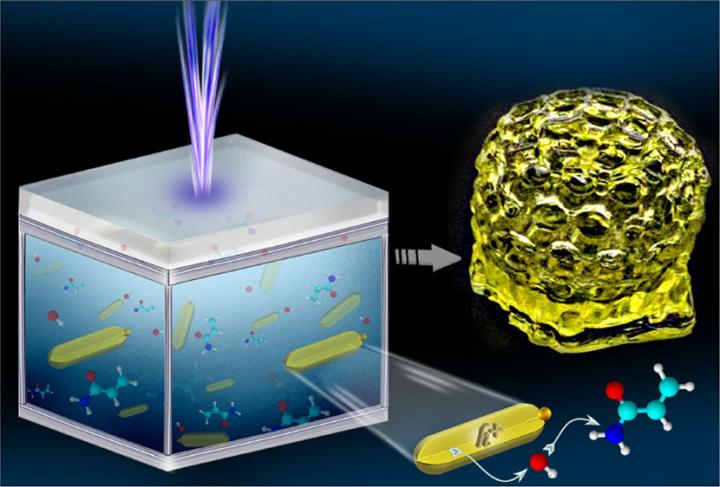
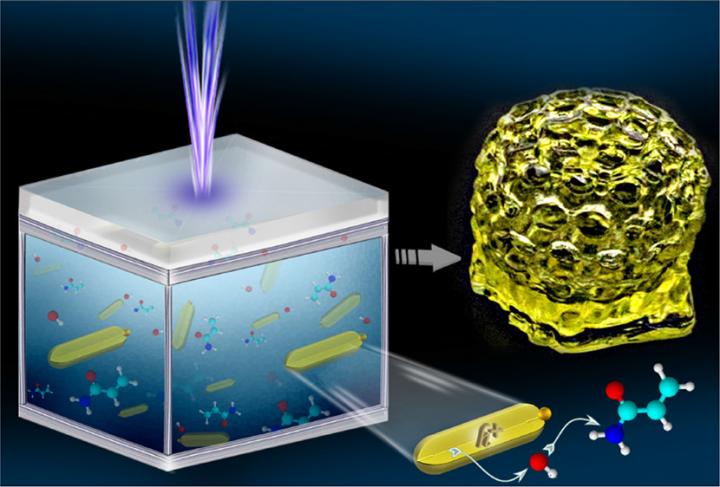
IMAGE

Credit: Adapted with permission from Pawar et al., Nano Lett. DOI: 10.1021/acs.nanolett.7b01870. Copyright (2017) American Chemical Society.

Researchers at the Hebrew University of Jerusalem's Center for Nanoscience and Nanotechnology have developed a new type of photoinitiator for three-dimensional (3D) printing in water. These novel nanoparticles could allow for the creation of bio-friendly 3D printed structures, further the development of biomedical accessories, and drive progress in traditional industries such as plastics.

3D printing has become an important tool for fabricating different organic based materials for a variety of industries. However, printing structures in water has always been challenging due to a lack of water soluble molecules known as photoinitiators — the molecules that induce chemical reactions necessary to form solid printed material by light.

Now, writing in Nano Letters, Prof. Uri Banin and Prof. Shlomo Magdassi at the Hebrew University's Institute of Chemistry describe an efficient means of 3D printing in water using semiconductor-metal hybrid nanoparticles (HNPs) as the photoinitiators.

3D printing in water opens exciting opportunities in the biomedical arena for tailored fabrication of medical devices and for printing scaffolds for tissue engineering. For example, the researchers envision personalized fabrication of joint replacements, bone plates, heart valves, artificial tendons and ligaments, and other artificial organ replacements.

3D printing in water also offers an environmentally friendly approach to additive manufacturing, which could replace the current technology of printing in organic based inks.

Unlike regular photoinitiators, the novel hybrid nanoparticles developed by Prof. Banin and Prof. Magdassi present tunable properties, wide excitation window in the UV and visible range, high light sensitivity, and function by a unique photocatalytic mechanism that increases printing efficiency while reducing the amount of materials required to create the final product. The whole process can also be used in advanced polymerization modalities, such as two photon printers, which allows it to produce high resolution features.

The research paper was featured in the American Chemical Society (ACS) Editor's Choice, where ACS offers free public access to new research of importance to the global scientific community, based on recommendations by the scientific editors of ACS journals from around the world. ACS is the leading publisher of peer-reviewed research journals in the chemical and related sciences.

###

Prof. Magdassi is the Enrique Berman Chair in Solar Energy at the Hebrew University. Prof. Banin is the incumbent of the Alfred & Erica Larisch Memorial Chair at the Institute of Chemistry at the Hebrew University.

Researchers involved in this study are affiliated with the Center for Nanoscience and Nanotechnology and The Institute of Chemistry at the Hebrew University of Jerusalem, in Israel, and the Institute of Systems Research and Department of Mechanical Engineering at the University of Maryland, in the United States.

Media Contact

Dov Smith
[email protected]
972-258-82844
@HebrewU

http://new.huji.ac.il/en

Original Source

http://new.huji.ac.il/en/article/35355 http://dx.doi.org/10.1021/acs.nanolett.7b01870

Share14Tweet8Share2ShareShareShare2

Related Posts

New Study Uncovers Mechanism Behind Burn Pit Particulate Matter–Induced Lung Inflammation

New Study Uncovers Mechanism Behind Burn Pit Particulate Matter–Induced Lung Inflammation

February 6, 2026

DeepBlastoid: Advancing Automated and Efficient Evaluation of Human Blastoids with Deep Learning

February 6, 2026

Navigating the Gut: The Role of Formic Acid in the Microbiome

February 6, 2026

AI-Enhanced Optical Coherence Photoacoustic Microscopy Revolutionizes 3D Cancer Model Imaging

February 6, 2026
Please login to join discussion

POPULAR NEWS

  • Robotic Ureteral Reconstruction: A Novel Approach

    Robotic Ureteral Reconstruction: A Novel Approach

    82 shares
    Share 33 Tweet 21
  • Digital Privacy: Health Data Control in Incarceration

    63 shares
    Share 25 Tweet 16
  • Study Reveals Lipid Accumulation in ME/CFS Cells

    57 shares
    Share 23 Tweet 14
  • Breakthrough in RNA Research Accelerates Medical Innovations Timeline

    53 shares
    Share 21 Tweet 13

About

We bring you the latest biotechnology news from best research centers and universities around the world. Check our website.

Follow us

Recent News

Scientists Identify SARS-CoV-2 PLpro and RIPK1 Inhibitors Showing Potent Synergistic Antiviral Effects in Mouse COVID-19 Model

Neg-Entropy: The Key Therapeutic Target for Chronic Diseases

Multidisciplinary Evidence-Based Guidelines for Therapeutic Drug Monitoring of Biologics in Inflammatory Bowel Disease

Subscribe to Blog via Email

Enter your email address to subscribe to this blog and receive notifications of new posts by email.

Join 73 other subscribers
  • Contact Us

Bioengineer.org © Copyright 2023 All Rights Reserved.

Welcome Back!

Login to your account below

Forgotten Password?

Retrieve your password

Please enter your username or email address to reset your password.

Log In
No Result
View All Result
  • Homepages
    • Home Page 1
    • Home Page 2
  • News
  • National
  • Business
  • Health
  • Lifestyle
  • Science

Bioengineer.org © Copyright 2023 All Rights Reserved.