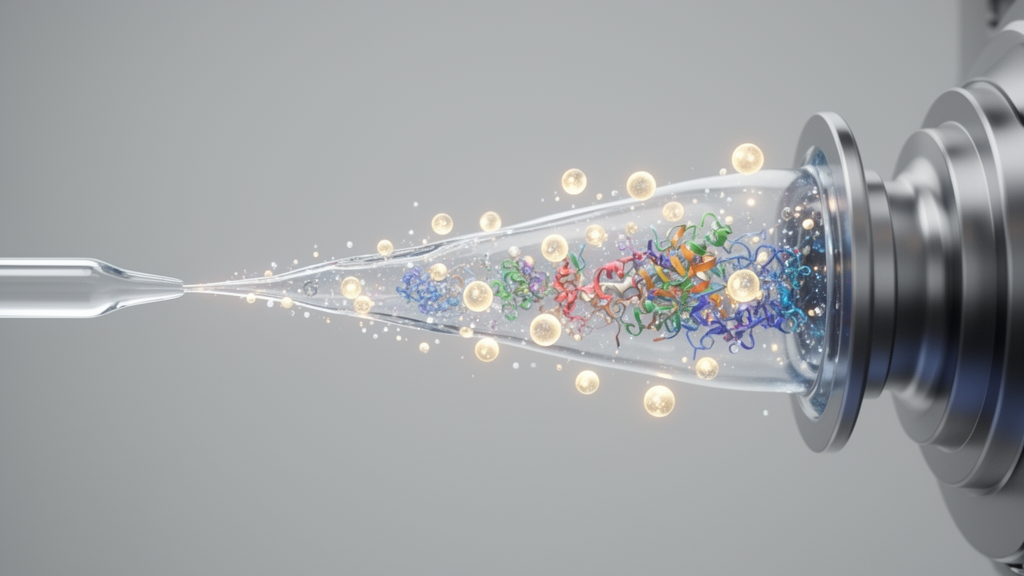
Coupling reversed-phase nano-liquid chromatography to an Orbitrap Fusion Lumos mass spectrometer using an open nanoflow sheath liquid interface enables researchers to modulate intact proteoform charge state distributions and signal intensities without altering denaturing chromatographic separation gradients. Researchers Tobias Waldmann, Philipp T. Kaulich, and Christian Neusüß investigated how emitter orifice dimensions and sheath liquid solvent chemistries govern electrospray ionization behavior for intact proteoforms extracted from Caucasian colon adenocarcinoma cells. By introducing a nanoflow sheath liquid interface—originally developed for capillary zone electrophoresis—into a nanoLC workflow, the study demonstrated that post-column sheath liquid addition shifts charge envelopes toward higher mass-to-charge ratios. Specifically, tailoring interface conditions shifted the dominant charge state of histone H4 from fifteen positive charges down to eight positive charges, illustrating an effective mechanism for expanding spectral separation between isobaric or modified proteoforms while preserving upstream liquid chromatographic resolution under standard acidic and organic mobile phases.
Mass spectrometry-based proteomics represents the recognized standard for investigating large numbers of intact proteins within complex biological samples, requiring robust hyphenation between mass spectrometers and separation techniques such as liquid chromatography or capillary zone electrophoresis. In conventional reversed-phase nanoLC-MS setups, column effluent containing organic modifiers and acidic additives is sprayed directly into the mass spectrometer through a pressure-tight, sheathless pulled-tip emitter. Because reversed-phase chromatography relies on acetonitrile and acidic eluents to separate proteoforms, eluting proteins remain extensively denatured and typically undergo electrospray ionization via the chain ejection model, generating broad distributions populated by highly charged ions. Although direct sheathless coupling is straightforward, these crowded low mass-to-charge envelopes frequently suffer from severe spectral congestion, causing overlapping precursor signals that hinder quantitative evaluation and trigger problematic co-isolation during tandem mass spectrometry fragmentation.
To examine electrospray ionization dynamics and manipulate proteoform charge states without disturbing upstream denaturing separations, the research team implemented the nanoCEasy nanoflow sheath liquid interface and evaluated its performance alongside conventional sheathless coupling. In the conventional arrangement, a ten-centimeter capillary emitter with a twenty-micrometer inner diameter and a ten-micrometer orifice inner diameter was coupled to the column via a conductive union and a nanoViper capillary. For the nanoflow sheath liquid coupling, a fifteen-centimeter capillary possessing an identical internal diameter had one end etched with hydrofluoric acid to an outer diameter of eighty to one hundred micrometers to penetrate deeply into the emitter. Unlike pressure-tight sheathless systems, the nanoCEasy interface functions as an open, self-supplying fluidic design where excess sheath liquid exits freely through the rear into waste. The interface was evaluated using glass emitters with a one-millimeter outer diameter and orifice inner diameters of either ten micrometers or thirty micrometers.
Biological testing of the hyphenated analytical system was conducted using low-molecular-weight proteoforms harvested from human Caucasian colon adenocarcinoma CaCo-2 cell cultures. The cells were grown in RPMI-1640 medium containing HEPES, L-glutamine, and phenol red, supplemented with ten percent fetal bovine serum and one percent penicillin-streptomycin at thirty-seven degrees Celsius with five percent carbon dioxide. Following detachment with TrypLE Express enzyme and washing with phosphate-buffered saline, cell pellets were stored at minus eighty degrees Celsius. Lysis of approximately twenty million cells was conducted in unbuffered eight-molar guanidinium chloride with complete protease inhibitor cocktail via ten freeze-thaw cycles alternating between an ethanol bath and ultrasonic treatment. Extracts were acidified with five percent formic acid, centrifuged at twenty-one thousand one hundred relative centrifugal force, and enriched through C18 solid-phase extraction. Intact proteoforms were eluted with acetonitrile fractions, dried completely by lyophilization, and resuspended in three percent acetonitrile with zero point one percent formic acid before analysis.
Nano-liquid chromatography separations were performed on an UltiMate 3000 RSLCnano system using an in-house slurry-packed ReproSil Gold 300 C4 column measuring four hundred fifty millimeters by seventy-five micrometers with three-micrometer particles. A ten-microliter sample volume was loaded onto a C4 trap column at twenty microliters per minute for five minutes using five percent mobile phase B before switching the trap in line with the separation column. Elution proceeded across a fifty-five-minute linear gradient from ten percent to ninety-five percent mobile phase B at a constant flow rate of one hundred nanoliters per minute. Effluent was introduced into an Orbitrap Fusion Lumos Tribrid mass spectrometer operating in intact protein, low-pressure, positive electrospray mode at two kilovolts. Survey MS1 spectra were collected across five hundred to two thousand mass-to-charge ratios at a resolution of one hundred twenty thousand, followed by electron transfer higher energy collisional dissociation MS/MS scans acquired at sixty thousand resolution.
To investigate the physicochemical effects of sheath fluid chemistry on electrospray performance, four different sheath liquid mixtures were systematically evaluated within the nanoCEasy interface. The standard mixture consisted of equal parts 2-propanol and water supplemented with zero point five percent formic acid. A second formulation composed of equal volumes of acetonitrile and water containing zero point five percent formic acid was examined to compare acetonitrile against 2-propanol on ionization efficiency. A third mixture incorporating acetonitrile and water with zero point one percent formic acid tested the consequences of reduced acid concentration, while a fourth aqueous formulation containing thirty percent 2-propanol and twenty millimolar ammonium acetate provided native-like electrospray conditions. Under a two-kilovolt spray potential, the ten-micrometer orifice emitter consumed approximately one hundred nanoliters per minute of sheath liquid, whereas the thirty-micrometer orifice emitter consumed approximately two hundred seventy nanoliters per minute, creating dramatically divergent effluent dilution environments during electrospray droplet formation.
Experimental comparisons established that emitter orifice inner diameter served as the predominant determinant governing absolute proteoform signal intensity across all evaluated sheath liquid compositions. When utilizing the ten-micrometer orifice emitter, base peak chromatogram intensities were roughly one order of magnitude higher than those recorded with the thirty-micrometer orifice emitter, matching the overall signal range of the conventional sheathless interface. Because the liquid chromatography system delivered effluent at a steady one hundred nanoliters per minute, the ten-micrometer emitter caused minimal sample dilution, producing mean proteoform fold changes between zero point six and zero point nine relative to sheathless coupling. Conversely, the thirty-micrometer emitter delivered substantially lower intensities, yielding mean fold changes between zero point zero five and zero point two compared to conventional nanoLC-MS. Among thirty-micrometer tests, the 2-propanol formulation with zero point five percent formic acid preserved the highest intensity, whereas acetonitrile formulations caused severe signal reduction that disproportionately impacted early-eluting proteoforms.
Quantitative repeatability and analytical precision were evaluated across triplicate injections by integrating extracted ion chromatograms for the most intense masses among twelve prominent proteoform peaks. The conventional sheathless nanoLC-MS interface displayed reproducible performance, registering an average relative standard deviation of nine percent across technical replicates. In the sheath liquid interface, the thirty-micrometer orifice emitter paired with 2-propanol and zero point five percent formic acid demonstrated comparable precision, exhibiting a mean relative standard deviation of eight percent. When testing the acetonitrile sheath liquid with zero point one percent formic acid, precision remained consistent between the thirty-micrometer emitter at fourteen percent and the ten-micrometer emitter at twelve percent. In marked contrast, pairing the ten-micrometer orifice emitter with the 2-propanol sheath liquid yielded notably diminished precision, showing an elevated mean relative standard deviation of twenty-nine percent, which the authors attributed to fluid viscosity, consumption rates, and mixing dynamics.
Deconvolution of mass spectra acquired at peak chromatographic maxima revealed that sheath liquid composition and emitter dimensions exerted profound control over proteoform charge state distributions. When spraying column effluent through the conventional sheathless interface or the ten-micrometer sheath liquid emitter, spectra exhibited single distributions dominated by highly charged ions. In contrast, the thirty-micrometer sheath liquid emitter induced a distinct secondary charge distribution shifted toward lower charge states and higher mass-to-charge values. Mechanistically, the authors explained that while denatured proteins in acidic organic solutions typically follow the chain ejection model to yield high charge states, sheath fluid additives and larger droplets may promote ion evaporation or charge residue ionization pathways, modulated by surface tension and electrostatic repulsion.
The capacity to shift proteoform charge state distributions toward higher mass-to-charge ratios offers substantial analytical utility by mitigating precursor co-isolation during tandem mass spectrometry fragmentation experiments. For the principal histone H4 proteoform at eleven thousand two hundred ninety-nine point thirty-nine daltons, transitioning from the fifteen-plus precursor to the eight-plus precursor significantly enlarged spectral intervals separating adjacent post-translationally modified forms. In raw mass spectra, an adjacent methylated proteoform with a fourteen-dalton mass difference was separated by merely zero point nine mass-to-charge units in the fifteen-plus state, expanding to one point seven units in the eight-plus state. Similarly, a putative acetylated proteoform bearing a forty-two-dalton modification broadened its spacing from two point eight to five point three mass-to-charge units. This broadened spacing prevents spectral overlap within standard two mass-to-charge quadrupole isolation windows, confirming that nanoflow sheath liquid interfaces provide a versatile mechanism to modulate intact protein spectra without modifying upstream chromatographic conditions.
Subject of Research: Modulation of intact proteoform ionization and charge states in LC-MS using a nanoflow sheath liquid interface
Article Title: Modulating proteoform charge states and signal intensities in LC-MS using a nanoflow sheath liquid interface
Article References: Waldmann, T., Kaulich, P. T., & Neusüß, C. (2026). Modulating proteoform charge states and signal intensities in LC-MS using a nanoflow sheath liquid interface. Analytical and Bioanalytical Chemistry. https://doi.org/10.1007/s00216-026-06835-1
Image Credits: AI Generated
DOI: 10.1007/s00216-026-06835-1
Keywords: reversed-phase nanoLC, mass spectrometry, nanoflow sheath liquid interface, nanoCEasy interface, proteoform charge state distribution, intact protein analysis, top-down proteomics, Orbitrap Fusion Lumos, emitter orifice diameter, co-isolation reduction, electron transfer dissociation, histone H4, electrospray ionization, chain ejection model, charge residue model, CaCo-2 adenocarcinoma cells
News Source: Bethany Barker. (November 25, 2026). Nanoflow Sheath Liquid Interface Modulates Proteoform Charge States in Liquid Chromatography. Scienmag.