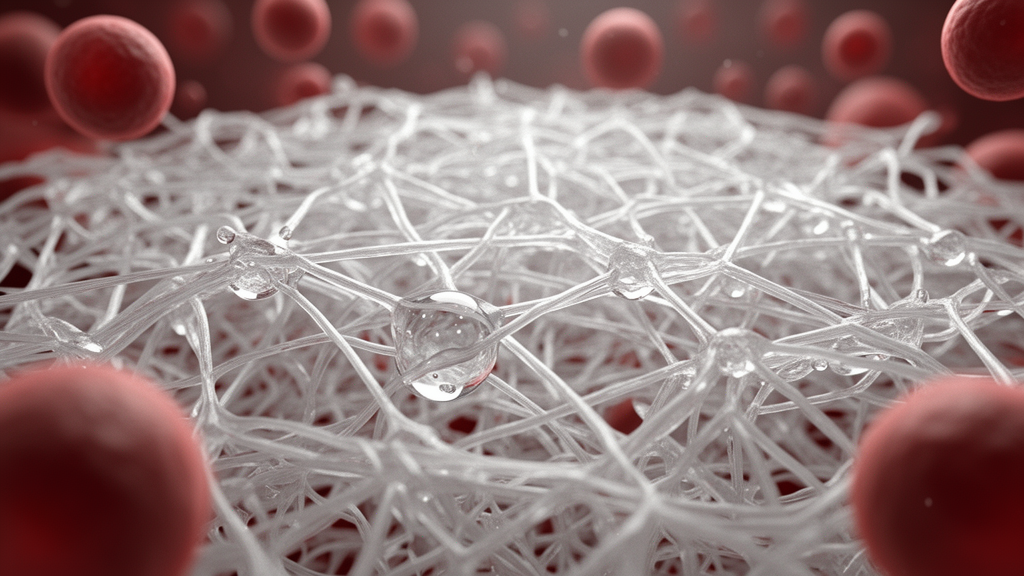
Analytical researchers have established a scaffold-assisted liquid-phase microextraction method that integrates a natural hydrophobic deep eutectic solvent within an electrospun polyacrylonitrile nanofibrous mat to simultaneously isolate the cardiovascular drugs propranolol and metoprolol from human donor plasma. Liquid-phase microextraction strategies have attracted considerable interest for the isolation and enrichment of organic compounds from complex biological matrices because very small volumes of the extraction phase markedly reduce organic solvent consumption while generating high sample-to-phase volume ratios that facilitate analyte transfer. However, the practical manipulation, reproducible retention, and mechanical stability of minute liquid droplets or free-floating solvent volumes often present significant operational difficulties in routine bioanalysis. To overcome these handling constraints while maintaining partition-based analyte transfer, the investigation evaluated an electrospun polyacrylonitrile network engineered not as a conventional solid-phase sorbent or composite adsorptive material, but as a robust, porous, and easily handled structural carrier that retains a fatty-acid eutectic liquid phase during extraction from pretreated plasma samples followed by high-performance liquid chromatography coupled with fluorescence detection.
Propranolol and metoprolol represent clinically essential beta-adrenergic receptor antagonists widely prescribed in the management of various cardiovascular disorders, making their quantitative determination critical in pharmacokinetic evaluations, pharmaceutical quality monitoring, and routine bioanalytical investigations. The chromatographic quantification of these therapeutic agents in physiological matrices such as plasma and serum is frequently complicated by the presence of endogenous proteins, lipids, and salts that interfere with column separation and detector response, particularly when the drugs exist at relatively low therapeutic concentrations. Conventional analytical approaches have historically relied upon protein precipitation with pure methanol or acetonitrile, classical liquid-liquid extraction, or multi-step solid-phase extraction, which typically demand considerable volumes of hazardous organic solvents and intensive labor. Miniaturized extraction techniques, including hollow-fiber liquid-phase microextraction, carrier-mediated extraction, and dispersive liquid-liquid microextraction, have sought to decrease consumption and increase enrichment, yet retaining and handling the liquid extraction media reproducibly has persisted as a key technical hurdle that porous fibrous supports can effectively mitigate.
Natural hydrophobic deep eutectic solvents prepared from abundant, naturally occurring fatty acids have gained recognition as tunable, low-volatility extraction media that create a distinctly lipophilic microenvironment tailored for hydrophobic target molecules. In this study, the research team synthesized and compared multiple binary and ternary formulations combining fatty acids with carbon chain lengths of nine, ten, and twelve atoms, specifically nonanoic acid, decanoic acid, and dodecanoic acid, alongside a pure nonanoic acid comparator. These mixtures were prepared by blending the fatty-acid constituents at defined molar ratios, including nonanoic acid to dodecanoic acid at ratios of two to one and three to one, decanoic acid to dodecanoic acid at two to one and three to one, and a ternary mixture of nonanoic, decanoic, and dodecanoic acids at three to one to one. The components, acting concurrently as hydrogen-bond donors and acceptors, were heated at sixty degrees Celsius with continuous agitation until forming clear, homogeneous liquids, which were subsequently cooled to ambient room temperature and examined for any visible phase separation before extraction testing.
The supporting nanofibrous scaffold was fabricated through electrospinning using a ten percent weight-per-volume solution of polyacrylonitrile with an average molecular weight of one hundred fifty thousand grams per mole dissolved in dimethylformamide after twenty-four hours of continuous mechanical stirring. The resulting viscous polymer formulation was loaded into an electrospinning system operated with an applied electric potential of twenty-six to twenty-seven kilovolts, a constant solution dispensing rate of zero point seventy-five milliliters per hour, a spinneret-to-collector distance of sixteen centimeters, and an aluminum foil collecting drum rotating at three hundred sixty revolutions per minute. Field-emission scanning electron microscopy of the pristine electrospun polyacrylonitrile revealed a continuous, randomly oriented, and interconnected network of submicrometer fibers devoid of noticeable bead formation. Following two hours of immersion in the selected eutectic solvent and gentle aqueous washing to remove non-retained surface liquid, morphological examination confirmed that the fibrous architecture remained structurally intact, displaying visibly thickened fibers, a more compact arrangement, and an observable continuous liquid phase embedded throughout the inter-fiber voids without inducing fiber fusion, dissolution, or structural collapse.
Extraction optimization demonstrated that the chemical formulation of the eutectic phase significantly governed extraction response, with binary mixtures generally outperforming the ternary formulation for both pharmaceutical analytes. The binary eutectic solvent composed of decanoic acid and dodecanoic acid at a two-to-one molar ratio yielded the highest chromatographic peak responses, an outcome attributable to its balanced hydrophobicity, favorable intermolecular interactions, and low dynamic viscosity, which has been previously reported as ten point seventy-six milliPascal-seconds at twenty-five degrees Celsius in the dried state. In contrast, pure nonanoic acid yielded markedly lower extraction efficiency, indicating that the intermolecular eutectic complex created a more favorable partitioning environment than an unblended fatty acid. Comparative trials conducted under identical experimental conditions demonstrated that pristine polyacrylonitrile fibers exhibited negligible analyte uptake on their own, confirming that the immobilized eutectic fluid functioned as the principal liquid extraction medium while the polymer network acted primarily as a porous, insoluble physical housing.
Desorption parameters were systematically investigated to achieve rapid, reproducible, and complete back-extraction of the beta-blockers from the immobilized eutectic phase into a chromatographic-compatible medium. Among evaluated desorption solvents consisting of methanol, acetonitrile, and a one-to-one volume mixture of the two, the binary blend generated the highest analytical response for both drugs. When evaluating desorption solvent volumes spanning two hundred to five hundred microliters, the analytical signal remained virtually unchanged after normalizing for volumetric dilution, leading to the selection of two hundred microliters as the optimum volume because it avoided any post-extraction nitrogen evaporation or reconstitution steps. Furthermore, examining sonication times of one, three, five, and seven minutes within an ultrasonic bath revealed no statistically significant gain in analytical recovery beyond sixty seconds, establishing a rapid one-minute ultrasonic treatment as sufficient for complete analyte desorption into two hundred microliters of the solvent blend.
To rigorously explore the operational parameter space, a four-factor central composite design comprising thirty randomized experimental runs with six central point replicates was deployed to optimize sample pH over seven to twelve, nanofiber scaffold mass from two to ten milligrams, sodium chloride concentration from zero to sixteen percent weight-per-volume, and extraction time from one to nine minutes. Analysis of variance verified that quadratic response surface models adequately described the experimental data, exhibiting high determination coefficients of zero point ninety-six forty-six for metoprolol and zero point ninety-six thirty-eight for propranolol, along with non-significant lack-of-fit probabilities exceeding zero point zero five. For metoprolol, sample pH exerted the dominant positive linear influence, aligning with its basic dissociation constant of nine point seven, which requires alkaline conditions to convert the protonated molecule into an uncharged neutral species possessing enhanced affinity for the lipophilic eutectic phase. Conversely, extraction time showed the strongest positive linear influence for propranolol, which has a dissociation constant of nine point five. Applying the multi-criteria desirability function yielded overall optimal conditions of pH eleven point nine, six point seven milligrams of nanofiber mat, four point one percent sodium chloride, and an extraction stirring duration of eight point eight minutes, which were subsequently validated by confirmatory triplicate trials.
The complete analytical workflow was applied to human donor plasma of blood group O-positive provided by the Iranian Blood Transfusion Organization, using voluntary blood donations devoid of identifiable patient information. Prior to microextraction, six hundred microliters of spiked plasma was treated dropwise with one point eight milliliters of acetonitrile in an ultrasonic bath, vortexed vigorously for four minutes, and centrifuged at three thousand four hundred sixty-one times gravity for ten minutes to pellet denatured proteins. The resulting supernatant was concentrated to zero point five milliliters under nitrogen at thirty degrees Celsius to eliminate residual acetonitrile, diluted to six milliliters with deionized water adjusted to pH eleven point nine, and stirred for eight point eight minutes with the eutectic-impregnated nanofiber. Chromatographic separation was performed on a reversed-phase C18 column measuring two hundred fifty by four point six millimeters with five-micrometer packing, utilizing an isocratic mobile phase of sixty-five percent acetonitrile and thirty-five percent five-millimolar potassium dihydrogen phosphate delivered at one milliliter per minute, coupled with a fluorescence detector programmed to switch excitation and emission wavelengths from two hundred twenty-five and three hundred nanometers for metoprolol to three hundred and three hundred forty nanometers for propranolol at four point five minutes.
Under the validated experimental conditions, the bioanalytical method demonstrated satisfactory linearity across twenty to one thousand nanograms per milliliter for metoprolol and ten to one thousand nanograms per milliliter for propranolol, achieving determination coefficients of zero point ninety-nine sixty-six and zero point ninety-nine seventy-two, respectively. Limits of detection, calculated statistically as three point three times the baseline standard deviation divided by the calibration slope, were six point seventy-four nanograms per milliliter for metoprolol and two point ninety-eight nanograms per milliliter for propranolol, with corresponding quantification limits of twenty point forty-three and nine point zero two nanograms per milliliter. Intra-day and inter-day precision assessed across three replicates at two hundred nanograms per milliliter produced relative standard deviations of seven point ninety and eight point fifty-seven percent for metoprolol, and three point twenty-seven and five point forty-three percent for propranolol, while absolute extraction recoveries reached thirty-two point forty and thirty-one point nineteen percent. Relative recoveries established in plasma spiked at fifty, one hundred, and two hundred nanograms per milliliter ranged between ninety-three point zero three and ninety-four point eighty-three percent for metoprolol and eighty point forty-two to ninety-one point twenty-three percent for propranolol, while comparative chromatograms of blank donor plasma confirmed the absence of interfering endogenous peaks at the drug retention times.
Reusability evaluations indicated that the electrospun polyacrylonitrile scaffold could be washed with three milliliters of methanol, dried, and freshly reloaded with the eutectic solvent for at least seven consecutive extraction cycles before displaying a noticeable decline in extraction efficiency during the eighth cycle. A quantitative greenness evaluation conducted using the ten-criterion AGREEprep tool yielded an overall environmental score of zero point forty-seven, reflecting the positive contributions of low sample volume, minimal desorption solvent consumption, rapid sonication, and polymer scaffold reusability, balanced against the environmental penalties associated with dimethylformamide in fiber electrospinning and acetonitrile during matrix protein precipitation. While the analytical limits of detection remain comparable rather than universally superior to existing techniques such as ultrasound-assisted emulsification microextraction, hollow-fiber liquid membranes, or mass-spectrometric procedures, the authors noted specific operational limitations, including the lack of direct quantitative measurements of solvent leaching under the strongly alkaline pH of eleven point nine and the absence of experimental evaluations regarding potential interference from circulating in vivo drug metabolites.
Subject of Research: Scaffold-assisted liquid-phase microextraction of cardiovascular beta-blockers from human plasma using deep eutectic solvents
Article Title: Electrospun nanofibrous scaffold for immobilizing natural hydrophobic deep eutectic solvent in liquid-phase microextraction of propranolol and metoprolol from human plasma
Article References: Nahr, M. S., & Heidari, H. (2026). Electrospun nanofibrous scaffold for immobilizing natural hydrophobic deep eutectic solvent in liquid-phase microextraction of propranolol and metoprolol from human plasma. Talanta Open, 14, Article 100691. https://doi.org/10.1016/j.talo.2026.100691
Image Credits: AI Generated
DOI: 10.1016/j.talo.2026.100691
Keywords: liquid-phase microextraction, deep eutectic solvents, electrospun nanofibers, polyacrylonitrile, propranolol, metoprolol, human plasma analysis, sample preparation, high-performance liquid chromatography, fluorescence detection, central composite design, fatty acid solvents, scaffold-assisted extraction, green sample preparation, AGREEprep metric, bioanalytical methods, extraction recovery
News Source: Bethany Barker. (November 24, 2026). Nanofiber Scaffold Immobilizes Eutectic Solvent for Plasma Beta-Blocker Extraction. Scienmag.