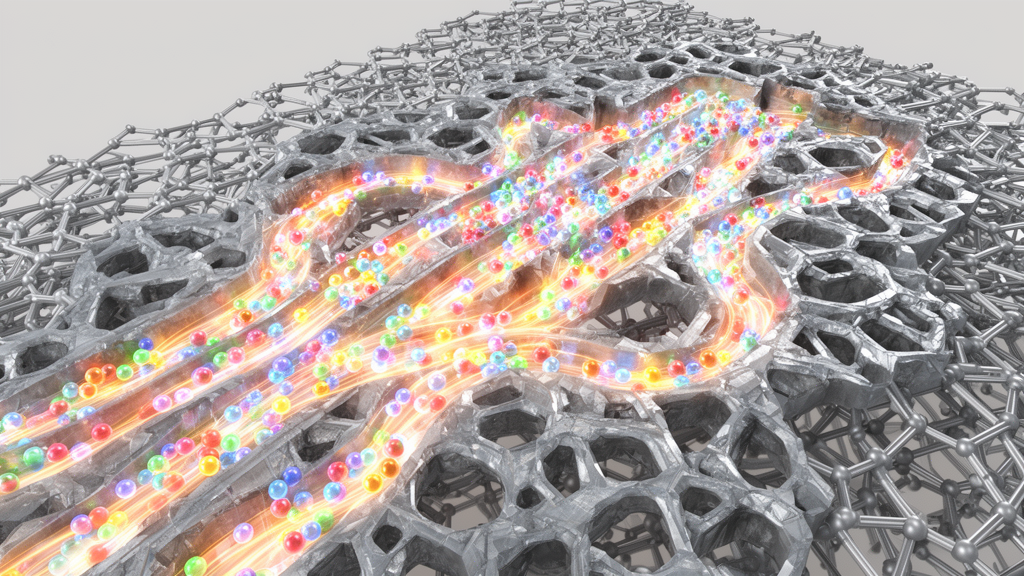
Researchers using synchrotron radiation have uncovered the microscopic mechanisms governing electrochemical activity and reversibility in composite graphite–silicon lithium-ion battery electrodes during their initial formation cycle. By combining interrupted-operando synchrotron X-ray nano-holotomography with three-dimensional digital volume correlation, the investigators mapped chemomechanical dynamics across both individual particle volumes and bulk electrode regions. The investigation demonstrated that localized ionic diffusion properties, particle morphology, spatial position within the electrode coating, proximity to silicon clusters, liquid electrolyte contact area, and directional mechanical strains directly regulate electrochemical performance. Crucially, the observations identified fast ionic transport channels that actively counterbalance intrinsic depth-dependent reaction heterogeneities arising from conventional ionic and electronic diffusion limitations.
Understanding the exact physical link between complex electrode microstructures and macroscopic electrochemical performance remains a vital objective for advancing high-capacity energy storage systems. Composite electrodes incorporating silicon into standard graphite formulations offer significantly higher theoretical capacities, yet they suffer from severe mechanical degradation and uneven charge distribution. Prior investigations into these degradation phenomena were largely constrained by the difficulty of obtaining mechanistic four-dimensional observations at the ultimate spatiotemporal scales required to resolve nanoscale phase boundaries. In this study, quantitative scale-bridging image analysis was deployed to continuously track microstructural rearrangements in operando conditions, establishing a hierarchical scale of influence among competing structural parameters rather than relying solely on ensemble properties.
To capture these phenomena without compromising the operational integrity of the electrochemical cell, the research team designed a dedicated in-house miniaturized battery cell tailored specifically for nano-computed tomography. The cell geometry featured an external diameter of 3.14 millimeters and an overall length of 35.2 millimeters, comprising a transparent perfluoroalkoxy polymer body with an internal diameter of 1.5 millimeters and a wall thickness of 0.8 millimeters. Compression and gas-tight hermetic sealing were maintained at a constant estimated pressure of 23 kilopascals using precision-threaded stainless-steel connectors tightened with a torque wrench. The upper connector was machined to a shorter length of 11 millimeters relative to the 24.2-millimeter lower connector to reduce mechanical weight and attenuate beam-induced wobbling during rotational tomography acquisitions.
The composite working electrodes investigated in the experimental campaign were manufactured on pilot-scale roll-to-roll machinery using an aqueous slurry formulation. The solid constituents comprised 74 weight percent synthetic carbon-coated graphite with a median diameter of 17 micrometers and a specific surface area of 4.1 square meters per gram, blended with 11 weight percent carbon-coated silicon nanoparticles possessing an average Brunauer–Emmett–Teller particle size of 48 nanometers. The binder system consisted of a 14 weight percent blend of styrene-butadiene rubber and carboxymethyl cellulose in equal parts, supplemented by 1 weight percent carbon conductive additive. The resulting slurry was knife-coated onto a 10-micrometer copper foil current collector, dried in a three-stage convection oven set to 70, 80, and 90 degrees Celsius, and calendered at a line load of 5 megapascals to yield an electrode capacity of 3.3 milliampere-hours per square centimeter and an active material loading of 6.67 milligrams of graphite and 1 milligram of silicon per square centimeter.
Electrode specimens measuring 0.7 millimeters in diameter were precision-machined from the parent coated foil via femtosecond laser cutting and assembled against a 1-millimeter metallic lithium counter electrode inside an argon-filled glovebox maintained below 0.5 parts per million of water and oxygen. The internal cell separator consisted of two stacked layers of borosilicate glass microfiber soaked with 5 microliters of non-aqueous electrolyte comprising 1 molar lithium hexafluorophosphate dissolved in a 3 to 7 volumetric mixture of ethylene carbonate and ethyl methyl carbonate enriched with 10 weight percent fluoroethylene carbonate. Parallel coin-cell cycling experiments utilizing lithium nickel oxide positive electrodes paired with identical composite anodes confirmed electrochemical cycling stability across a 2.5 to 4.2 volt potential window at 25 degrees Celsius over 100 extended galvanostatic cycles.
Interrupted-operando X-ray nano-holotomography scans were conducted at the ID16B beamline of the European Synchrotron Radiation Facility using a conic incident X-ray beam focused to 55 nanometers horizontally by 60 nanometers vertically at an operating photon energy of 29.4 kiloelectronvolts and an incident flux of 3.4 times 10 to the 11th photons per second. High-resolution three-dimensional volumes were recorded across a 360-degree rotational path using a CMOS camera equipped with a 30-micrometer lutetium oxyorthosilicate scintillator positioned 280 millimeters downstream of the specimen. Interrupted-operando tomographic acquisitions recorded 2,205 angular projections with a 35-millisecond exposure time, completing full 50-nanometer voxel size scans of a 102 by 102 square micrometer field of view within 9 minutes during hourly open-circuit voltage relaxation intervals while cycling at a specific current of 110 milliamperes per gram between 5 millivolts and 1 volt.
Phase retrieval calculations were implemented using an octave script applying a Paganin-type deterministic phase-amplitude approach with a delta-to-beta ratio of 2,744, followed by filtered backprojection reconstruction using PyHST2 software to generate calibrated floating-point volumetric datasets. Subsequent image processing entailed polar coordinate ring artifact subtraction and machine-learning phase segmentation through random forest classifiers operating in Ilastik software. Because extreme phase shift gradients at the copper collector interface generated localized reconstruction artifacts, quantitative microstructural segmentation and continuous digital volume correlation were isolated within an interior electrode subvolume measuring 102 by 102 by 40 micrometers. A specialized image segmentation workflow incorporating max-filter dilation and Chan–Vese level-set back-propagation was developed to accurately isolate individual folded graphite particles from adjacent void spaces and porous binder networks.
Kinematic deformation fields and volumetric strain invariants were quantified using the open-source digital volume correlation package SPAM, evaluating affine transformation matrices across hierarchical correlation windows scaled down to 4 by 4 by 4 micrometers with a 50 percent overlap. In parallel, discrete particle tracking correlated the spatial translation and finite strain tensors across 56 individual graphite particles throughout the entire first electrochemical cycle. Complementary wide-angle X-ray scattering measurements conducted at beamline ID31 with a 67 kiloelectronvolt photon beam scanned the 60-micrometer electrode thickness in 5-micrometer depth increments to correlate crystallographic lithium staging with the localized phase distributions, keeping cumulative irradiation dosages below known beam damage thresholds.
The quantitative kinematic measurements revealed that composite electrode deformation during initial lithiation is highly anisotropic and irreversible, governed primarily by the mechanical strain of the graphite particles rather than by the volumetric expansion of the dispersed silicon phase. This observation establishes that graphite functions as the primary structural backbone of the composite electrode, with localized translational movements and grain distortions driving overall microstructural rearrangement. Furthermore, the local spatial distribution of conductive carbon-binder-domain and silicon clusters directly dictates the mechanical reversibility and electrochemical utilization of adjacent graphite grains, creating microscale variations in reaction kinetics across the electrode layer.
Direct numerical simulations of steady-state ionic transport across segmented pore geometries solved Dirichlet boundary diffusion equations to determine effective transport coefficients and directional tortuosity factors. Although electrochemical lithiation activity generally diminished toward the current collector due to classical depth-dependent liquid-phase diffusion limitations, the statistical analysis demonstrated that this macroscopic gradient is frequently overridden by particle-scale geometric pathways. High-speed ionic transport channels within the interconnected pore network preserved high lithiation rates in selected particles positioned deep within the electrode layer. These findings demonstrate that battery electrode operation and failure cannot be accurately modeled through bulk volume fractions or operating currents alone, highlighting the necessity of particle-resolved geometric metrics to guide manufacturing optimization.
Subject of Research: Operando four-dimensional nanoscale X-ray imaging of chemomechanics and ionic transport in composite graphite–silicon lithium-ion battery electrodes
Article Title: Four-dimensional X-ray nano-holotomography reveals multiscale chemomechanics in composite graphite–silicon battery electrodes
Article References: Vanpeene, V., Stamati, O., Cadiou, F., Jacquet, Q., Villanova, J., & Lyonnard, S. (2026). Four-dimensional X-ray nano-holotomography reveals multiscale chemomechanics in composite graphite–silicon battery electrodes. Nature Nanotechnology. https://doi.org/10.1038/s41565-026-02327-6
Image Credits: AI Generated
DOI: 10.1038/s41565-026-02327-6
Keywords: nano-holotomography, synchrotron X-ray, graphite-silicon composite, lithium-ion batteries, digital volume correlation, chemomechanics, ionic diffusion, electrode microstructure, formation cycle, tortuosity factor, electrochemical activity, phase retrieval, operando imaging, ESRF beamline ID16B, anisotropic deformation, particle tracking, battery degradation
News Source: Faith Mcneil. (November 20, 2026). Nano-Scale Tomography Maps Fast Ionic Transport Pathways in Battery Electrodes. Scienmag.