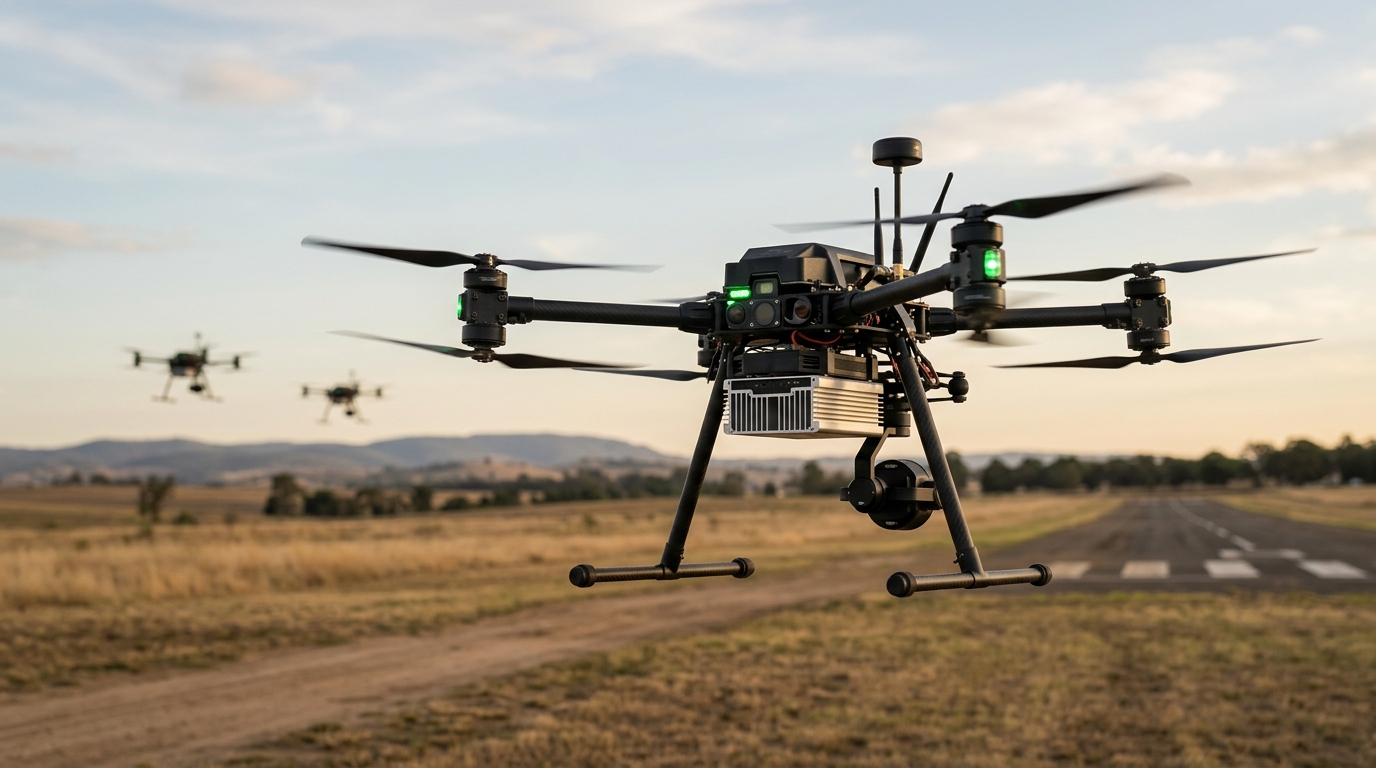
A research team has demonstrated an adaptive architectural framework designed to protect cooperative aerial and vehicular edge computing networks from rogue aerial disruption while coordinating computational tasks across distributed entities. Modern intelligent transportation systems increasingly deploy unmanned aerial vehicles to support data routing, dynamic offloading, and resource management alongside ground-based electric vehicles. However, open wireless environments leave air-to-air and air-to-ground channels highly vulnerable to malicious aerial actors. Rogue unmanned aerial vehicles can infiltrate these operational frequencies to carry out selective packet dropping, broadcast jamming, and targeted message suppression. Such deliberate disruptions impair resource allocation algorithms, delay critical computational tasks, and jeopardize the stability of municipal transit infrastructure. To address these vulnerabilities, researchers designed the SPELD architecture, establishing a resilient communication bridge that dynamically couples aerial and ground computing resources through continuous multicast probing and automated reliability inference.
The fundamental challenge confronting hybrid intelligent transportation infrastructure stems from the operational asymmetry between high-mobility aerial nodes and terrestrial transport fleets. While unmanned aerial vehicles offer agile spatial coverage and line-of-sight connectivity, their transmission links remain exposed to long-range radio-frequency jamming and unauthorized signal interception. When rogue aerial platforms inject intermittent packet discarding and selective suppression into this mixed environment, conventional rule-based security protocols fail to isolate adversarial anomalies from normal mobility-induced signal loss. Without specialized assessment mechanisms, legitimate aerial and ground units cannot verify channel health, creating widespread operational paralysis across safety-critical cooperative tasks.
To overcome this operational blind spot, the SPELD framework introduces a multi-tier threat-aware protocol that continuously monitors communication channels using lightweight multicast probe request-response exchanges. Rather than attempting direct physical localization or hardware-level attribution of malicious devices, the protocol observes empirical transmission behavior across all active wireless links. By transmitting synchronized probe requests across single-hop neighborhoods, participating nodes capture real-time measurements of response arrival latency, trip duration, and packet loss frequencies. Each transmission outcome is logged as a discrete delivery record governed by strict temporal response deadlines. When cumulative response ratios across an active link fall below established reliability thresholds, the framework automatically flags the corresponding channel as potentially compromised, enabling collaborative systems to adapt their routing vectors and workload distributions before failure cascades occur.
Computational task orchestration within the architecture is managed through an integrated multi-factor cost evaluation that balances competing operational priorities across aerial and ground resources. When an edge vehicle prepares to offload computational tasks, the decision logic evaluates candidate nodes using a risk-aware formulation that weighs expected queue waiting times, observed transmission delays, and estimated link reliability values. To prevent local queue saturation, an electric vehicle federation manager continuously tracks global system backlogs, dynamically balancing task placements across participating terrestrial vehicles rather than relying on myopic delay calculations. This cooperative coordination avoids oscillatory job migrations by formally tracking federated task states. If aerial and terrestrial offloading routes become degraded by rogue signal suppression, the execution pipeline activates a deterministic fallback mechanism, preserving operational continuity by executing computational workloads locally.
Situational awareness across dynamic municipal environments is sustained through automated neighbor discovery primitives that build real-time state abstractions without relying on centralized coordination servers. Vehicles and aerial platforms query surrounding resources using dedicated operational primitives that quantify immediate reachability, physical proximity, and processing queue backlogs. Because the discovery procedure relies directly on successful multicast handshake responses, the neighbor querying mechanism functions simultaneously as an early warning sensor. Missing probe replies, expanding propagation delays, and intermittent delivery dropouts immediately alert downstream execution engines to potential interference, linking discovery protocols directly to cybersecurity defenses.
To evaluate predictive pattern recognition capabilities under noisy and adversarial channel conditions, the researchers incorporated a data-driven machine learning pipeline comparing multiple classifier architectures. The framework processed observable communication traces, capturing waiting times, inter-node distances, and delivery success records while applying systematic anomaly imputation to stabilize learning boundaries. Four distinct supervised model families were evaluated: a probabilistic Bayesian classifier, a margin-based Support Vector Machine, a Simple Neural Network, and a multi-layer Artificial Neural Network. The experimental design employed stratified training and testing splits across seventy and thirty percent partitions to address the natural statistical imbalance between successful deliveries and adversarial dropouts, preventing algorithmic bias toward benign operational states.
Performance evaluations demonstrated substantial variations in the ability of different machine learning models to capture the non-linear degradation signatures produced by rogue aerial disruption. The probabilistic Bayesian classifier delivered the lowest predictive fidelity, achieving an overall accuracy of 63.2 percent and a macro-averaged F1-score of 0.58, illustrating an inability to map complex decision boundaries within fluctuating vehicular telemetry. The Support Vector Machine demonstrated markedly improved generalization, reaching an accuracy of 83.1 percent and a balanced macro metric of 0.83. The Simple Neural Network achieved 86.1 percent accuracy alongside a macro F1-score of 0.86, confirming the effectiveness of neural layers in capturing non-linear telemetry shifts. The Artificial Neural Network demonstrated the highest predictive performance across all benchmarks, attaining an accuracy of 97.7 percent and a macro F1-score of 0.98, confirming its ability to profile subtle disruption patterns and accurately forecast delivery reliability under adversarial stress.
The complete framework was experimentally validated within a high-resolution simulation platform developed in Python and integrated with the SUMO mobility simulator, utilizing real-world spatial geometries from the Manhattan street grid extracted via OpenStreetMap. Across fifteen distinct simulation scenarios, researchers instantiated heterogeneous aerial and terrestrial mobility profiles governed by realistic acceleration profiles, velocity boundaries, intersection constraints, and random spatial injections. To eliminate stochastic noise, the experimental suite executed fifteen complete repetitions for each operational scenario using unique random seeds. The simulations examined diverse traffic volumes and scale parameters, capturing fine-grained transmission outcomes under both benign operational circumstances and active rogue aerial message suppression attacks.
The system-level simulation findings revealed distinct operational regimes across the fifteen evaluated scenarios. Under lower-indexed scenarios featuring moderate vehicle density and limited contention, packet delivery success ratios remained stable between 88 and 92 percent, accompanied by low transmission latencies averaging between 34 and 43 milliseconds and reduced energy consumption. Mid-range scenarios spanning indices eight through eleven achieved optimal performance, recording peak packet success ratios of approximately 97.3 percent and average latencies of 78 milliseconds, reflecting an ideal balance between node availability, load-sharing capacity, and adversarial mitigation. Conversely, high-stress scenarios spanning indices twelve through fifteen exhibited substantial latency growth, reaching up to 4.25 seconds due to simultaneous queue accumulation, heightened channel contention, and extensive retransmission overhead under persistent rogue interference, while maintaining delivery success ratios between 95.8 and 96.4 percent.
Analysis of traffic density scaling confirmed that delivery failure rates are highly sensitive to overall system congestion and network scale. Under low-traffic regimes, failed message transmissions grew at a steady and moderate pace, rising from 2,512 failures at a simulation scale of 500 to 5,097 failures at a scale of 1,000. In contrast, high-traffic conditions caused an exponential escalation in delivery failures, surging from 12,009 at a scale of 600 to 33,908 at a scale of 1,000. Energy audits across all experimental runs mirrored these transmission trends, demonstrating that benign low-density scenarios preserved energy through reduced packet repetition, whereas heavy adversarial contention significantly elevated energy consumption across communication, reception, and retransmission cycles. Future extensions of the research intend to incorporate battery-aware offloading policies, detailed aerial power consumption dynamics, collaborative multi-UAV navigation planning, and advanced counter-adversarial security defenses.
Subject of Research: Secure multicast probing and machine learning for aerial and vehicular edge computing
Article Title: SPELD: Secure multicast probe-driven edge-UAV framework for sustainable load distribution
Article References: Zaheer, T., Sajid, J., Malik, A. W., Santos, M. M. D., & Khan, S. U. (2027). SPELD: Secure multicast probe-driven edge-UAV framework for sustainable load distribution. Cluster Computing, 30(1), Article 60. https://doi.org/10.1007/s10586-026-06835-x
Image Credits: AI Generated
DOI: 10.1007/s10586-026-06835-x
Keywords: Unmanned Aerial Vehicles, Electric Vehicles, Mobile Edge Computing, Intelligent Transportation Systems, Rogue UAV Detection, Multicast Probing, Task Offloading, Artificial Neural Networks, Packet Dropping, Message Suppression, Network Reliability, Resource Allocation, Vehicular Networks, SUMO Simulator, Cybersecurity, Support Vector Machines, Traffic Congestion
News Source: Marilyn Langley. (November 27, 2026). Multicast Probe Framework Secures Aerial Edge Computing Against Rogue Vehicle Disruption. Scienmag.