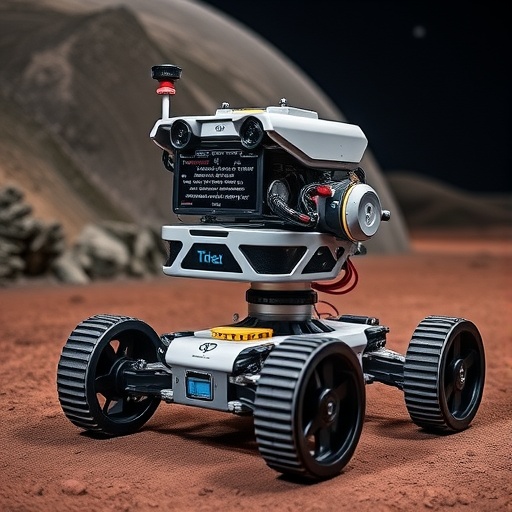
In an era marked by rapid technological advances, the exploration of uncharted territories has garnered immense interest across various fields, including robotics. The recent paper by Nayak, Lim, Rossi, and their colleagues under the theme of “Multi-robot exploration for the CADRE mission”, shines a light on a transformative approach that captures the imagination of researchers and enthusiasts alike. These developments are not merely academic but promise to redefine how we navigate and understand complex environments, pushing the frontiers of robotic capabilities.
The CADRE mission focuses on advancing the capabilities of multi-robot systems, specifically designed for exploring environments that pose significant challenges to human operatives. This research addresses how multiple robots can work collaboratively to achieve exploration tasks more efficiently than a single unit could. By leveraging the strengths of a multi-agent system, this innovative project aims to create a framework for autonomous robotic exploration that could be adapted to a multitude of scenarios, from disaster zones to extraterrestrial landscapes.
At the heart of this research is the design and implementation of algorithms that allow for real-time decision-making among the robotic units involved. These algorithms utilize cutting-edge artificial intelligence and machine learning techniques to enable robots to assess their surroundings, distribute tasks intelligently, and adapt their strategies based on changing environmental conditions. Such capabilities are crucial, especially in unpredictable or hostile environments where human intervention might be limited or dangerous.
The researchers showcased how the CADRE mission incorporates multiple forms of robots, each tailored for specific tasks and environments. For instance, some units are designed with advanced sensory equipment to gather data about the surrounding terrain, while others may be specialized in navigating through tight spaces or across rugged landscapes. This division of labor not only enhances efficiency but also ensures that various operational challenges are met with appropriate technological responses.
Another significant aspect of this research is its emphasis on communication between robots. Effective collaboration hinges on the ability of these robotic units to exchange information seamlessly. The study introduces novel communication protocols that allow for high-bandwidth data transfer even in environments filled with obstacles that could interfere with signals. This feature is especially critical during exploration missions where maintaining connectivity is essential for safety and operational success.
The implications of the CADRE mission are vast. Beyond the immediate benefits for exploration on Earth, such advancements could lay the groundwork for future missions to Mars or beyond. As humanity sets its sights on colonizing other planets, understanding how multi-robot systems can operate collaboratively in alien terrains will be pivotal to mission success. This research not only offers insights into robotic capabilities but also contributes a wealth of knowledge to the field of space exploration.
The authors conducted numerous simulations to validate their framework’s effectiveness. These simulations showcased various scenarios, enabling the researchers to measure the robots’ performance in diverse conditions, including limited visibility and complex terrains. The results demonstrated a significant improvement in exploration efficiency, which is a remarkable achievement given the challenges typically associated with deploying robots in these contexts.
One cannot overlook the potential social implications of multi-robot exploration. As robots become increasingly capable of undertaking tasks traditionally reserved for human workers, questions about the future of labor and human-robot interaction arise. The results from this study encourage discussions about how we can integrate these advanced systems into our daily lives, from urban search-and-rescue missions to enhancing agricultural practices through precise field exploration.
Moreover, the findings in this research call for continued investment and interest in robotic technologies. As the world grapples with issues such as climate change and natural disasters, the ability of robots to function autonomously in concert can significantly bolster our response strategies. The CADRE mission not only advances scientific understanding but also provides practical applications that could improve our ability to manage crises.
The technological breakthroughs discussed in this study can serve as a springboard for future innovations. As researchers refine the algorithms and hardware used in robotic systems, we may see exponential growth in their capabilities. This evolution will not only further revolutionize exploration but also open new avenues for robotic assistance in everyday life.
In conclusion, the CADRE mission represents a milestone in the domain of robotics, particularly in multi-robot collaboration. By intelligently exploring and interacting with their environments, these robots pave the way for future endeavors that may have once seemed the realm of science fiction. The implications for scientific research, disaster response, and even planetary exploration are profound, making this area of study not just relevant but vital for our future.
As we anticipate developments from the CADRE mission, it’s vital for stakeholders from academia, industry, and government to collaborate. Such partnerships can accelerate the deployment of these technologies, ensuring that we harness the power of multi-robot systems for human benefit. As this research unfolds, the lessons learned could well shape the trajectory of robotics, making our worlds a safer and more interconnected place.
This exploration could serve as the cornerstone for future studies, as each advancement in robotic technology offers a glimpse into what may be possible tomorrow. Collaborative research initiatives will not only fuel this progress but also ensure that our ethical and social viewpoints keep pace with our technological capabilities. The journey into multi-robot exploration is just beginning, but it holds endless possibilities for those willing to embrace innovation.
Subject of Research: Multi-robot exploration for the CADRE mission.
Article Title: Multi-robot exploration for the CADRE mission.
Article References:
Nayak, S., Lim, G., Rossi, F. et al. Multi-robot exploration for the CADRE mission. Auton Robot 49, 17 (2025). https://doi.org/10.1007/s10514-025-10199-3
Image Credits: AI Generated
DOI: https://doi.org/10.1007/s10514-025-10199-3
Keywords: Multi-robot systems, autonomy, exploration, artificial intelligence, collaboration, disaster response, space exploration.
Tags: artificial intelligence in roboticsautonomous robotic explorationCADRE mission advancementscollaborative robotic systemsdisaster zone exploration roboticsextraterrestrial landscape explorationinnovative robotic frameworksmachine learning for roboticsmulti-agent systems in explorationmulti-robot explorationreal-time decision-making algorithmsrobotic capabilities in challenging environments