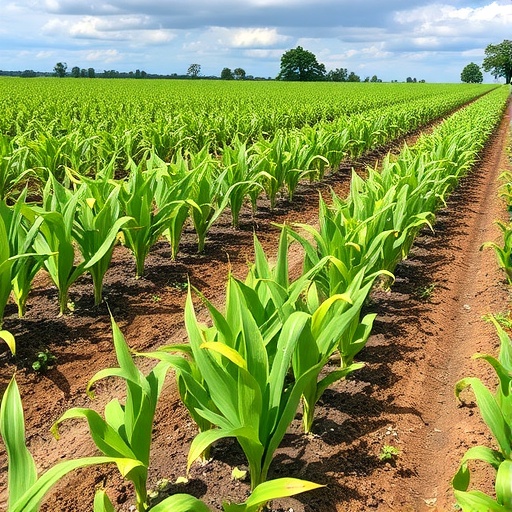
In the quest for food security amid ever-increasing climate challenges, scientists are turning to innovative technologies to enhance crop resilience against abiotic stressors. A recent study by Dakal, T.C., Dagariya, S., and Goswami, B., published in Discovery of Plants, presents groundbreaking research on the utilization of multi-omics approaches to tackle these pressing agricultural issues. As climate conditions become increasingly erratic, it is vital for researchers and agronomists to explore novel methodologies for improving crop tolerance to extremes such as drought, salinity, and temperature fluctuations.
The integration of different omics technologies—genomics, transcriptomics, proteomics, and metabolomics—represents a systematic strategy that allows for a comprehensive analysis of how plants respond to abiotic stresses. By utilizing multi-omics data, researchers can pinpoint specific genetic and biochemical pathways that contribute to stress responses, leading to the identification of candidate genes for targeted breeding efforts. This multidisciplinary approach not only streamlines the identification of stress tolerance traits but also offers insights into the mechanisms that underlie these complex responses in plants.
One of the standout features of this study is its focus on the interactive relationship between various omics layers. For instance, genomics provides information about the plant’s genetic makeup, while transcriptomics reveals which genes are actively expressed under specific stress conditions. Proteomics adds another layer by analyzing the proteins produced in response to stress, and metabolomics assesses the small metabolites that play crucial roles in plant metabolic pathways. By layering these data sets, the researchers can create a more holistic view of plant responses to abiotic challenges.
In their study, Dakal and colleagues emphasize the importance of incorporating field data alongside laboratory findings. While controlled experiments yield valuable insights, real-world environmental conditions present a multitude of variables that can influence plant behavior. By validating their multi-omics approach in diverse agricultural settings, the researchers ensure that their findings are robust and applicable to a wide range of crops and conditions.
Moreover, the application of machine learning and bioinformatics tools in analyzing multi-omics data allows for the prediction of plant responses under stress. These computational techniques can sift through vast amounts of data to identify patterns and correlations that might be missed by traditional analytical methods. As a result, researchers can rapidly identify key targets for genetic manipulation or breeding programs aimed at enhancing crop resilience.
Another significant aspect of this research is its potential to customize crop varieties for specific environments. By understanding the unique stress responses of various crop species, breeders can develop tailored strategies that enhance the adaptive capacity of plants to local conditions. This local adaptation is crucial in regions where climate change impacts are most pronounced, as it can lead to higher yields and increased food security.
Furthermore, this integrative approach fosters collaborative efforts across scientific disciplines. Agronomists, geneticists, and metabolic engineers can work together to translate molecular insights into practical applications for farmers. The collaboration between different fields amplifies the potential for innovation and ensures that scientific advances quickly make their way into agricultural practices.
As the world grapples with the dual challenges of population growth and climate change, research like this is critical for developing sustainable agricultural practices. The ability to cultivate crops that can withstand extreme conditions not only enhances food security but also supports livelihoods in vulnerable communities. By investing in multi-omics research, stakeholders can ensure a more resilient agricultural system that can thrive despite environmental uncertainties.
Additionally, the study sheds light on the importance of breeding programs that emphasize genetic diversity. By harnessing genetic variation within and among crop species, researchers can create a broader base of resilience against abiotic stresses. This genetic diversity serves as a buffer against the unpredictable nature of climate patterns, allowing crops to adapt and endure over time.
The practical implications of Dakal et al.’s research extend beyond the laboratory. Policymakers and agricultural practitioners are encouraged to support initiatives that integrate advanced breeding technologies with traditional practices. Emphasizing the importance of multi-omics approaches can inspire new partnerships between academia, industry, and farming communities, paving the way for innovative solutions to age-old agricultural challenges.
Ultimately, the findings from this research provide a hopeful outlook for the future of global agriculture. By leveraging cutting-edge scientific advancements, we can enhance the resilience of crops to abiotic stresses, ultimately securing food supplies and fostering sustainable agricultural ecosystems. As we continue to navigate the complexities of climate change, the role of integrative multi-omics will undoubtedly become more pivotal in shaping the future of agriculture.
To sum up, the journey toward addressing crop abiotic stress resilience through multi-omics approaches marks a significant stride in agricultural science. The collaborative expeditions across various scientific domains hold the potential to unlock valuable insights into how plants can adapt to the challenges posed by our changing environment. As this field of study progresses, one thing remains clear: the fusion of science, technology, and agriculture is vital in ensuring a stable food supply for generations to come.
This groundbreaking research underscores the ingenuity of modern agricultural science. As we delve deeper into the multi-omics era, it’s paramount to maintain a strong commitment to innovation, sustainability, and cross-disciplinary collaboration in tackling the pressing issues of our time.
Subject of Research: Crop Abiotic Stress Tolerance
Article Title: Integrative multi-omics approaches for crop abiotic stress tolerance
Article References: Dakal, T.C., Dagariya, S., Goswami, B. et al. Integrative multi-omics approaches for crop abiotic stress tolerance. Discov. Plants 2, 361 (2025). https://doi.org/10.1007/s44372-025-00431-w
Image Credits: AI Generated
DOI: https://doi.org/10.1007/s44372-025-00431-w
Keywords: Multi-omics, crop resilience, abiotic stress, genomics, transcriptomics, proteomics, metabolomics, machine learning, breeding strategies.
Tags: abiotic stress tolerance in plantsagricultural research for climate adaptationcomprehensive analysis of plant stress responsescrop resilience against climate changedrought and salinity tolerance in cropsenhancing crop tolerance through multi-omicsgenomics and transcriptomics integrationinnovative technologies for food securityinteractive omics layers in plant responsemulti-omics strategies in agricultureproteomics and metabolomics in crop researchtargeted breeding for stress resilience