In a newly reported clinical case series, endoscopists successfully achieved biliary cannulation and completed diagnostic and therapeutic biliary interventions in four consecutive patients with Roux-en-Y gastrectomy by employing a multi-loop traction device during single-balloon enteroscopy-assisted endoscopic retrograde cholangiopancreatography. Across all four cases, the mechanical adjunct corrected unfavorable papillary orientation and counteracted excessive papillary mobility, allowing the proceduralists to overcome anatomical hurdles that had previously impeded conventional cannulation attempts without causing any observed procedure-related adverse events.
Endoscopic retrograde cholangiopancreatography in patients with surgically altered gastrointestinal anatomy presents substantial technical difficulty because endoscopists must navigate reconstructed limbs using a forward-viewing enteroscope that lacks an elevator mechanism. Even after the enteroscope successfully reaches the major duodenal papilla, securing biliary access frequently fails when the papilla faces the blind intestinal limb, can only be approached tangentially, or displays pronounced mobility that causes it to shift away whenever an endoscopic catheter attempts engagement.
The procedural cohort was drawn from an institutional experience spanning January 2024 through June 2026, during which 80 single-balloon enteroscopy-assisted procedures were performed, including 21 in individuals with prior Roux-en-Y gastrectomy. The enteroscope reached the papilla in 17 of those post-gastrectomy procedures; difficult cannulation was encountered in four patients, all of whom underwent multi-loop traction assistance and were evaluated without exclusion, while no biliary cannulation failures following successful papillary access were reported among the procedures completed without traction devices.
Every procedure was conducted using an Olympus SIF-H290S enteroscope by one of two operators possessing five to six years of total endoscopic retrograde cholangiopancreatography experience and four to five years of specialized experience managing surgically altered anatomy. Initial cannulation was attempted from the most stable position using an MTW cannula paired with an EndoSelector guidewire in Cases 1 through 3, whereas Case 4 utilized an Olympus VisiGlide 2 guidewire; no unintended pancreatic duct access or alternative rescue maneuvers occurred prior to traction deployment.
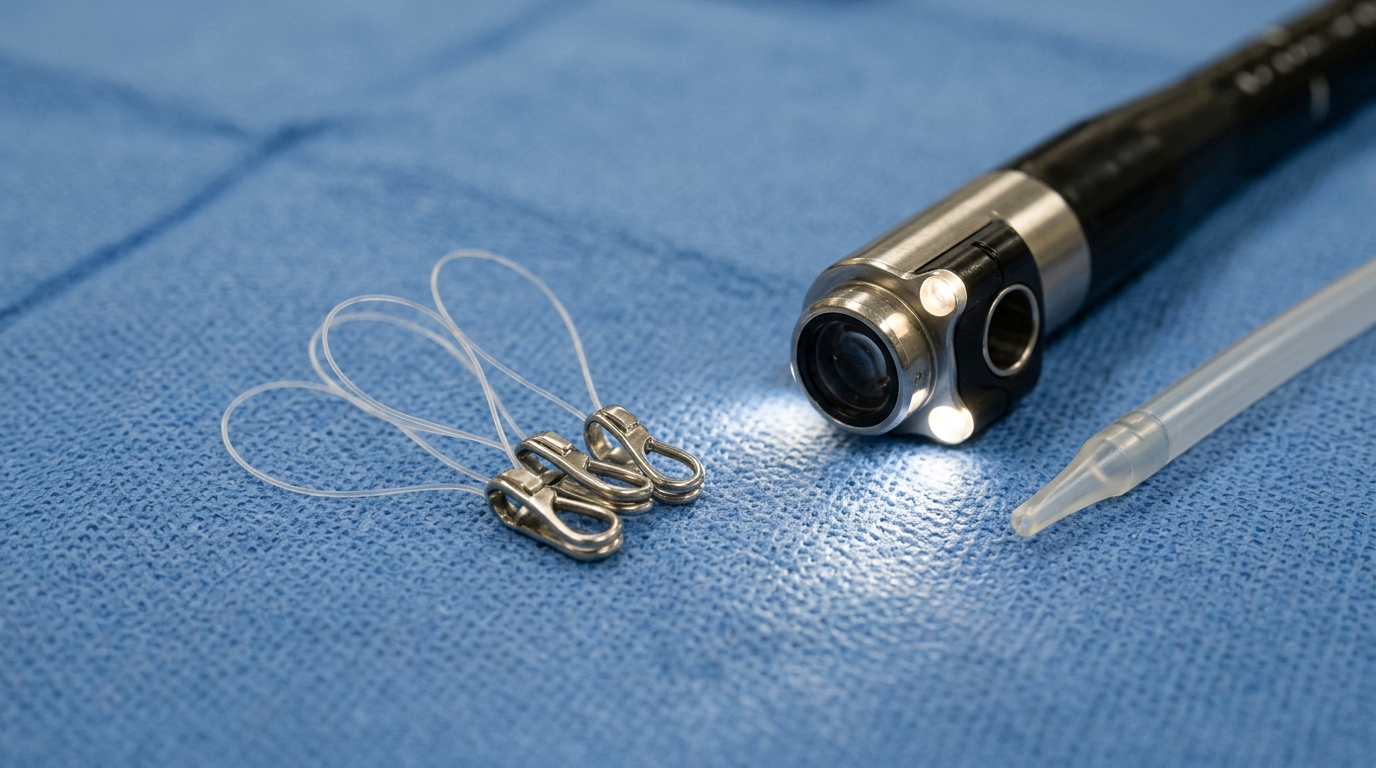
To execute traction, the endoscopist attached one terminal loop near the papillary base or immediately adjacent tissue, then grasped and fixed the opposite terminal loop to oral-side mucosa, defining the oral vector along the direction of scope insertion rather than the anatomical oral-to-anal axis while avoiding distant mucosal anchors that might stretch without transmitting sufficient mechanical force to correct the papillary axis.
Case 1 involved a 77-year-old male with suspected distal bile duct cancer who had previously undergone total gastrectomy with Roux-en-Y reconstruction. Conventional cannulation was pursued without traction for approximately 25 minutes, but persistent tangential visualization prevented stable orifice engagement; following a seven-minute multi-loop traction deployment that pulled the papillary base orally to achieve en face visualization, biliary cannulation was achieved 12 minutes later, enabling successful tissue biopsy and biliary stent placement.
Case 2 involved an 83-year-old male with common bile duct stones after total gastrectomy whose papilla faced the blind limb and could not be maintained in a retroflexed position. During an initial five-minute approach, physiological peristalsis combined with excessive papillary mobility prevented the endoscope from making physical contact with the orifice, prompting immediate traction placement without any preliminary orifice cannulation attempts; once deployed over five minutes, oral traction established en face alignment, biliary cannulation succeeded within two minutes, and complete stone removal was performed.
Case 3 involved a 79-year-old male presenting with common bile duct stones following total gastrectomy with Roux-en-Y reconstruction whose papilla was visible but highly mobile, continually retreating whenever contacted by the cannulation catheter. Following 22 minutes of unstable attempts, Operator A deployed the traction device across three minutes to mechanically stabilize the papilla, achieving biliary cannulation 11 minutes after traction establishment and subsequently completing therapeutic stone extraction.
Case 4 involved a 65-year-old male with common bile duct stones after distal gastrectomy who had previously experienced an unsuccessful cannulation at an external facility where a temporary pancreatic stent was placed to facilitate subsequent biliary stenting before both stents were removed or spontaneously dislodged. Facing a mobile papilla oriented toward the blind limb, standard cannulation failed over an eight-minute interval; following a four-minute deployment of the traction device, en face visualization improved, biliary cannulation was completed eight minutes later, and stone removal was executed.
The study authors contextualized the intervention against earlier literature on enteroscopy traction, noting that prior applications of multi-loop devices, S-O clips, and traction bands primarily targeted intradiverticular or peridiverticular papillae, native anatomy, or endoscopic submucosal dissection. Although the multi-loop design provides selectable attachment loops between its ends, deploying the system necessitates two separate hemoclips, introduces additional procedural time, and retains hardware in the digestive tract without direct comparative trial data establishing its relative ease, adjustability, or safety over alternative traction modalities.
Follow-up assessments documented no procedure-related adverse events during hospitalization or through initial outpatient visits scheduled between days 7 and 19 post-procedure. Subsequent endoscopic inspections performed on day 68 in Case 2 showed the device was absent with no mucosal injury, whereas an inspection on day 79 in Case 1 identified one remaining clip without tissue injury; however, the authors stressed that their uncontrolled four-patient design, operator-dependent traction mechanics, and unmeasured detachment timelines mean multi-loop traction must currently be viewed as an adjunct rescue technique requiring experienced supervision rather than a proven procedure-shortening standard.
To evaluate the efficiency of the intervention systematically, the investigators established distinct temporal benchmarks for each phase of papillary access. Pre-traction duration was measured from the moment the major papilla was initially visualized until the deployment of the multi-loop traction assembly began. Deployment duration was formally defined as the interval beginning when the hemoclip carrying the multi-loop device emerged from the enteroscope channel and concluding when the second hemoclip secured mucosal purchase on the oral side. Post-traction cannulation duration was tracked from the successful establishment of mechanical tension until selective biliary cannulation was achieved. Although cannulation followed within two to twelve minutes across all four procedures, the study authors emphasized that these recorded intervals cannot be interpreted as empirical proof that traction shortens overall procedure times.
Operator A performed the interventions for Cases 1, 3, and 4, whereas Operator B managed Case 2. Before traction was initiated, the number of conventional attempts varied substantially across the cohort. In Case 1, the exact number of preliminary attempts was not recorded; in Case 3, four unsuccessful attempts occurred over twenty-two minutes; and in Case 4, a single unsuccessful attempt took place over eight minutes. Conversely, Case 2 involved zero direct attempts at the papillary orifice because excessive mobility and active duodenal peristalsis prevented initial catheter contact altogether. None of the four individuals had undergone prior endoscopic sphincterotomy or endoscopic papillary balloon dilation, and no unintended pancreatic duct entries occurred during any of the reported sessions.
The physical deployment mechanics required deliberate anatomical considerations to prevent technical complications during endoscope manipulation. Across all four cases, traction was applied specifically between the two terminal loops of the multi-loop device rather than utilizing intermediary rings. The first clip was placed near the papillary base or immediately contiguous tissue, while the second clip anchored the opposite loop to the oral-side mucosa relative to the advancing enteroscope. Proper calibration of mechanical tension was critical to avoid mucosal tearing, and reapplication of the device was not required in any patient. Furthermore, the researchers noted that if trainees perform this procedure, an experienced pancreatobiliary endoscopist must directly supervise anchor selection, vector adjustments, and potential retrieval decisions should bleeding or excessive tension occur.
Follow-up evaluations provided initial observations regarding device retention and tissue healing over variable monitoring windows. While the overall institutional denominator encompassed eighty enteroscopy-assisted procedures and twenty-one post-gastrectomy cases, this traction series was restricted to four specific patients. Initial outpatient clinic visits occurred on day 7 for Case 2, day 10 for Case 4, day 14 for Case 1, and day 19 for Case 3. Long-term contact extended considerably, reaching day 19 in Case 3, day 73 in Case 4, day 167 in Case 2, and day 952 in Case 1. Repeat endoscopic examinations were conducted only in Cases 1 and 2, performed at days 79 and 68 post-procedure, respectively. In Case 1, a single clip remained in place without causing tissue damage, whereas in Case 2, the entire traction assembly had spontaneously detached and passed without mucosal injury. Cases 3 and 4 did not undergo follow-up endoscopic inspection.
These observations expand upon earlier traction literature while highlighting important unresolved clinical questions. Prior published reports of multiloop devices primarily evaluated intradiverticular or peridiverticular papillae, whereas alternative techniques such as mini-forceps traction have been documented predominantly in native unaltered anatomy. Because repeat endoscopy was completed in only two patients and spontaneous detachment timing could not be monitored, device safety and spontaneous dislodgement timelines remain unproven. The authors concluded that the small, uncontrolled four-patient design and operator-dependent placement choices underscore the need for further clinical experience to clarify optimal anatomical indications, mechanical techniques, and long-term safety profiles.
Subject of Research: Multi-loop traction device-assisted biliary cannulation during single-balloon enteroscopy-assisted ERCP in patients with Roux-en-Y gastrectomy
Article Title: Multi‐Loop Traction Device‐Assisted Papillary Traction During Single‐Balloon Enteroscopy‐Assisted Endoscopic Retrograde Cholangiopancreatography After Roux‐en‐Y Gastrectomy: A Four‐Case Series
Article References: Hirata, D., Komoto, S., Horiuchi, T., Yoshioka, M., Takahashi, S., Furuhashi, H., Narimatsu, K., & Hokari, R. (2027). Multi‐Loop Traction Device‐Assisted Papillary Traction During Single‐Balloon Enteroscopy‐Assisted Endoscopic Retrograde Cholangiopancreatography After Roux‐en‐Y Gastrectomy: A Four‐Case Series. DEN Open, 7(1), Article e70471. https://doi.org/10.1002/deo2.70471
Image Credits: AI Generated
DOI: 10.1002/deo2.70471
Keywords: endoscopic retrograde cholangiopancreatography, single-balloon enteroscopy, Roux-en-Y gastrectomy, multi-loop traction device, biliary cannulation, papillary traction, common bile duct stones, distal bile duct cancer, surgically altered anatomy, SIF-H290S enteroscope, SureClip, EndoSelector guidewire, VisiGlide 2, papillary orientation, papillary mobility, total gastrectomy, distal gastrectomy
News Source: Ophelia Keating. (November 22, 2026). Multi-Loop Traction Device Enables Biliary Cannulation After Roux-en-Y Gastrectomy. Scienmag.