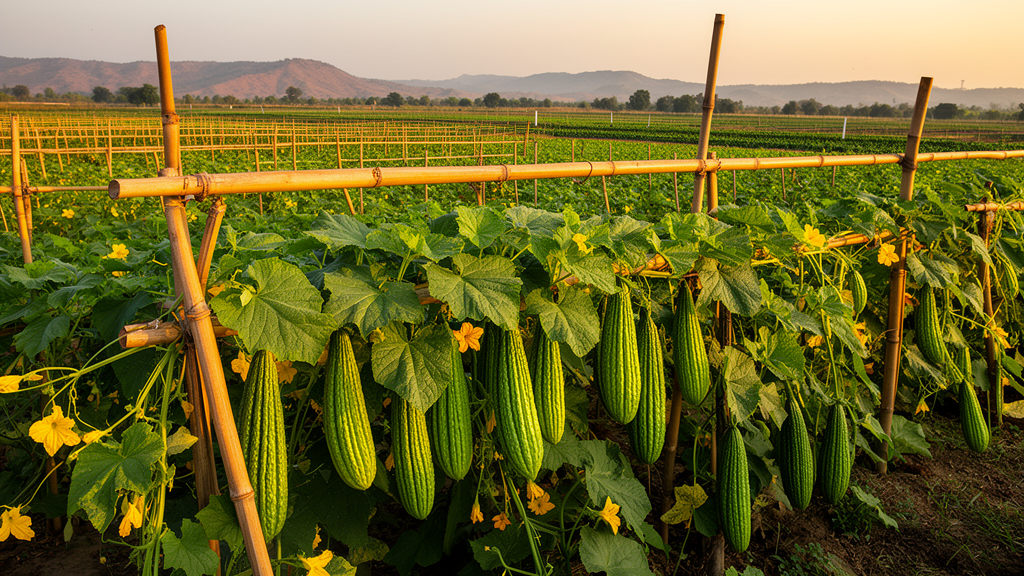
Agricultural researchers evaluating indigenous germplasm have identified superior ridge gourd accessions that combine high productivity with environmental stability across contrasting Indian climates. By conducting multi-environment field trials across two distinct agro-climatic zones over two consecutive growing seasons, scientists from the ICAR-National Bureau of Plant Genetic Resources evaluated two hundred diverse accessions of ridge gourd, scientifically known as Luffa acutangula. The comprehensive investigation integrated mixed-model best linear unbiased predictions, additive main effects and multiplicative interaction modeling, weighted average of absolute scores, and a multi-trait genotype-ideotype distance index. Through this combined analytical framework, the research team separated environmental fluctuations from genetic performance, pinpointing specific accessions that maintain dependable agronomic yields despite fluctuating climatic conditions. The findings provide plant breeders with verified parental lines capable of delivering high fruit numbers, desirable seed production, and accelerated flowering times, establishing a vital genetic baseline for developing climate-resilient vegetable cultivars suited for diverse tropical and subtropical farming systems.
The genus Luffa includes two economically prominent cucurbitaceous crops: ridge gourd, Luffa acutangula, and sponge gourd, Luffa cylindrica, cultivated extensively throughout tropical and subtropical regions. Beyond domestic cooking, the crop possesses dual economic utility across plant maturity, with immature fruits harvested for food while mature fibrous fruits are processed into natural bath sponges and industrial goods. With over fifty percent of modern crop yield variability attributed to climate fluctuations, breeding programs increasingly demand widely adapted cultivars capable of consistent productivity, transcending the regional boundaries of current cultivars such as Arka Vikram, Pusa Nutan, and Pusa Nasdar.
To resolve these production constraints, researchers conducted a comprehensive multi-environment field trial spanning two consecutive spring-summer growing seasons during 2021 and 2022. The study evaluated germplasm across two geographically and climatically contrasting locations in India. The northern site was located at the New Area Experimental Farm of the ICAR-National Bureau of Plant Genetic Resources in New Delhi, situated at twenty-eight point sixty-three degrees north latitude and seventy-seven point fifteen degrees east longitude. The southern testing location was established at Vadugapatti within the Harur district of Tamil Nadu, positioned at twelve point one zero nine eight degrees north latitude and seventy-eight point four eight four three degrees east longitude. The experimental environments exhibited distinct soil dynamics, with New Delhi featuring sandy loam soils having an alkaline mean pH of eight point one, whereas Tamil Nadu presented red sandy soils with a mean pH of seven point twenty-eight.
The biological material evaluated across the four location-year environments consisted of two hundred indigenous Luffa acutangula accessions collected from twenty-two Indian states and conserved in the National Genebank at New Delhi. Field trials utilized an augmented block design, distributing the two hundred unreplicated test accessions across seven blocks alongside three replicated standard checks: PUSA Nutan, Swarna Upahar, and Swarna Manjari. Sowing occurred in the second half of March in New Delhi and the first half of March in Tamil Nadu. Rows measured three meters in length with intra-row plant spacing of zero point thirty meters. Individual fruits remained on vines until physiological maturity, followed by harvesting from early to late June, after which seeds were extracted, sun-dried, and adjusted to twelve percent moisture content for standardized morphological evaluation.
Morphological evaluations followed national descriptor guidelines, recording eight quantitative agronomic traits from five randomly selected plants per accession: petiole length, peduncle length, leaf length, days to first female flowering, days to fifty percent flowering, number of fruits per plant, seeds per fruit, and one-hundred-seed weight. To analyze phenotypic variation and control for micro-environmental soil disparities, the research team fitted a mixed-effects linear model using restricted maximum likelihood in R version four point five point three. Replicated control cultivars allowed researchers to accurately estimate nested block effects, deriving adjusted genotypic means and best linear unbiased predictions for all two hundred test accessions. Genotype stability across environments was subsequently evaluated using the additive main effects and multiplicative interaction model, the weighted average of absolute scores index, and multi-trait genotype-ideotype distance calculations.
The mixed-model analysis of variance demonstrated significant genetic variation among the two hundred accessions across all eight traits. The fixed environmental main effect reached statistical significance solely for petiole length, yielding an F-value of twenty point zero six eight and a P-value of zero point zero zero five seven, whereas the remaining seven traits displayed non-significant environmental main effects. Crucially, genotype-by-environment interaction effects were statistically significant at a P-value below zero point zero zero one for seven traits: petiole length, peduncle length, fruit number, days to fifty percent flowering, days to first female flowering, seed number per fruit, and one-hundred-seed weight. Leaf length was the notable exception, exhibiting no detectable interaction variance and an estimated interaction variance component of zero, coupled with high broad-sense heritability of zero point nine eight five, reflecting uniform genetic expression across testing sites.
Stability partitioning through additive main effects and multiplicative interaction modeling revealed that the first interaction principal component axis dominated the interaction sums of squares for responsive traits. For vegetative characters, petiole length interaction resolved across three axes, with the primary axis explaining seventy-eight point one percent of variation, highlighting accession Acc_6 as possessing superior petiole growth alongside high environmental stability. For peduncle length, accessions Acc_111 and Acc_31 recorded the lowest interaction scores, with Acc_31 achieving the finest balance of length and stability. Flowering traits exhibited remarkably coherent interaction structures, with the first interaction axis explaining approximately ninety-one percent of variation for both days to fifty percent flowering and first female flowering. Accession Acc_123 demonstrated superior performance across both reproductive traits by combining low interaction scores with desirable early flowering, alongside stable early accessions Acc_124, Acc_19, and Acc_158.
Fruiting traits displayed pronounced environmental sensitivity, with the first interaction axis explaining between seventy-five point seven and ninety-nine point eight percent of interaction variance. For fruit number, accession Acc_131 uniquely combined superior stability with above-average fruit counts per vine, whereas accession Acc_165 produced the highest overall fruit numbers but exhibited substantial instability, marked by elevated scores of one point fourteen for WAASB and one point forty-four for IPCA1. In seed counts, accession Acc_123 paired exceptional environmental stability with above-average seed output, while accessions Acc_41 and Acc_184 exhibited specific environmental adaptation in New Delhi and Tamil Nadu, respectively. Seed mass evaluations identified accession Acc_196 as maintaining above-average one-hundred-seed weight alongside strong stability, contrasting with heavy-seeded accessions Acc_152 and Acc_63, whose pronounced interaction scores indicated strong environmental sensitivity suitable primarily for specialized growing conditions.
To synthesize fruiting dynamics across traits, researchers performed hierarchical clustering on standardized trait means and stability values for fruit number, seed number, and seed weight, sorting accessions into five distinct multi-trait stability groups. Cluster one comprised accessions exhibiting high stability but modest yield output, whereas cluster two united genotypes combining above-average fruit numbers with dependable consistency. Cluster three represented the most agronomically desirable group, characterized by superior seed counts per fruit, above-average seed weight, and robust multi-environment stability. Conversely, clusters four and five contained highly productive yet environmentally vulnerable accessions whose performance fluctuated markedly across seasons and locations. This classification demonstrates that evaluating yield components solely through raw trait means risks selecting unstable lines, emphasizing the critical role of biometrical stability indices in screening parental germplasm for commercial cultivar development.
Multi-trait selection using the genotype-ideotype distance index integrated all eight agronomic traits by performing factor analysis, retaining four distinct biological factors that accounted for seventy-one point eighty-one percent of total phenotypic variation. Factor one accounted for twenty-five point fifty-one percent of variance and represented flowering duration; factor two governed vegetative vine traits; factor three comprised leaf length and fruit counts; and factor four encompassed seed number and seed weight. Predicted genetic gains demonstrated desirable responses across most parameters, including a nineteen point sixty-nine percent gain for petiole length, an eleven point thirty-five percent gain for seed count, and beneficial reductions of minus five point sixty-five percent and minus five point seventy-one percent for flowering intervals. However, simultaneous multi-trait selection revealed an inherent physiological trade-off, producing an unfavorable predicted gain of minus thirteen point ninety-one percent for one-hundred-seed weight despite an increasing breeding objective.
Across combined multi-environment analyses, the genotype-ideotype distance index identified accessions Acc_21, Acc_3, Acc_8, Acc_109, and Acc_190 as elite multi-trait performers closest to the ideal ideotype, with Acc_21 achieving the lowest overall index value of two point fifty-five. Meanwhile, the integrated AMMI and WAASB stability framework pinpointed Acc_6 for stable vegetative growth, Acc_111 for peduncle stability, Acc_123 for earliness and seed count, Acc_131 for consistent fruit yield, and Acc_196 for dependable seed weight. The researchers noted that while these identified accessions represent exceptionally promising donor materials for climate-resilient breeding, the experimental conclusions remain bounded by the four location-year environments tested. Broader multi-environment trials across diverse soil regimes, varying seasons, and additional Indian agro-ecological zones will be required to confirm stability before advancing these lines into official varietal release programs.
Subject of Research: Genetic stability and multi-trait evaluation of ridge gourd germplasm across diverse Indian environments
Article Title: Integrated BLUP, AMMI, WAASB and MGIDI analyses for identifying stable and high-performing ridge gourd ( Luffa acutangula L.) genotypes across diverse environments
Article References: Jha, M., Dasmandal, T., Chand Rana, J., Archak, S., & Verma, M. (2026). Integrated BLUP, AMMI, WAASB and MGIDI analyses for identifying stable and high-performing ridge gourd (Luffa acutangula L.) genotypes across diverse environments. Journal of Agriculture and Food Research, 32, Article 103427. https://doi.org/10.1016/j.jafr.2026.103427
Image Credits: AI Generated
DOI: 10.1016/j.jafr.2026.103427
Keywords: ridge gourd, Luffa acutangula, plant breeding, genotype by environment interaction, AMMI model, WAASB stability index, MGIDI analysis, best linear unbiased prediction, germplasm characterization, ICAR-NBPGR, climate resilience, quantitative agronomic traits, augmented block design, fruit yield stability, flowering earliness, heritability, multi-trait selection, restricted maximum likelihood
News Source: Alan Morgan. (November 12, 2026). Multi-Environment Evaluation Identifies Stable High-Yielding Ridge Gourd Accessions in India. Scienmag.