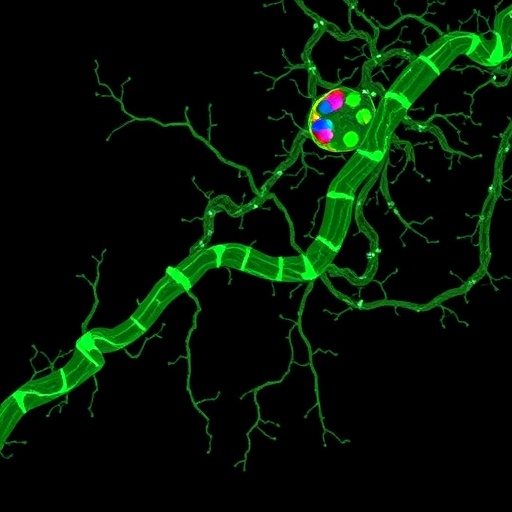
About half of children born with Jacobsen syndrome, a rare inherited disease, experience social and behavioral issues consistent with autism spectrum disorders. Researchers at University of California, San Diego School of Medicine and collaborators developed a mouse model of the disease that also exhibits autism-like social behaviors and used it to unravel the molecular mechanism that connects the genetic defects inherited in Jacobsen syndrome to effects on brain function.
The study, published March 16, 2016 in Nature Communications, also demonstrates that the anti-anxiety drug clonazepam reduces autistic features in the Jacobsen syndrome mice.
"While this study focused on mice with a specific type of genetic mutation that led to autism-like symptoms, these findings could lead to a better understanding of the molecular mechanisms underlying other autism spectrum disorders, and provide a guide for the development of new potential therapies," said study co-author Paul Grossfeld, MD, clinical professor of pediatrics at UC San Diego School of Medicine and pediatric cardiologist at Rady Children's Hospital-San Diego.
Jacobsen syndrome is a rare genetic disorder in which a child is born missing a portion of one copy of chromosome 11. This gene loss leads to multiple clinical challenges, such as congenital heart disease, intellectual disability, developmental and behavioral problems, slow growth and failure to thrive.
Previous research by Grossfeld and colleagues suggested that PX-RICS might be the missing chromosome 11 gene that leads to autism in children with Jacobsen syndrome. To investigate further, Grossfeld contacted University of Tokyo researchers who had already been studying PX-RICS for its role in brain development, but were unaware of the link to autism in humans.
In this study, the Japanese researchers determined that PX-RICS is most likely the gene responsible for autism-like symptoms in Jacobsen syndrome. To do this, they performed several well-established tests that measure common autism symptoms — anti-social behavior, repetitive activities and inflexible adherence to routines. As compared to normal mice, mice lacking PX-RICS spent less time on social activities (e.g., nose-to-nose sniffing and huddling) and were more apathetic or avoidant when approached by a stimulator mouse. PX-RICS-deficient mice also spent more than twice as much time on repetitive behaviors such as self-grooming and digging than normal mice. In addition, mice lacking PX-RICS more closely adhered to a previously established habit and were less able to adapt their behavior in novel situations.
Grossfeld's colleagues in Tokyo also explored the molecular mechanism connecting lack of PX-RICS to behavior. They found that mice lacking the PX-RICS gene were also deficient in GABAAR, a protein crucial for normal neuron function. That observation inspired the researchers to test clonazepam, a commonly used anti-anxiety drug that works by boosting GABAAR, as a potential treatment for autism-like symptoms in these Jacobsen syndrome mice.
PX-RICS-deficient mice treated with low, non-sedating doses of clonazepam behaved almost normally in social tests, experienced improvements in learning performance and were better able to deviate from established habits.
"We now hope in the future to carry out a small pilot clinical trial on people with Jacobsen syndrome and autism to determine if clonazepam might help improve their autistic features," Grossfeld said.
###
Study co-authors include Tsutomu Nakamura, Fumiko Arima-Yoshida, Fumika Sakaue, Yukiko Nasu-Nishimura, Yasuko Takeda, Ken Matsuura, Toshiya Manabe, Tetsu Akiyama, University of Tokyo; Natacha Ackshoomoff, UC San Diego; and Sarah Mattson, San Diego State University.
This research was funded, in part, by Grants-in-Aid for Scientific Research, Takeda Science Foundation, Uehara Memorial Foundation, Global COE Program and Strategic Research Program for Brain Sciences, MEXT, Japan.
Media Contact
Heather Buschman
[email protected]
619-543-6163
@UCSanDiego
http://www.ucsd.edu