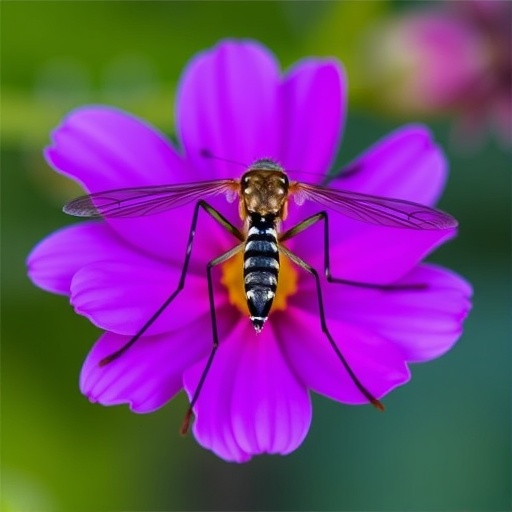
Mosquito-borne diseases remain one of the most formidable public health challenges of our time, responsible for over 600,000 deaths globally each year. Among the diseases transmitted by mosquitoes, dengue, malaria, and Zika viruses claim the most lives and cause widespread morbidity. Alarmingly, the effectiveness of traditional insecticides is waning as mosquitoes increasingly evolve resistance. This growing insecticide resistance has spurred urgent investigations into alternative strategies to prevent mosquito bites and reduce disease transmission. In this context, a groundbreaking study has emerged from an international team of researchers, including experts from the University of Washington, uncovering novel sensory mechanisms mosquitoes use to detect and avoid certain natural repellents, potentially ushering in a new era of mosquito control.
Published in Nature Communications on February 20, 2026, this innovative research zeroes in on a naturally occurring organic compound known as borneol. Found in a variety of aromatic plants such as rosemary, camphor trees, and several herbal species, borneol has long been recognized for its scent and repellent properties. However, the molecular and neural underpinnings of mosquito avoidance to borneol remained elusive until now. The study reveals that the primary urban mosquito vector, Aedes aegypti, uses a highly specialized odorant receptor, termed OR49, to detect borneol with remarkable sensitivity.
Through an intricate combination of genetic, electrophysiological, and neurobiological techniques, the researchers demonstrated that OR49 is finely tuned to borneol molecules. This receptor is localized within the maxillary palps of the mosquito—sensory appendages critical for odor detection and host-seeking behavior. Activation of OR49 triggers a specific nerve cell in the maxillary palp, which then relays a distinct neural signal to a unique region in the mosquito brain. This neural signaling cascade culminates in robust avoidance behavior, driving mosquitoes away from areas rich in borneol.
To dissect the functional importance of OR49 in borneol detection, the team employed gene knockout methodologies to disable the Or49 gene in Aedes aegypti. Remarkably, mosquitoes lacking OR49 exhibited a near-complete loss of neuronal response to borneol and showed a stark reduction in behavioral avoidance. This finding confirmed that OR49 is indispensable for borneol sensitivity, establishing a direct genetic and neural basis for this repellent response.
The implications of these findings are profound. Co-author and University of Washington Biology Professor Jeffrey Riffell expressed surprise at the sensitivity mosquitoes exhibit to borneol. “By elucidating the exact receptor and neuronal pathways involved, we can now engineer new repellent compounds that not only outperform borneol in efficacy but can also offer longer-lasting protection,” he stated. Such advances could revolutionize personal mosquito repellents, shifting from broad-spectrum chemicals to highly specific odorant receptor targeting molecules with improved safety and sensory appeal.
Beyond repellent development, the study offers promising prospects for mosquito surveillance and vector control. The researchers emphasize that because OR49-mediated repellency is exceptionally potent, identifying structurally related volatile compounds that activate the OR49 pathway could “push” mosquitoes away from humans effectively. Jason Pitts, associate professor of biology at Baylor University and co-senior author, noted that such compounds could be simpler and more cost-effective to produce. Additionally, some may possess scent profiles that are more pleasant or acceptable to humans, overcoming a common barrier in repellent use and adoption.
This research also forges a critical bridge between molecular neuroscience and public health. Understanding the olfactory genetics of Aedes aegypti has broader consequences, offering insights into how mosquitoes interact with their environment and select hosts. The team’s longer-term goal is to decipher the genetic mechanisms underlying how these mosquitoes seek nectar sources, a natural attractant. Such understanding paves the way for developing attractants that lure mosquitoes into traps, thereby enhancing surveillance precision and enabling more effective population control strategies.
The study’s broader impact extends well beyond Aedes aegypti. Similar pathways and receptors are likely conserved or analogous in other culicine mosquitoes and even across different insect taxa. This raises hopes that the fundamental knowledge gained here can be extrapolated to combat mosquitoes that transmit malaria and other scourges. Moreover, the principles established may inform interventions against a variety of biting insects that continue to threaten global health and economic development.
Technically, the study represents a tour de force in neuroethology and chemical ecology. The team meticulously recorded neural activity from identified olfactory neurons within mosquito maxillary palps while exposing them to borneol and related compounds. This approach allowed the mapping of specific receptor-ligand interactions and downstream neural circuits responsible for repellent avoidance responses. The elegant dissection of this pathway marks a milestone in sensory biology, showcasing how a solitary receptor can dictate complex behavioral outcomes pivotal for survival and disease ecology.
Co-author Carlos Ruiz, a postdoctoral scholar at the University of Washington, played a key role in crafting the neural recording protocols and data interpretation. The multi-institutional collaboration drew funding and intellectual support from major agencies such as the National Institutes of Health, the Bill and Melinda Gates Foundation, the National Science Foundation, and international science bodies from China and Israel. This wide-ranging support underscores the global commitment to innovative vector-borne disease research.
Looking forward, translating this neural sensitivity into practical mosquito control tools will require close multidisciplinary efforts. Formulating borneol analogs or derivatives that maintain high receptor affinity while exhibiting enhanced stability and low toxicity will be paramount. Field trials to assess repellency under real-world conditions will also be critical to validate laboratory findings. Ultimately, integrating these novel repellents into existing control frameworks could significantly reduce human-mosquito contact, mitigating the burden of deadly diseases.
In sum, this discovery advances our fundamental understanding of mosquito olfaction and offers a tangible pathway toward safer, smarter, and more effective repellents. As mosquito resistance to insecticides mounts, leveraging the mosquito’s own sensory system to “trick” or deter them represents a transformative strategy. The intricate dance of molecular signals and behavioral responses elucidated here is a testament to the power of cutting-edge neuroscience in addressing some of the world’s most pressing health challenges.
Subject of Research: Sensory coding and olfactory receptor mechanisms underlying borneol repellency in Aedes aegypti mosquitoes
Article Title: Sensory coding of borneol repellency in culicine mosquitoes via the Or49 pathway
News Publication Date: February 20, 2026
Web References:
Nature Communications Article DOI
Baylor University Press Release
References: The original research article authored by the UW and international team, published in Nature Communications, February 20, 2026.
Keywords: Mosquito-borne diseases, Aedes aegypti, borneol, odorant receptor OR49, olfactory neurobiology, mosquito repellents, insecticide resistance, vector control, sensory coding, plant-based repellents, neural circuitry, public health
Tags: Aedes aegypti odorant receptorsalternative mosquito bite preventionborneol mosquito repellentherbal mosquito repellent compoundsinsecticide resistance in mosquitoesmolecular basis of mosquito avoidancemosquito sensory mechanismsmosquito vector control researchmosquito-borne diseases preventionnatural compounds for mosquito controlneurobiology of mosquito olfactionplant-based mosquito repellents