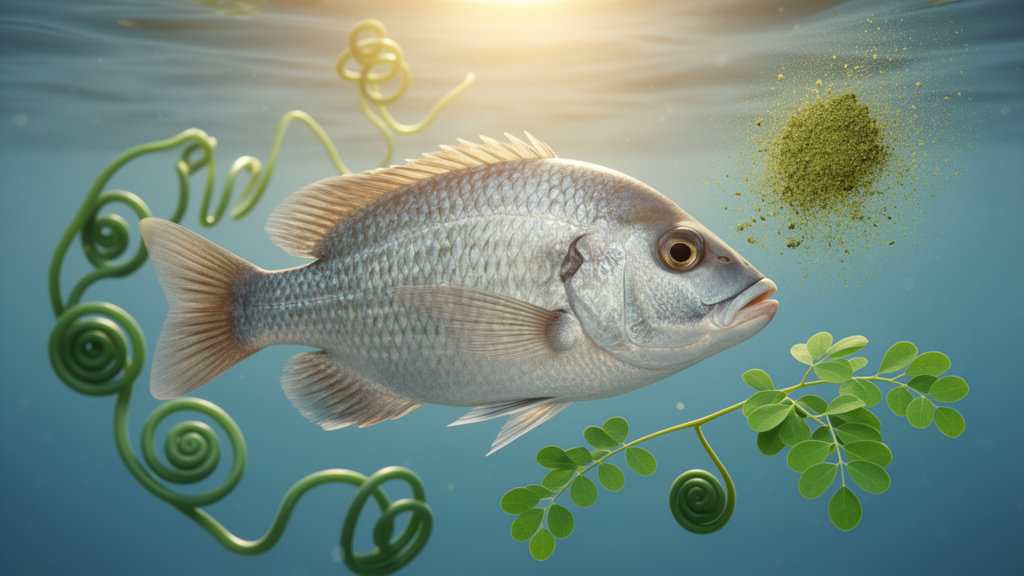
Fish exposed to the synthetic pyrethroid deltamethrin developed telltale signs of anemia, liver and kidney dysfunction, and visible tissue damage in their gills, kidneys, and livers. When the same toxic exposure was paired with dietary supplements of Moringa oleifera or the blue-green alga Arthrospira platensis, blood values and tissue architecture recovered substantially, though not completely. The study, published in BMC Marine Science, adds to a growing body of work testing whether inexpensive plant and algal additives can reduce the chemical burden on farmed fish.
The researchers, based at the University of Okara, set out to quantify both sides of the problem: how much harm a sublethal dose of deltamethrin inflicts on a commercially important fish, and how much of that harm can be undone with nutrition alone. Deltamethrin is a type II synthetic pyrethroid used against crop ectoparasites and on domestic animals. Because the compound adsorbs strongly and is hydrophobic, it enters aquatic environments both directly and indirectly, and previous work has shown that it disrupts the nervous systems of fish by blocking sodium channels, inhibiting acetylcholinesterase, and interfering with GABA receptors, while also damaging the liver and gills.
Nile tilapia was the test species for practical as well as scientific reasons. The tropical omnivore is farmed worldwide and is a standard model for probing how aquatic pollutants affect fish physiology, serving in laboratory bioassays as an indicator of intoxication risk. Ten-week-old fingerlings, weighing on average 32.17 grams and measuring about 15.5 centimeters, were purchased from a commercial fish farm and acclimated for a week in dechlorinated water held at a pH of 7.3, a temperature of about 24.3 degrees Celsius, and dissolved oxygen near 7.4 milligrams per liter.
The experimental design was a completely randomized layout with four treatment groups, each replicated across three aquariums holding seven fish. Group 1 served as the untreated control. Group 2 was exposed to deltamethrin at a concentration of 3.12 micrograms per liter, a dose selected on the basis of earlier studies. Group 3 received the same deltamethrin exposure plus moringa leaf powder mixed into the diet at 10 grams per kilogram of body weight, while Group 4 received deltamethrin together with spirulina at 15 grams per kilogram of diet per day. The powders were blended with the regular commercial feed, bound with a little water and fish oil, and offered once daily at 2 percent of body weight. All fish were fed for 28 days, after which ten animals per group were sampled for blood and tissue analysis under procedures approved by the university’s ethics committee.
The hematological results were unambiguous. Compared with controls, fish exposed to deltamethrin alone showed significantly lower red blood cell counts, white blood cell counts, hematocrit, hemoglobin, mean corpuscular hemoglobin, mean corpuscular hemoglobin concentration, mean corpuscular volume, and platelet counts. The authors interpret this pattern as microcytic hypochromic anemia, consistent with reduced hemoglobin synthesis, depressed red cell production by the hematopoietic system, and increased destruction of circulating red cells under toxicant stress. The drop in white cells points to suppressed nonspecific immunity, and the fall in platelets suggests injury to the blood system with potential consequences for hemostasis and coagulation.
Serum biochemistry told a matching story of organ stress. Deltamethrin-exposed fish had significantly elevated triglycerides, cholesterol, LDL, VLDL, the liver enzymes ALT and AST, urea, creatinine, and blood urea nitrogen, alongside reduced HDL, albumin, total protein, and globulin. Rising transaminases indicate that hepatocyte membranes were losing their integrity and leaking enzymes into the bloodstream. Elevated urea and creatinine are standard markers of compromised kidney function, suggesting the organs could no longer clear nitrogenous waste efficiently. Falling total protein and albumin point to impaired hepatic protein synthesis and a weakened capacity to counter oxidative stress.
Histology made the internal damage visible. Gills from deltamethrin-exposed fish showed curved lamellae, lamellar disarray, lamellar aneurysms, and cellular abnormalities, changes that impair gas exchange and disrupt homeostasis. Kidney sections revealed renal sinus formation, elongated tubules, clustered nuclei, and pyknotic nuclei, signs of cellular death. Liver tissue displayed pyknotic nuclei, necrosis, and damaged hepatic veins. Control fish showed none of these lesions. Because gills are the primary entry route for waterborne toxins, their deterioration is both a direct injury and a warning that the fish’s first line of defense had been breached.
Both dietary supplements blunted the damage, though neither eliminated it. Fish receiving deltamethrin plus moringa showed partial recovery across the hematological panel, with slight increases in red cells, white cells, hematocrit, mean corpuscular volume, and hemoglobin. The authors attribute this to flavonoids such as quercetin in moringa, which may promote erythropoiesis and limit hemolysis under oxidative stress, and to the plant’s immunomodulatory activity, which could explain the rise in white cells. On the biochemical side, moringa-fed fish showed small favorable shifts in cholesterol, triglycerides, VLDL, HDL, and LDL, along with reductions in ALT and AST that the researchers link to the hepatoprotective flavonoids quercetin and kaempferol. Moringa also modestly raised total protein, albumin, and globulin, and its diuretic properties may have helped lower urea and creatinine by flushing waste products.
Spirulina produced a comparable protective profile through a different biochemical route. Fish on the spirulina diet showed slight improvements in the full hematological panel, which the authors connect to phycocyanin, a pigment making up roughly 14 percent of spirulina that stimulates erythropoietin production and thereby supports red cell formation. The C-phycocyanin content may also strengthen immune function, helping to explain the increased white cell counts. Lipid profiles improved with a marginal rise in HDL and substantial decreases in cholesterol, triglycerides, LDL, and VLDL, effects attributed to beta-carotene, phenolic compounds, and polyunsaturated fatty acids that influence lipid metabolism. Serum urea and creatinine declined significantly in the spirulina group, which the authors read as evidence of kidney protection, and liver enzymes fell as beta-carotene helped limit cellular damage.
The study’s conclusion is deliberately practical: powdered moringa and spirulina stabilized biochemical profiles, reduced histopathological lesions, and restored hematological parameters in deltamethrin-stressed tilapia, positioning both as economically viable and nutritionally beneficial feed additives for aquaculture. The findings rest on a small laboratory trial with seven fish per replicate tank, doses drawn from prior literature rather than dose-finding within this study, and a single deltamethrin concentration over 28 days, so the degree of protection under field conditions, at other pesticide levels, or over longer production cycles remains to be tested. What the experiment does establish is that under controlled exposure, dietary supplementation measurably softened the blow of a pervasive aquatic pollutant, offering fish farmers a low-cost nutritional lever at a time when pesticide runoff continues to reach the waterways where farmed and wild fish alike must live.
Subject of Research: Protective dietary effects of moringa and spirulina against deltamethrin toxicity in Nile tilapia
Article Title: Protective effects of Moringa oleifera and Arthrospira platensis against deltamethrin-induced toxicity in Nile tilapia (Oreochromis niloticus)
Article References: Akhtari, F., Noor, W. A., Akmal, H., Maqsud, S., Shahzad, K., Ahmad, S., & Ghaffar, M. (2026). Protective effects of Moringa oleifera and Arthrospira platensis against deltamethrin-induced toxicity in Nile tilapia (Oreochromis niloticus). BMC Marine Science, 1(1), Article 6. https://doi.org/10.1186/s44479-026-00007-y
Image Credits: AI Generated
DOI: 10.1186/s44479-026-00007-y
Keywords: Nile tilapia, deltamethrin, Moringa oleifera, Arthrospira platensis, spirulina, aquaculture, pesticide toxicity, hematology, histopathology, liver enzymes, kidney function, feed additives
News Source: Drew Townsend. (October 28, 2026). Moringa and Spirulina Ease Pesticide Damage in Nile Tilapia. Scienmag.