Credit: ©Science China Press
Plasmon-enhanced molecular spectroscopies have attracted tremendous attention as powerful detection tools with ultrahigh sensitivity down to the single-molecule level. The optical response of molecules in the vicinity of nanostructures with plasmon resonance would be dramatically enhanced through interactions with plasmons. However, beyond the signal amplification, the molecule-plasmon interaction also inevitably induce strong modifications in the spectral lineshapes and distort the implied chemical information of molecules. A typical example is surface-enhanced infrared absorption (SEIRA) spectra. Due to the dominated molecule-plasmon coupling, the lineshapes of molecular absorption spectra exhibit complicated asymmetric Fano lineshapes, instead of the symmetric Lorentzian lineshapes of probe molecules in the gas phase or in solution phase.
Many pioneering studies focused on the energy detuning-dependent (the energy difference between plasmon resonant energy and molecular vibrational energy) and damping-dependent (the radiation loss vs. the intrinsic ohm loss) lineshape effect. The issue of how the molecule-plasmon near-field interactions directly control the evolutions of SEIRA spectral lineshapes has been rarely explored. Furthermore, beyond the two-body interaction picture, how the molecule-plasmon interactions for molecules with distinctive coupling strengths collectively control the evaluation of spectral lineshapes is also not clear. Recently, Jun Yi, En-Ming You, Song-Yuan Ding, and Zhong-Qun Tian from Xiamen University made exciting progress and theoretically revealed how the molecule-plasmon coupling strength controls the spectral evolutions in SEIRA spectra. The results show even if the same molecules couple with the same plasmonic structures, spectral lineshapes depend on coupling distance, molecular density, and intrinsic loss of the plasmon in the zero-detuning condition, i.e., the plasmon resonant energy is equal to molecular vibrational energy.
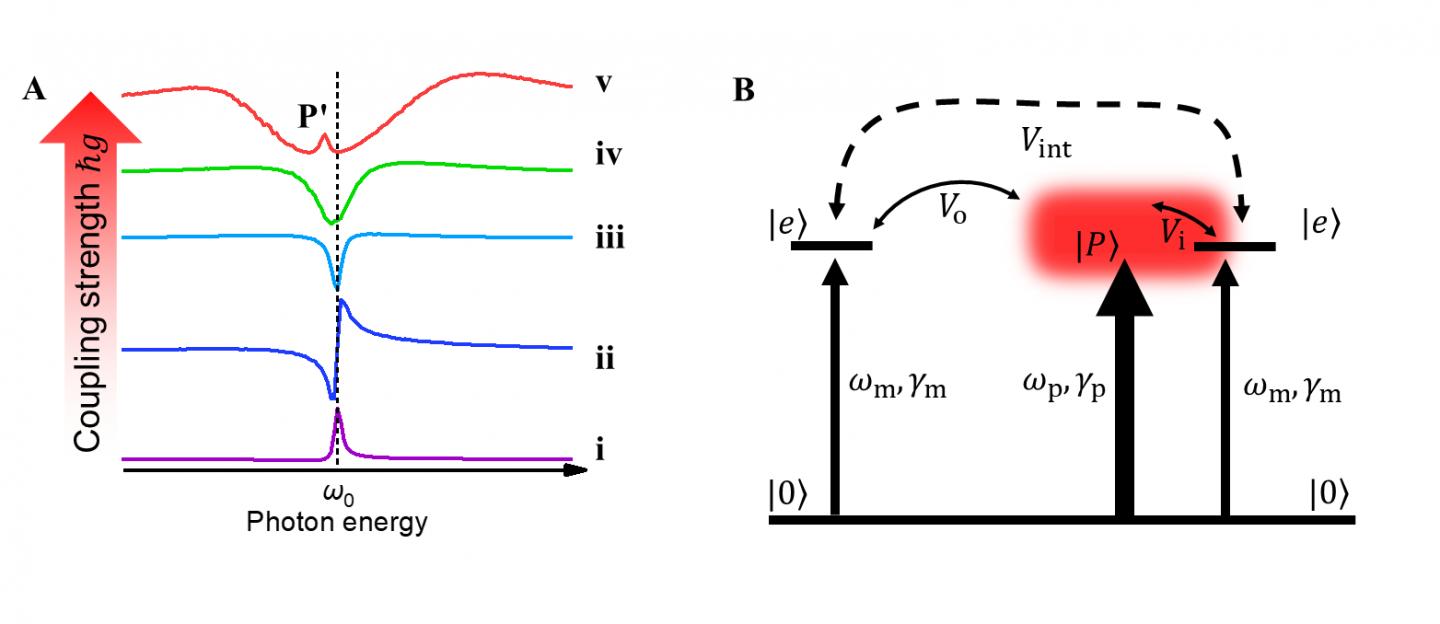
The authors first showed that the spectral lineshape evolves from anti-absorption dip to asymmetric Fano profile as the coupling strength between molecules and plasmons gradually diminished by extending the distance between molecules and the plasmonic structure. The results were also reproduced by an analytical model with the molecule-plasmon coupling strength as the input parameter, which further revealed a dominated dipole-dipole interaction between molecules and plasmons.
The authors further found that molecular density also plays a crucial role in determining the spectral lineshapes, since the coupling strength depends on the square root of the molecular density. Interestingly, a new spectral mode was predicted when the density exceeds the threshold and would red-shift to lower energy as the density increases. The authors clarified the new mode origins from plasmon-mediated coherent intermolecular interactions, specifically, between molecules located inside and outside the plasmonic hotspots. Detailed studies showed the energy-shift of the new mode highly depends on the intermolecular coupling strength, thus can be applied to investigate the coherent intermolecular interaction in nanoscale. The studies unveil how molecule-plasmon coupling strength impacts on the spectral profiles, and shed light on further studies on plasmon-dressed molecular electronic or vibrational states in various coupling-strength regimes.
###
This research received funding from the National Natural Science Foundation of China (21727807, 21872115, 21403179 and 91950121).
See the article:
Jun Yi, En-Ming You, Song-Yuan Ding, Zhong-Qun Tian
Unveiling the molecule-plasmon interactions in surface-enhanced infrared absorption spectroscopy
Natl Sci Rev (2020). doi: 10.1093/nsr/nwaa054
https:/
Media Contact
Song-Yuan Ding
[email protected]
Related Journal Article
http://dx.