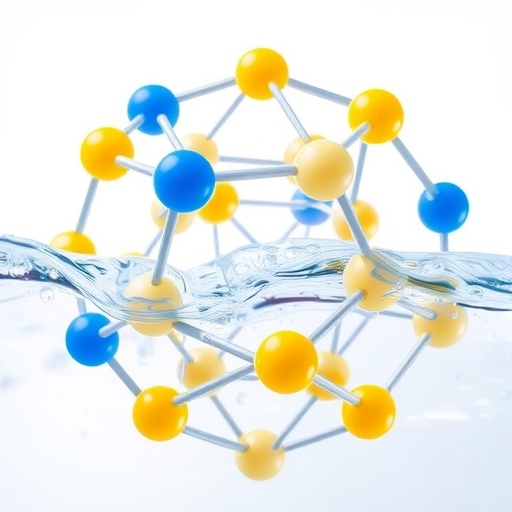
In a groundbreaking advancement in supramolecular chemistry, researchers at the University of Jyväskylä in Finland have engineered an innovative class of synthetic molecules capable of capturing sulfate ions with remarkable efficiency in aqueous environments. This pioneering work addresses a longstanding challenge in chemical sensing and environmental remediation: selectively binding sulfate ions, which are notoriously difficult to capture in water due to their strong hydration.
Sulfate ions are abundantly present as pollutants in industrial effluents and natural water bodies, posing significant environmental and health concerns worldwide. Conventional synthetic receptors have struggled to effectively recognize sulfate in water because the ion preferentially retains its hydration shell, thereby resisting association with receptor molecules. The novel receptors developed by the Jyväskylä team disrupt this status quo by exhibiting more than a thousand-fold enhanced sulfate binding affinity relative to existing artificial systems, achieving binding strengths akin to those observed in natural protein sites.
This remarkable leap in performance is attributed to the molecular topology underlying the receptors, which feature “Solomon link” architectures. These structures consist of two macrocyclic rings intricately interlocked and entwined multiple times, forming mechanically interlocked molecules with topological complexity rarely exploited for practical applications. The mechanical bond in these Solomon links enforces a rigid yet adaptable cavity shaped precisely to accommodate sulfate ions, enhancing specificity through preorganization.
Unlike flexible or loosely defined binding sites common in many synthetic receptors, the mechanically interlocked Solomon link maintains a geometry that closely matches the size, charge distribution, and hydrogen bonding preferences of sulfate. This preorganization minimizes the entropic and enthalpic costs typically associated with adapting receptor conformation upon guest binding, thereby contributing substantially to the observed ultra-high affinity. Positively charged regions and strategically positioned hydrogen bond donors within the cavity synergistically engage the sulfate ion, stabilizing the complex even in the competitive milieu of water.
Associate Professor Fabien Cougnon, leading the study, emphasizes that the receptors’ performance is on par with natural protein sulfate-binding motifs, which have evolved to sequester even trace concentrations of sulfate with exquisite selectivity. This bio-inspired mimicry underscores the potential for mechanically interlocked molecular topologies to transcend traditional design paradigms in supramolecular chemistry, enabling functionally superior synthetic receptors.
The synthesis of these Solomon links demanded precise control over the assembly of interlocked macrocycles, achieved through advanced templating methods that guide ring formation and linking. The result is a family of multiply entangled molecules that exhibit exceptional stability and defined cavities suitable for high-affinity anion recognition. The entanglement not only stabilizes the molecular architecture but also imparts dynamic flexibility, allowing subtle conformational adjustments to optimize sulfate binding without compromising structural integrity.
Beyond their binding prowess, these receptors offer promising applications in environmental monitoring and purification technologies, where selective extraction of sulfate from contaminated water is both a scientific and practical challenge. Their robustness and specificity make them attractive candidates for incorporation into sensors, membranes, or separation materials designed to mitigate sulfate pollution originating from mining, manufacturing, and agricultural runoff.
Moreover, the fundamental understanding gleaned from these Solomon link receptors opens avenues for designing bespoke molecular machines and sensors capable of recognizing a variety of charged species in complex aqueous media. The work represents a paradigm shift—leveraging topological entanglement to architect molecular recognition elements rather than relying solely on traditional covalent framework design principles.
Published in the esteemed journal Chem, the study sets a new benchmark for synthetic anion receptors operating under realistic conditions. It demonstrates that the elusive goal of combining strong, selective binding with water compatibility can be achieved through innovative molecular design grounded in mechanical bonds and supramolecular preorganization.
This research crystallizes the potential of molecular entanglement, once a predominantly academic curiosity, into a practical tool for addressing real-world problems such as water purification and chemical sensing. The cross-disciplinary implications extend to nanotechnology, catalysis, and biomedical diagnostics, where precise molecular recognition in aqueous environments is paramount.
Looking forward, the team envisions expanding the repertoire of mechanically interlocked architectures to target other environmentally relevant anions and biomolecules, harnessing the unique interplay between topology and function. Such developments could revolutionize how chemists approach the challenge of selective binding in complex, highly competitive media like water.
In sum, the University of Jyväskylä’s breakthrough in constructing multiply entangled Solomon link receptors heralds a new era in supramolecular chemistry, blending intricate molecular topology with purposeful function. The outcome is a robust, efficient system for sulfate capture poised to impact environmental science and technology profoundly, exemplifying the power of molecular design innovation.
Subject of Research: Not applicable
Article Title: Multiply entangled receptors for high-affinity anion recognition in water
News Publication Date: 10-Mar-2026
Web References: https://www.jyu.fi/en/research-groups/cougnon-group-supramolecular-chemistry-molecular-nanotopology
References: Cougnon Group – Supramolecular Chemistry & Molecular Nanotopology
Image Credits: The University of Jyväskylä
Keywords
Sulphate binding, supramolecular chemistry, mechanically interlocked molecules, Solomon link, molecular entanglement, water purification, anion recognition, chemical sensing, environmental monitoring, synthetic receptors, molecular topology, hydrogen bonding
Tags: artificial receptors mimicking protein siteschemical sensing of sulfate ionsenhanced sulfate binding affinityenvironmental monitoring of water contaminantsindustrial effluent sulfate removalmechanically interlocked molecules in water purificationmolecular entanglement for sulfate removalselective sulfate ion bindingSolomon link molecular topologysupramolecular chemistry for environmental remediationsynthetic sulfate receptors in waterwater pollutant sulfate capture